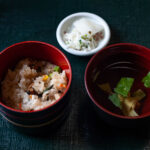
duck meat stew (dish from Ishikawa prefecture)

Japanese-style meal

duck meat stew (dish from Ishikawa prefecture)(jibuni)

local cuisine

A local dish of Kanazawa City, Ishikawa Prefecture. It is a dish of simmered duck or chicken, Kaga’s specialty sudare-fu, seasonal vegetables, and other ingredients. It has been handed down from the Edo period to the present day. The characteristic feature of this dish is that the meat is covered with flour and simmered, thus thickening it. There are various theories as to the origin of the name, including that Christian feudal lord Takayama Ukon learned it from missionaries and introduced it to the Kaga domain, that Okabe Jibuemon, a military ration officer under Toyotomi Hideyoshi, introduced it from Korea, and that it was introduced by a Russian who drifted ashore. Another theory is that it was named after the fact that it is boiled in a pot, jibu-jibu.

新着・おすすめ情報

  1. soup served at the end of a traditional Japanese dinner

  2. Honmyoji Temple (Sugamo, Tokyo)

  3. What are the roles of the “three courtesans”? What do each of them bring with them?

  4. Okunitama Shrine (Fuchu, Tokyo)

  5. Kamiya Bar, the oldest bar in Japan, well-known for its Denki Bran, and its innovations through the ages.

  6. They also restore ancient musical instruments used in traditional performing arts. Okadaya Fuse’s Struggle to Preserve Traditional Japanese Culture

  7. Four long-established restaurants specializing in nabe cuisine! 4 long-established restaurants specializing in hot pot dishes Let’s enjoy the taste of that famous restaurant by order!

  8. An arrow wheel is a windmill attached to the pole of a carp streamer. What is the meaning of the sound of its spinning?

  9. polearm

  10. Itsukaichi Constitution Draft Monument (Akiruno, Tokyo)

  11. 【第8回】江戸時代から語られるぶっかけの由来と食べ方指南

  12. Fukutoku Shrine Meibuki Inari (Nihonbashi, Tokyo)

  13. Hatomori Hachiman Shrine (Sendagaya, Tokyo)

  14. Definitions of “Daiginjo-shu” and “Junmai Daiginjo-shu” [Words Related to Sake].

  15. The family motto is “Be a connoisseur. Gyokuho-Do” has continued to support the tea culture by handling tea utensils of the Unshu-Matsudaira and Omotesenke families.