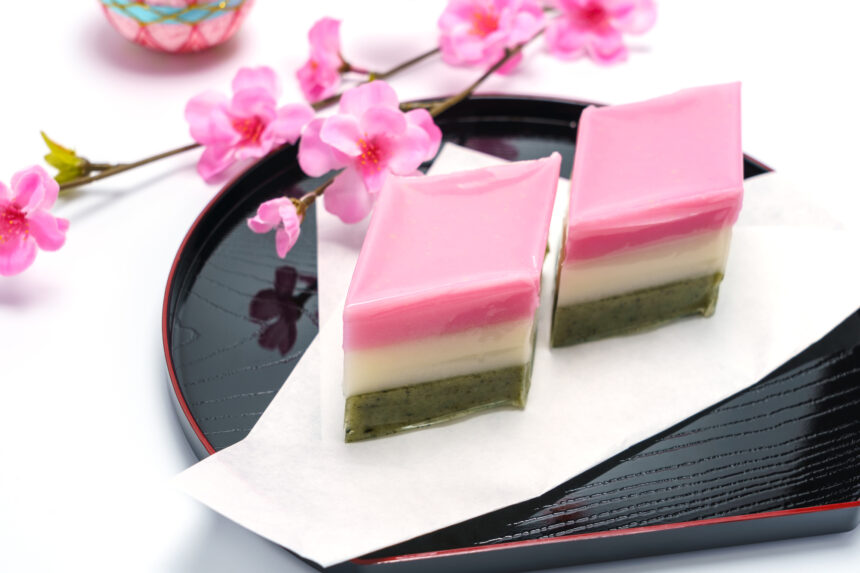
What is the meaning behind the three colors of “Hishimochi”? Hina Doll Decorations

puppet

What is the meaning behind the three colors of “Hishimochi”? Hina Doll Decorations(Hishimochi)

Dolls’ Festivalpeach festival

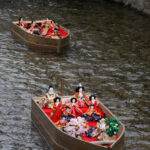
Mochi (rice cakes) cut into diamond shapes are displayed with hina dolls on Hina Matsuri. Most rice cakes are layered with three colors from the top: red (pink), white, and green, but there is no rule for this. In some areas, five colors are used. Since ancient times, in China, water chestnuts have been used for the festival of the Snake of the First Serpent (Joushi-no-Matsuri). The custom was to eat rice cakes made of water chestnuts and gogyo, one of the seven spring herbs. This custom was introduced to Japan, and people began to make rice cakes with mugwort, which sprouts around the same time. It was not until the Edo period (1603-1867) that the current diamond shape was adopted. At first, two layers of white and green rice cakes were piled on top of each other, but in the Meiji period (1868-1912), a layer dyed red with gardenia seeds was added. The red and green colors are meant to ward off evil spirits, while the white color is meant to bring prosperity and longevity to offspring.

新着・おすすめ情報

  1. kasuri

  2. small coloured sugar candy covered in bulges

  3. What vegetables should not be used in “vegetarian cooking” without animal products?

  4. Japanese dessert consisting of two slices of kasutera (sponge cake) with red bean jam in between

  5. A Walk in Edo with Old Maps] No.5: Traces of Edo Remain Strong in “Differences in Elevation” and “Town Names” in Ushigome and Ichigaya

  6. Kimono can be re-tailored and reused as a haori or obi. Kimono is the ultimate SDGs costume.

  7. Hotel New Otani, Tokyo, Japan

  8. sake brewed without addition of saccharides and no more than 120 litres of seed alcohol per tonne

  9. bush

  10. Nitta Shrine (Musashishinden, Tokyo)

  11. Changing flavors and characteristics from generation to generation: the management strategy of the long-established “Tokiwando Thunder Stirrers’ Okoshi Honpo,” founded in 1816.

  12. To make swords a part of our daily lives. The future of swords is the goal of Nihon Katana, a long-established sword specialty store.

  13. Yagiri no Ferry (Shibamata ferry terminal)

  14. What is the origin of the name “Kintsuba”? How is it written in kanji?

  15. ridges on a blade (sword, knife, etc.)