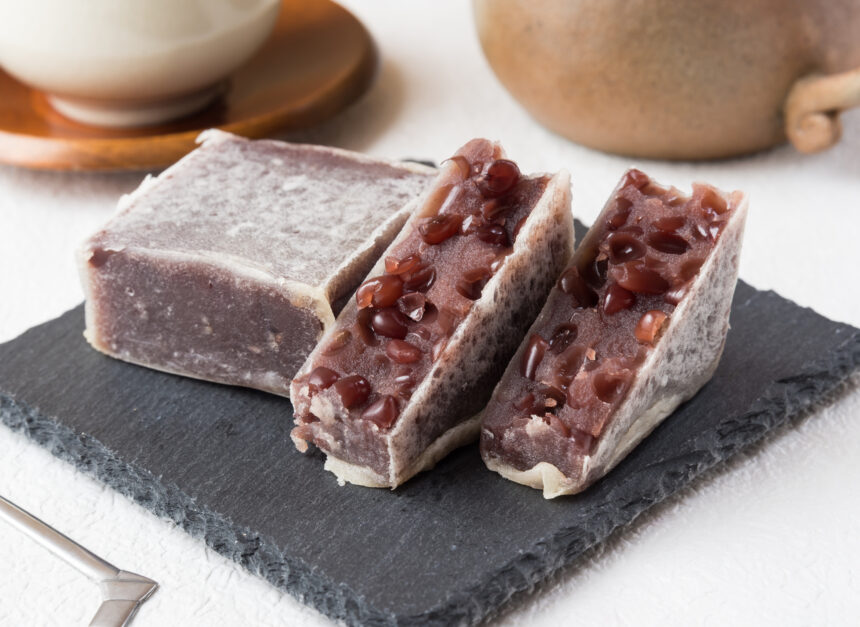
What is the origin of the name “Kintsuba”? How is it written in kanji?

Japanese confectionery

What is the origin of the name “Kintsuba”? How is it written in kanji?(Kintsuba)

red bean pastepresent (brought by a visitor)

Kintsuba is a Japanese confectionery made by dipping red bean paste in melted flour dough or wrapping it in a thin flour crust and baking it on a griddle.

Kintsuba is written in kanji (Chinese characters) as “kintsuba,” and was originally called “ginzubaku,” a confection produced in Kyoto during the Edo period (1603-1868). Ginzubaku was wrapped in a rice flour skin and baked, but in the process of being introduced to Edo (present-day Tokyo), it was changed to wheat flour, and the name was changed to “Kinzubaku” because “gold is more economical than silver”. The shape is round and flat like the brim of a sword, thus the name. The size is easy to eat in one bite, and although koshi-an is the most common, there are variations depending on the region and store, and some stores offer it with various types of an (sweet) bean paste depending on the season.

They are popular as gifts and among foreign tourists, and are made according to traditional methods that require skill and care. Recently, they have been attracting attention overseas as well, and are a representative of Japan’s traditional Japanese confectionery culture.

新着・おすすめ情報

  1. sweet yuzu-flavoured steamed dumpling

  2. day of the ox in midsummer (during the hottest season)

  3. type of soft Japanese confectionery made with rice flour (somewhat similar to Turkish delight)

  4. Abiru Shrine (Akiruno, Tokyo)

  5. geese alighting

  6. Manners Related to Tea: How to Make and Serve Delicious Tea, and Manners for Receiving Tea

  7. Shinagawa Shrine (Kita-Shinagawa, Tokyo)

  8. straight sword

  9. common variety of women’s kimono sash

  10. small coloured sugar candy covered in bulges

  11. man’s formal divided skirt

  12. Sticking to domestically produced raw materials, each tooth is spun by hand. The commitment of the long-established “Juso Yakushi-ten” (Juso Yakushi Shop)

  13. 【イベント開催】豊かな自然と伝統のまち与謝野町で非日常の体験

  14. Honshiba Park (Tamachi, Tokyo)

  15. Tokyo National Museum