

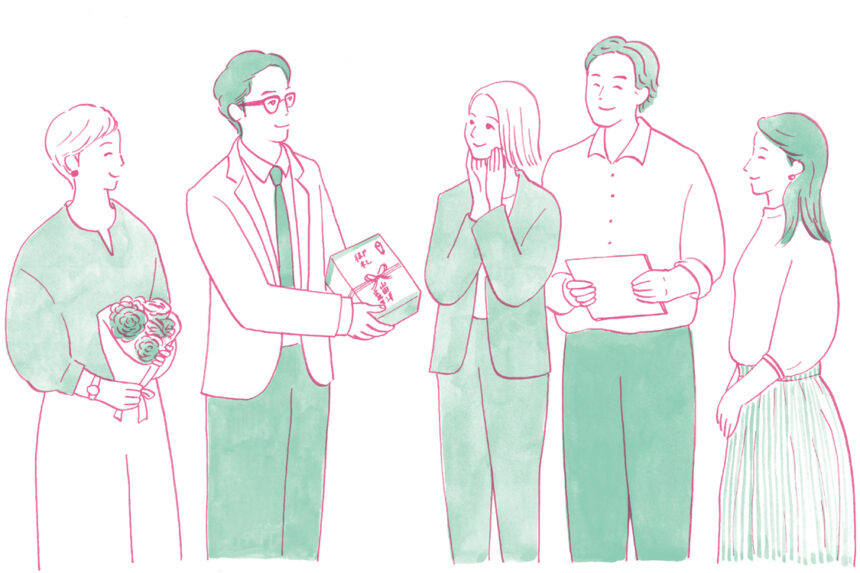
A parting gift for someone who is retiring or moving on. What is the price, how to choose, and what is the etiquette for giving gifts?
end of the fiscal yearchangeretirement (from office)farewell giftgift for a parting gift
The end of the fiscal year is also a time for saying goodbye in the workplace. It is a time when more and more people leave their companies due to personnel transfers or resignations. We asked Ms. Hiroko Nishide, a manner consultant, about the manner in which to present parting gifts to those who have taken care of you as a token of appreciation.
What is the price of the gift for each recipient, neither too cheap nor too expensive?
A parting gift is a gift given to a person who has been a great help to you, to express gratitude for their past support and to wish them well in their future endeavors.
When giving a parting gift, the first thing to consider is the price. You want to choose a gift that is neither too cheap nor too expensive, but just the right price. The market price for a farewell gift for a boss or a senior is about 5,000 yen, and for a colleague or a junior about 3,000 yen.
If you are giving a gift to more than one person, be careful not to make it too expensive or inexpensive, as it will be a burden on the recipient and too inexpensive will be rude.
How to choose a special and memorable parting gift
Since you are going to go to the trouble of giving a gift, you want the recipient to feel good about receiving it. We asked them to give us examples of items that they would be happy to choose as parting gifts.
One of the best gifts I recommend is personalized goods. I often give personalized chopsticks to people who are leaving the company. Some of them even include the name of the company. As a memento, they will remember it and feel it is special. For male bosses, it is also a good idea to have them addressed to their wives, children, or favorite pets. The most important thing about a gift is to choose one while thinking of the face of the recipient. Although it is said that non-extinguishable items are preferable for parting gifts, there is no problem in giving a personalized champagne to a person who loves to drink, for example. It will be a special commemorative gift that will be appreciated,” says Nishide.
Let’s think about what would please you from the examples of items listed below.
Office goods such as business card holders and ballpoint pens
Personalized mug bottles
Bouquets and flower arrangements
Relaxation and beauty items
Tickets to experience activities
Tableware and interior goods (for those who are moving)
It is important to inform the department and everyone involved of what to choose and how much to spend before the gift is given.
What is important when giving a gift of parting gifts is to have a thorough discussion with everyone involved. Make sure to communicate well about when, who, and what the gift will be, and make sure that everyone agrees on the content of the gift. If someone decides on their own, there will be people who are dissatisfied, so the key is to communicate properly,” says Nishide.
What NG items should not be given as parting gifts?
When choosing a gift, it is important to be aware of items that have been considered “best avoided” and the reasons for this. For example, combs and cyclamen were considered unsuitable gifts because they are associated with suffering and death, stationery, watches, and bags because they are taken to mean more diligence, and handkerchiefs, also known as shukin, because they are associated with severance. There are other such items, but should they really be avoided?
However, today, more and more people do not care about this kind of thing, and many people are happy to receive these items. With the knowledge that they were avoided, choose a gift that suits your relationship with the recipient and their preferences. The Corona disaster has been called the “New Normal Era,” and this new era can be called the “True Era. I believe that the true era is an era of choice. It is an era in which people think for themselves and choose what to do and how to do it. Therefore, the true value of a person will be tested by what he or she chooses based on what he or she knows. As long as it is something that will please the recipient and that expresses the feelings of the giver, it doesn’t matter what kind of gift you choose,” says Mr. Nishide.
Do I need a noshi paper for a parting gift? What kind of writing on the envelope and mizuhiki?
Another concern is the noshi-gami to be applied to the parting gift. In the first place, is it better to put a noshi paper over the gift? And if so, are there any rules regarding the type of writing on the front of the envelope and the type of mizuhiki?
Whether or not to put noshi-gami on a parting gift depends on the recipient. If you want to present the gift in a formal style, it is better to do so. The most appropriate notation on the wrapping paper for a parting gift is “Gorei” (thank you). The reason for resigning may vary from person to person, such as retirement, marriage, childbirth, job change, etc. Therefore, the way to write “noshi” (gift wrapping paper) is important. Therefore, there are various ways to write “noshi” such as “thanks,” “best wishes,” “congratulations on your marriage,” etc. However, by writing “gorei” (thank you), it is more appropriate. However, by writing “Gorei” (thank you), it can be used for any reason. The basic mizuhiki is a red and white bowknot. The name of the sender should be inserted. If a department is jointly named, it should be written as “Representative name + 00 department members. Noshi-gami (paper for wrapping gifts) was first used in the old days when gifts were given with abalone, which was a luxury item, and became noshi abalone. Thus, noshi-gami is not required when giving a gift of raw food.”
The time to give the parting gift is on the last day of work or the day before.
Next, let’s talk about when to give a parting gift. When is the best time to give a parting gift?
Generally, the best time to give a gift is on the last day of work or the day before. However, if you are holding a farewell party in your department, you should give the gift at that time. There is no rule that says you have to do it this way, so you can be flexible according to the situation and your own schedule,” says Nishide.
It is a good idea to confirm in advance when the paid holidays will begin. Also, some people may feel as if they are being asked to “leave early” if they are given their leave too early, so you need to be careful about that as well.
In addition, if you are giving a heavy or large gift, consider sending it home, says Nishide.
If you find it difficult to carry home, it is not considered rude to send it to your home. It is also common to verbally tell the recipient that you sent the gift because you didn’t want it to become luggage, and then hand-deliver a colored paper, letter, or bouquet of flowers at the farewell ceremony,” says Nishide.
If I were the one leaving, would I need to return the parting gift?
Basically, there is no need to return or give a gift in return for a parting gift. However, if you want to express your gratitude for their kindness as a feeling, you may prepare such a gift.
The item to be given depends on the type of gift received and the relationship with the recipient. Some companies may have a rule that says you do not need to return the gift, so please check in advance. If it is a large group, a gift of 300 yen to 500 yen per person, or even sweets as a thank-you gift, is acceptable. If you want to give something to commemorate the occasion to those who were close to you, personalized goods such as the aforementioned personalized chopsticks would be a good idea. In this case, you do not need to put a “noshi” (gift wrapping cloth) on the chopsticks, as it would be too ostentatious. Japan is a country of wrapping, so you should wrap the gift in a minimum of simple wrapping and give it to the recipient on the day after you receive the parting gift. At that time, you should thank the recipient by saying, “Thank you very much for all your help. It would be nice if you can send a handwritten message to the recipient saying, “Thank you very much for all your help and good luck in the future,” as well as a thank you note. If you receive a parting gift on the last day of work, it is a good idea to prepare a gift in return and give it to the recipient on the spot or send it to the company at a later date,” says Ms. Nishide.
Cherish the desire to make others happy.
While there is a certain pattern of etiquette for parting gifts, the most important thing is to prepare a gift that expresses your gratitude to the recipient and your desire to make him or her happy. By considering the recipient’s preferences as well as what will encourage them to move on to the next stage of their lives, you will be able to give a gift that will enrich their hearts and minds.
Interview and text by Yoshiko Tezuka
Illustrations by Tomoko Shinozuka
Hiroko Nishidethree
We spoke with…
Manner consultant. He has taught manners to actors, athletes, and celebrities in NHK historical dramas, movies, and commercials, and has also covered the manners of the Imperial Family. She has also supervised and written more than 100 books, which have sold more than 1 million copies. The know-how that Ms. Nishide imparts can be easily incorporated into daily life and work, and is popular for its highly convincing content.
For more information about Ms. Hiroko Nishide, please visitOfficial Siteand,InstagramThe information is updated as needed on the following website.