

Anyone can do it by themselves! How to tie a yukata obi – Kai-no-kuchi version
obi knotyukata (light cotton kimono worn in the summer or used as a bathrobe)whelk’s eggs
Kai-no-kuchi is a chic and simple obi knot that is quickly tied using a han-haba obi.This knot is recommended for married women and older women who want to dress in a more mature manner.*Please note that if you are using a wide han-haba obi, it is difficult to tie.
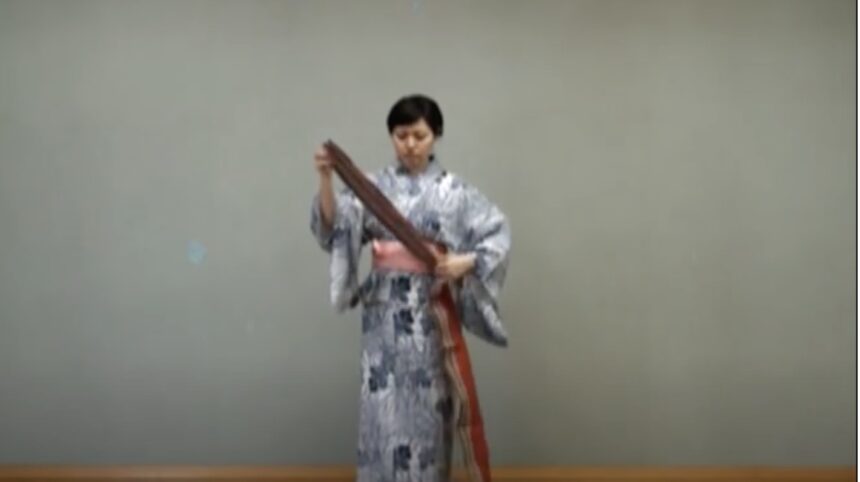
1: Fold one end of the half-width obi in two from the middle to make it half as wide as it is.
2: Take the length of two and a half thumb and pinky finger spread lengthwise as a “te”.
3: Leaving the “te”, wrap the obi around the body, gradually widening it.
4: After wrapping two wraps around the body, hold the lower side of the obi by the sides and pull firmly downward at an angle.
5: Hold the longer sash (this is called tare) with outstretched hands.
If there is still a large amount of excess, place the tip of the “tare” between the body and wrap it around the back. If there is still a considerable amount of excess, place the tip of the “tare” between the obi and the body and wrap it around the back of the body.
6: Keeping the obi in that position, hold the lower side of the obi back by the sides and pull the left and right obi together again.
7: Cross “tare” up and “te” down.
8: After wedging the “tare” under the “te” and pulling it upward, spread the base of the “tare” neatly.
9: Fold the “tare” inward into a triangle to form a loop.
10: Pass the “te” through the loop and pull it tight. Make sure to tie it tightly because if it is loose, the obi will come undone. If you are worried, you may use an obi sash.
Tie it tightly to give it a backward appearance.
11: Holding the obi with both hands, shift it to the right and turn it to the back, being careful not to expose the yukata.
12: Finally, shape it and it is done.
Tokyo Tarothree
store that has been gone out of business