Bank of Japan

historic sitefield affiliated with a shrine (the tax-exempt proceeds of its harvest going to pay for shrine operations)

Bank of Japan(Bank of Japan)

important cultural property

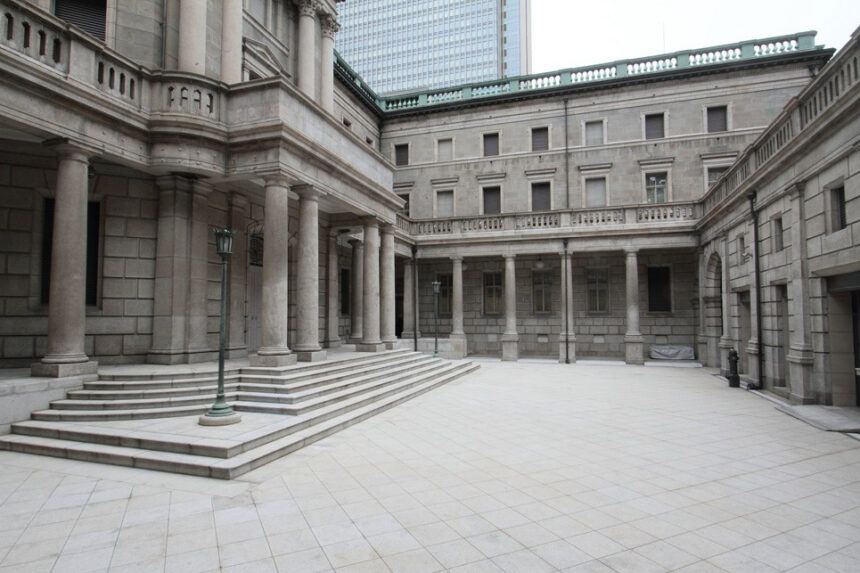
The Bank of Japan Head Office consists of an old building, a new building, and an annex. The main building of the old building was built on the site where the “Kinza” was located, which was contracted by the Edo shogunate to manufacture gold coins such as koban during the Edo period (1603-1868). Designed by architect Kingo Tatsuno, it was completed in 1896. It was the first national modern Western building designed by a Japanese architect. The building, built of stone in the classicist style, withstood the Great Kanto Earthquake, and after some renovations, the exterior and interior still retain the appearance of the building as it was when it was first built. The main office is open for tours, and visitors can see the courtyard, the underground vault, the old sales floor, and the dome of the exhibition room. Together with the adjacent Currency Museum, visitors can learn about the history of Japanese finance.

Spot OutlineOutline

address (e.g. of house) 2-1-1 Nihonbashi Hongokucho, Chuo-ku, Tokyo
Access 1 min. from Subway Mitsukoshimae Station, 6 min. from Subway Nihonbashi Station, 8 min. from JR Tokyo/Kanda Station

phone 03-3277-2815 (every Monday through Friday from 9:30 to 16:30)
Business Hours Reservation tour: every Monday through Friday (advance reservation required), reservations can be made through a dedicated online site (https://www5.revn.jp/bojtour/)
regular closing day National holidays, year-end and New Year holidays (December 29-January 4)
External Links

Official Web Site

Founding and opening of business 1882 (the 15th year of Meiji)

新着・おすすめ情報

  1. The family motto is “Be a connoisseur. Gyokuho-Do” has continued to support the tea culture by handling tea utensils of the Unshu-Matsudaira and Omotesenke families.

  2. What is the meaning behind the three colors of “Hishimochi”? Hina Doll Decorations

  3. 【第8回】江戸時代から語られるぶっかけの由来と食べ方指南

  4. Inari-zushi

  5. Honshiba Park (Tamachi, Tokyo)

  6. Yamamoto-Tei (aristocratic group of pious men)

  7. Ruins of Kira Residence (Honjo Matsuzaka-cho Park)

  8. Why Sarashina Soba is pure white? Pride in preserving the traditional Sarashina Soba with Onshochi Soba Soup and traditional Sarashina Soba Noodles

  9. battledore (early form of badminton racket)

  10. Fukutoku Shrine Meibuki Inari (Nihonbashi, Tokyo)

  11. sweet burdock and miso-bean paste covered with a thin layer of mochi

  12. special brewing

  13. Takao Yakuoin (Mt. Takao, Tokyo)

  14. How to read “strong snacks”? Kaiseki and Kaiseki Cuisine

  15. 【第12回】「手打ち」というだけで蕎麦は美味しいわけではない