

The Five Secret Secrets of Long-established BusinessesRyogoku/Kameidotraditional crafttype of tortoiseshell (shell) tortoiseshell (esp. of the Chinese soft-shelled turtle)tortoiseshell (of the hawksbill turtle)
Bringing the best of Japan to the world, and the best of the world to Japan, agatajapan.
Japan is one of the few countries in the world where there are more than 33,000 long-established shops that have been in business for a hundred years. In this series of articles, we ask the owner of a long-established business about the “five secrets” that make it a long-established business.
Tortoiseshell work is the result of the finely honed skills of craftsmen working with rare natural materials, and for more than 200 years the seventh-generation Edo Bekko-ya, founded in 1802, has continued to deal with precious materials and improve its techniques. How does the seventh-generation owner continue to deal with materials and techniques? And what other ideas does he value in addition to “technique”?
Through the five secrets that make a long-established business a long-established business, we will look at the driving force behind Edo Bekko-ya’s continued creation of the “real thing.
Continuing to deal with rare tortoiseshell work in a work without lies
There must be innovation to continue the tradition.”
New technologies are created through the creation of new goods.”
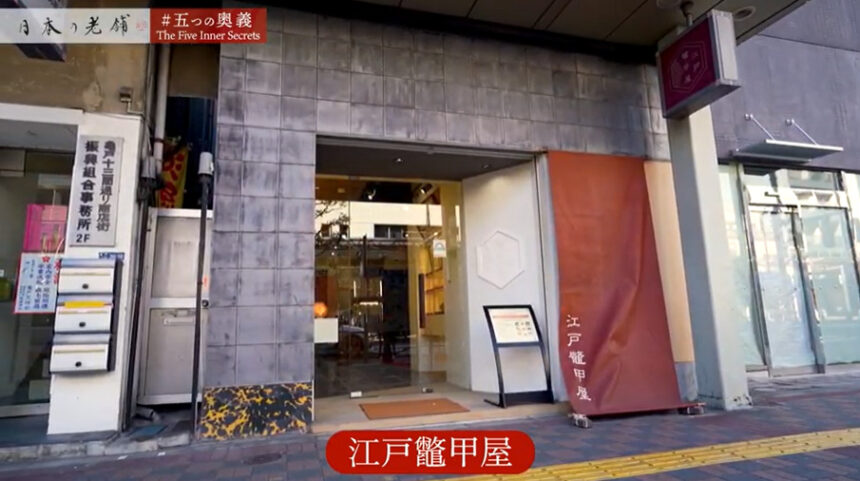
These are the words of Kotaro Ishikawa, the seventh-generation owner of Edo Bekko-ya. The place where such honest work is produced is Kameido, Koto-ku, Tokyo. Inside the Edo Bekko-ya store facing the main street, you will find a variety of tortoiseshell work, including eyeglasses, ornamental hairpins, and necklaces.
To begin with, tortoiseshell work is a processed product made from the shell of a sea turtle called “taimai. Edo Bekko-ya was founded in 1802 in Bakuro-cho, Nihonbashi. At that time, its main products were ornaments such as ornamental hairpins and obi clasps. A set of combs and ornamental hairpins were so expensive that one could live on them for a year.
Ishikawa Tortoiseshell Factory’s workshop is established in Kinshicho, Tokyo. The import and export of tortoiseshell shells is banned under the Washington Convention. The key point of our industry is how to use the precious materials we procured before the ban was lifted,” says Ishikawa.
The Five Secret Secrets of Long-established Businesses No. 1: Use up valuable materials without wasting them
In order to avoid wasting precious materials, it is important to make full use of every part in the right place. For example, in making a wristwatch belt in tortoiseshell work, the artist was seen paying close attention to the “process of determining the pattern” by overlapping two shells and allowing the colors to shine through the light. The artist must consider the most efficient way to cut the material while also taking into account the next piece to be made.
Each piece of tortoiseshell material shows a natural pattern,” says Ishikawa.
This means that, unlike man-made products, the same pattern can never be created twice. This is why there are special precautions unique to tortoiseshell work, such as the “spotted matching” process, in which the amber colors of the shell overlap each other to make the pattern flow together.
The shell is a material that may disappear in another 15 years or so. Mr. Ishikawa values the awareness of using small parts for earrings and pierced earrings, which do not require large pieces of fabric, with careful consideration of balance and calculation.
The five secrets of long-established shops #2: Adjust the temperature and pressure according to one’s “senses
By applying heat, water, and pressure to the glutinous substances contained in the shell, it is possible to increase the thickness of the shell as a single plate. The tortoiseshell shell is soaked in water for about 10 minutes, sandwiched between sheets of plywood, and then pressurized with a hot plate at an appropriate temperature that is neither too hot nor too cold. The temperature and pressure are all adjusted by human senses.
The difficulty of working with tortoiseshell, which is a natural material that varies in hardness and softness from one piece to another, is the need to make subtle adjustments to the temperature and the amount of force required, even in summer and winter, to achieve satisfactory results at all times.
You have to learn as you go along,” says Ishikawa.
The Five Secret Secrets of Long-established Businesses, Part 3: The tools that support craftsmanship are as important as life itself.
Mr. Ishikawa says that the tools that support the craftsmanship are as important as life itself. In the field of tortoiseshell craftsmanship, where there are no manuals, a change in tools and the senses and habits of the craftsman can be a fatal blow.
Tortoiseshell is sharpened with custom-made blades. He handles them carefully and maintains them, protecting the most useful tools like his own hands and feet.
Five Principles of Long-established Businesses, Part 4: Change is inevitable, so take on the challenge of innovation.
Mr. Ishikawa was born in 1973. When he was a student, he studied abroad in the United States. When he visited Germany on business for the trading company he joined after graduation, he was told, “You can do your current job without me, but I think your family’s job can only be done by you.
According to the seventh generation, “‘Tradition and innovation’ are two sides of the same coin. Just as kimonos, which were people’s clothing in the Edo period, were replaced by Western-style clothes in the Meiji and Taisho periods, the times inevitably bring change. Continuing to innovate accordingly leads to the preservation of traditional craftsmanship and techniques. That is why Mr. Ishikawa keeps trying to “always show new possibilities.
The Five Secret Secrets of Long-established Businesses No. 5: Never say “I can’t” to a customer’s request.
Edo Bekko-ya’s challenge for innovation has produced a wide variety of products.
Illuminating the darkness, this “lampshade” is made of tortoiseshell attached to a wooden frame made of Yakusugi cedar. This lamp, created with a natural pattern, is a one-of-a-kind product. The “wine glass” with tortoiseshell legs is removable for greater flexibility in care and maintenance. The tortoiseshell tortoiseshell “eyeglass frames” change slightly with body temperature and adjust to the degree of curvature of your ears.
New goods call for new techniques, and this gives us a sense of the infinite possibilities of traditional crafts.
Edo Bekko-ya’s policy is to never say “I can’t do it. Mr. Ishikawa says that he aims to meet 100% of customers’ requests, and if there is another excellent craftsman who can do a certain job, he is willing to ask for his help.
Mastering both craftsmen and merchants leads to the real thing.
Of course, the skills and knowledge of a craftsman are important,” says Ishikawa.
However, Edo Bekko-ya also has a policy that “as a merchant, it is important to respond to the best interests of our customers.
Mr. Ishikawa believes that mastering the path of both craftsmen and merchants as workers leads to the real thing.
I did not start this business in my own lifetime,” said Mr. Ishikawa. His straight eyes showed his sense of mission to pass on the techniques he learned to the next generation.
Starmark Corporation
Good things of Japan to the world Good things of the world to Japan Good things of tradition to the present day Good things of the present day to tradition.
The video “The Five Secret Secrets: Edo Bekko-ya” is available athere (place close to the speaker or where the speaker is)from (e.g. time, place, numerical quantity)