2023.02.07 〜 2023.06.18

Learn about the history and appeal of the ever-evolving “single-lens reflex camera
An SLR camera has one lens (single lens) that serves both as a photographer and a viewfinder, and a mirror reflects the light through the lens to the viewfinder. Because it allows photographers to check the angle of view and focus of the lens through the viewfinder, SLR cameras have long been used mainly by professional photographers and amateurs who enjoy taking serious photographs.
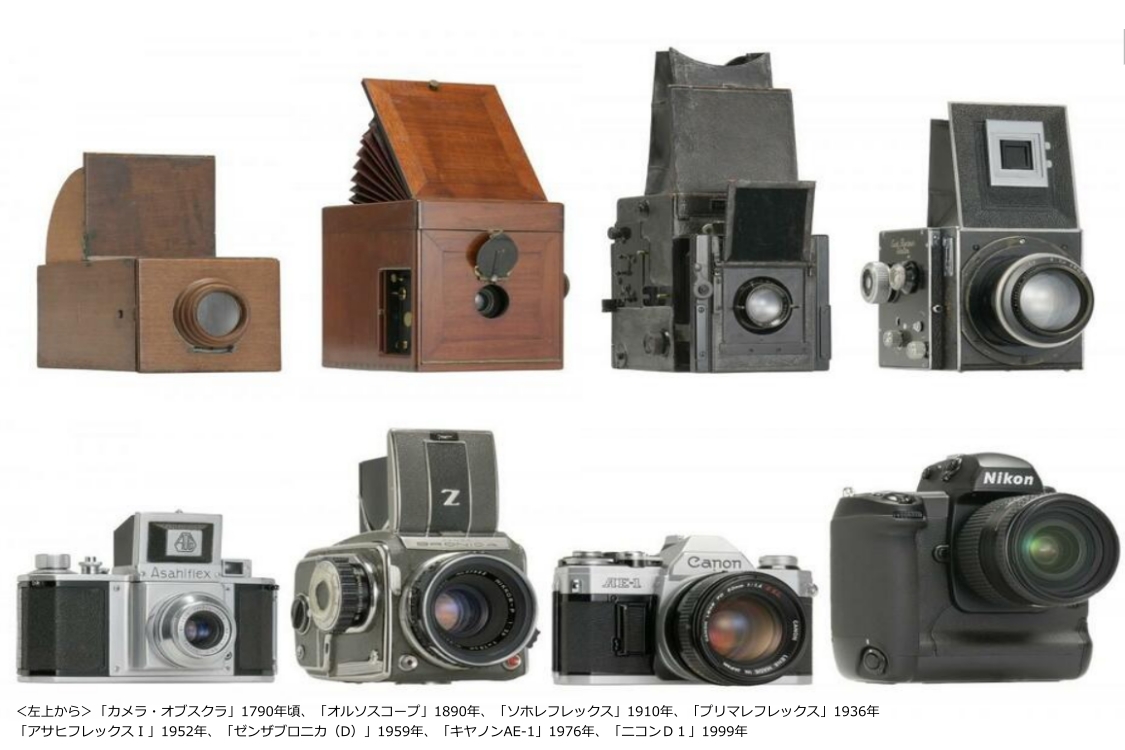
The “camera obscura,” a device used by artists for sketching and other purposes before the invention of photography, was a single-lens reflex camera. Since the introduction of the small, precision metal SLR camera using roll film in the 1930s, it has established a firm position as a versatile camera that can be used for various types of photography, and has continued to support the recording of images as a major piece of equipment until the digital age.
SLR cameras also played a major role in the Japanese camera industry. Starting around the 1950s, Japanese camera manufacturers shifted their mainstay products from Leica-type perspective viewfinder cameras, which had been their target, to SLR cameras, which were not widely used for general photography at the time. This shift was successful and led Japan to become a camera superpower, and Japanese-made SLR cameras remained the mainstay of photographic equipment for a long period of time.
Even today, when mirrorless cameras and smartphones are being used more and more, “SLR” cameras are still synonymous with authenticity. The natural view through the optical viewfinder and the precision with which the mirror and shutter intricately interlock and operate with precision continue to be attractive features of SLR cameras.
In this exhibit, the history of the “SLR camera” will be unraveled, and the mechanism and appeal of SLR cameras will be introduced.
From the exhibition schedule
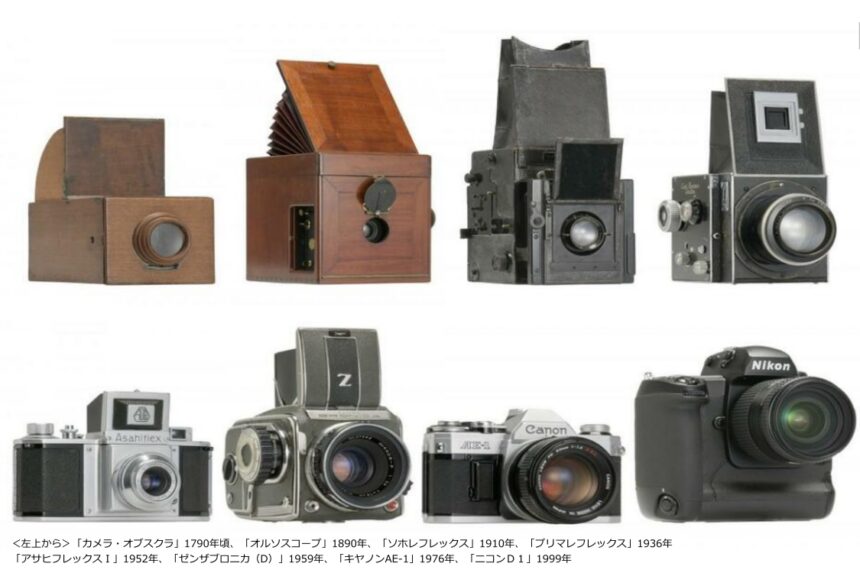
Camera obscura.”
Circa 1790 (Kansei 2), unknown
An optical instrument used prior to the invention of photography to accurately depict a picture. In Latin, “camera” means room and “obscura” means dark, hence the origin of the word “camera.
Orthoscope.”
1890 TOURTIN, FRANCE
The first French-made SLR camera.
Sohoreflex.”
1910 Marion, England
Wooden SLR camera using dry plate.
Exakta.”
Ihage, Germany, 1933
An early metal compact precision SLR camera.
Prima Reflex.
1936 Kurt Benzin (Germany)
A focal-plane-shutter SLR camera with a 6 x 6 cm format screen.
Duflex.”
1943 Gamma, Hungary
SLR camera with an eye-level viewfinder with polo mirror and a quick-return mirror.
Contax S
1949 VEB Zeiss Ikon (East Germany)
The first SLR camera to use a pentaprism in the viewfinder.
Asahiflex I
1952 Asahi Optical Industries (Japan)
Japan’s first 35mm format SLR camera. It was also equipped with a perspective viewfinder for vertical photography.
Miranda T.
1955 Orion Camera (Japan)
Japan’s first 35mm SLR camera with pentaprism.
ZUNO.
1958 ZUNO OPTICAL INDUSTRIES (Japan)
An automatic aperture system that works in conjunction with the body’s internal mechanism. At the time, it was called “fully automatic aperture.
Zenza Bronica (D)
1959 Bronica camera (Japan)
6 x 6 cm format SLR camera with descending quick-return mirror and focal-plane shutter.
Olympus Pen F
1963 Olympus Optical Industries (Japan)
SLR camera with interchangeable lens with half-format (18 x 24 mm) screen.
Canon AE-1
1976 Canon (Japan)
Significant computerization with on-board microcomputer. High performance and low cost achieved by internal unitization, etc.
Minolta α7000
1985 Minolta Camera (Japan)
An AF SLR camera with the AF drive source (motor) for the interchangeable lens on the body side.
Nikon D1
1999 Nikon (Japan)
Launched at the then low price of 650,000 yen, it contributed to the popularization of digital SLR cameras.
(Models to be exhibited are subject to change.)
The camera names listed here are part of the models that will be exhibited.

Event SummaryOutline
| Location | Japan Camera Museum B1F, JCII Ichibancho Building, 25 Ichibancho, Chiyoda-ku, Tokyo |
|---|---|
| Access |
1 minute from Hanzomon Station on the Tokyo Metro Hanzomon Line, 8 minutes from Kojimachi Station on the Tokyo Metro Yuraku Line
|
| Holding period | Tuesday, February 7, 2023 – Sunday, June 18, 2023 |
| Opening Hours | 10:00~17:00 |
| Contact Us | 03-3263-7110 |
| admission fee | 300 yen |
| closed day |
Every Monday (or the following Tuesday if Monday is a national holiday) *The museum will be open during the GW period (4/29 (Sat.) to 5/7 (Sun.)) |
| Related Links | Official Site |