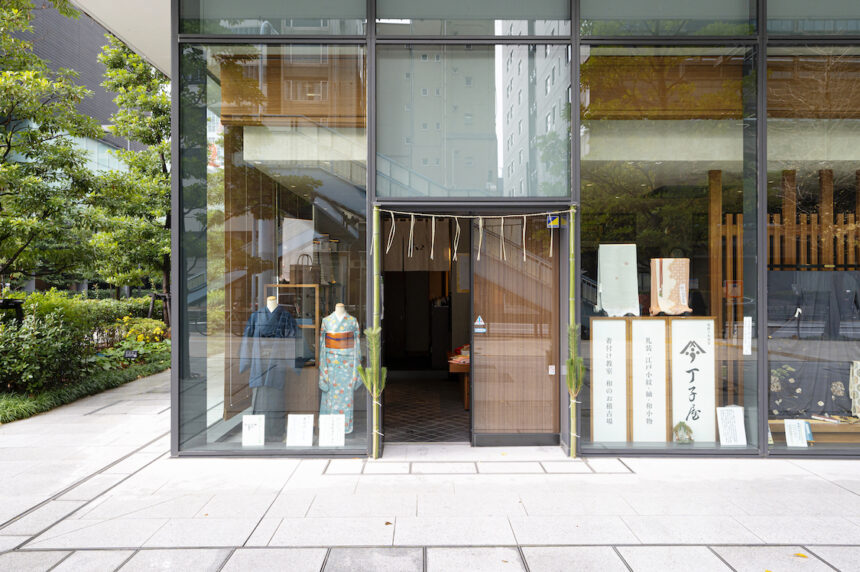
The difference between a yukata used as pajamas and a yukata worn to a fireworks display, which only a Japanese person can understand.

Column: Don’t call me the landlady!turfJapanese clothingyukata (light cotton kimono worn in the summer or used as a bathrobe)clothing

Hello.

My name is Eri Kobayashi, the sixth generation owner of the 225-year-old kimono shop “Choukoya” in Toranomon.
I am writing this column, which will run for about 20 issues, through an opportunity provided by agataJapan tokyo, and I would like to share with you the ABCs, the mysterious points, and my own viewpoints on kimono, which I myself felt seven years ago, in 2016, when I took over a well-established kimono shop from a completely different industry, in an easy-to-understand way, with some episodes added. I hope to share with you my own views on “kimono” with some episodes. Thank you very much in advance.

Have the Japanese of today become foreignized?

The kimono is a garment that has existed for more than 1,000 years without changing its shape. Sometimes there are older people who lament that “Japanese people today have become foreigners or aliens,” and many of us are probably that far removed from the kimono in our daily lives.

Perhaps the most familiar thing to those of you who read this column is “Yukata, not Kimono! I am sure that you are probably most familiar with “Yukata, not Kimono! As of May 9, 2023, when I am writing this column, Corona has settled down, and this summer, fireworks festivals will finally be held in various regions.
Fireworks festivals are a summer tradition, and in fact, the Sumida River Fireworks Festival, which is arguably the most famous fireworks festival in Japan, was held in 1733 by Tokugawa Yoshimune, the 8th shogun of the Edo shogunate, to repose the souls of the dead from the (great) famine and cholera epidemic that swept through the city of Edo.

The prototype of the yukata is the “yumakata” worn when entering a steam bath.

This is the year to wear a yukata to a fireworks display! But do you know the origin of yukata, a must-have item for fireworks displays?
The original yukata was called “yukatabira,” a linen kimono used for steaming baths that was popular during the Muromachi period (1333-1573). Katabira is a katahira, or unlined kimono. In the mid-Edo period, unlined kimono was called hitoe, and since cotton yukata were becoming more common, hemp was deliberately called katabira. This is why the name “yukata” (yukatabira) has remained, even though cotton yukata are the most common type of yukata in modern times.
Originally, yukata were worn after taking a bath. Incidentally, the proprietress of Chokoya is 75 years old this year, but she still does not wear a yukata in her restaurant even in summer. The reason for this is that the feeling of “wearing a kimono outside and a yukata after taking a bath” has not disappeared. It is a pajama-like position in modern Japanese inns.

A foreigner goes out in a yukata, which is kept in a hotel instead of pajamas.

There are many hotels in the vicinity of Dingoya, so we often have foreign visitors.
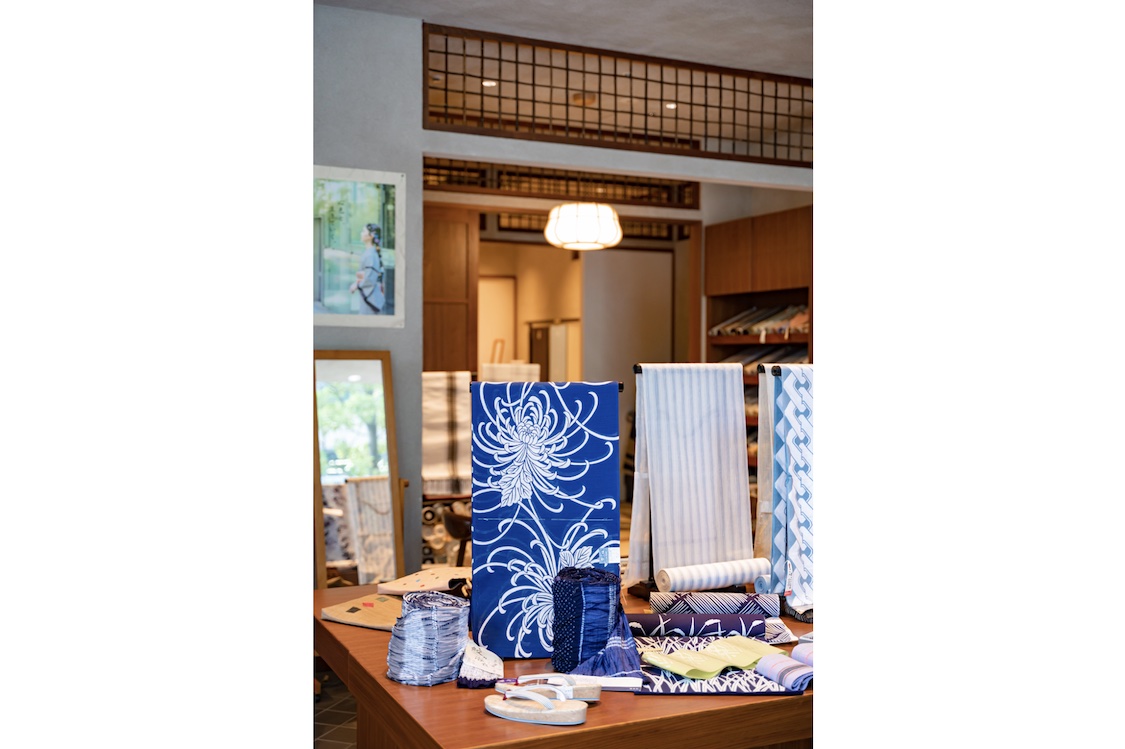
They often hang around outside in the indigo-dyed yukata on a white background that the hotels keep in place of pajamas! The yukata that Japanese people wear at fireworks displays and the yukata that hotels keep in place of pajamas, both are yukata.
I think it is because I am Japanese that I can sense the difference between a yukata and a yukata that is not used as pajamas (laugh). So, I would like people to enjoy the kimono as an extension of their daily life, starting with the yukata for the fireworks display, without saying “I don’t know anything about kimonos, it’s difficult”. For this reason, in this column, I hope to convey the joys and difficulties of the kimono without hiding them, so that everyone can feel a little more familiar with the kimono.
To think that more than 200 years ago, the people of Edo, just like we do today, wore yukata after taking a bath and looking up at the fireworks in the night sky, and to think that we are back in a world where the corona has settled down and we can spend time surrounded by many people in summer again…. I am filled with a sense of excitement.
May 9, 2023 Eri Kobayashi, Dingko-ya VI

Eri Kobayashi

The sixth generation head of the Dingoya family

This article was written by…

She is the sixth generation of “Choukoya,” a long-established kimono store founded in Kansei 10, which suddenly appears on the first floor of the Toranomon Hills Business Tower. 2016, she decided to take over her husband’s business, a kimono shop, from a completely different industry such as ORIX Group. Kimono dresser and kimono personal color analyst. She conveys “kimonos that will last for the next generation” that are not bound by common sense or stereotypes, and is a permanent board member of the Hyakunenkai, an association of long-established kimono shops in Shiba from 2020.
Her hobbies are “dressing and coordinating others” and solo camping.Dingoya Home PageDingoya Instagram

新着・おすすめ情報

  1. Nezu Shrine (Nezu, Tokyo)

  2. Kikujuudo Isetatsu Yanaka Main Store

  3. YOUKIZA

  4. buckwheat mash (buckwheat flour in hot water served with shoyu)

  5. Philosophical Hall Park (Araiyakushi, Tokyo)

  6. Zoshigaya Old Mission Building (Zoshigaya, Tokyo)

  7. Sengakuji Temple

  8. 浅草

  9. Nihonbashi (bridge)

  10. Hakocho Orange Street Store

  11. Fuzoku ningyo” are dolls that reflect the customs of various regions in Japan. There are Edo genre dolls, Kyoto dolls, etc.

  12. Nogi Shrine (Akasaka, Tokyo)

  13. What is “Katahira”? What kind of process is it? Words related to Sake

  14. 【第18回】古くから食べられてきた「そばがき」の作り方

  15. A Walk in Edo with Old Maps] No.4: Was the Yoshiwara brothel located in Ningyocho? A play by day, a brothel by night. A Journey to the Ruins of a Former Pleasure Spot