Manners for visiting shrines and temples: money offering, how to pray, how to get a red seal, etc.

Adult Manners Courseshrine visittemplevisit to a shrine or templemanners (when visiting a shrine)book of stamps (each confirming donation to a temple on a pilgrimage)Shinto shrine(Shinto) shrines and (Buddhist) temples

Shrines and temples are often a stopover when traveling. Since they are the spiritual centers of many people and places of sacred faith, why don’t we take a look at the manners of worship before visiting a shrine or temple? What are the differences in the way of worship between shrines and temples? By acquiring knowledge of the original meaning, you will be able to visit shrines and temples with a fuller heart.

What is the definition of a shrine and a temple, and what is the difference between them?

First, let’s review the definitions of a shrine and a temple.
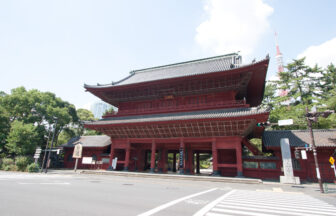
A shrine is a Shinto religious institution, a place where the gods reside. It is based on an indigenous religion that originated naturally in Japan. Natural disasters such as typhoons and drought were seen as the wrath of the gods, so the main thing is to calm and protect them, as in the song, “The village’s shizumigami no kami-sama no ……”. Therefore, the temple was built as a place to express gratitude and awe to the gods for the safety of the day, and to make a wish for future safety.
On the other hand, temples are essentially Buddhist religious institutions where the teachings of Buddha are studied. Temples were built as places where monks, who believed in and practiced the teachings of Buddha, could learn and practice the doctrines and become one with the Buddha.
So what are some things to keep in mind when visiting shrines and temples?
Manners are all about putting yourself in the other person’s shoes. So, of course, you can make requests at shrines, but basically, you should express your gratitude to the gods. Even the gods will be happy if you express your gratitude and thanks to them. I believe that by making the other person happy, the blessings will be returned to you. Of course, you should pay a visit to the gods to express your gratitude when you have achieved the fulfillment of your wish.
On the other hand, at temples, the content of your visit will differ depending on whether the principal object of worship is a Buddha or a Bodhisattva. Buddha-sama are the Nyorai, which mainly include Buddha Shakyamuni, Amida Nyorai, and Yakushi Nyorai. Bodhisattvas, on the other hand, are most often Kannon Bosatsu and Jizo Bosatsu. Essentially, we do not make requests directly to the Buddha. It is the Bodhisattva who directly hears our requests. For example, if you want to be cured of an illness, you can ask a priest to tell Yakushi Nyorai, and if you want your child to be safe, you can put your hands together with Jizo Bosatsu on the side of the road yourself. Therefore, it is wise to check the principal image before visiting a temple.”
Originally, when visiting a temple, it was said that it was good to reflect on oneself, thank for one’s daily well-being, and pray for purity of mind.
Today, the meaning of this custom has become less important, and many worshippers are now praying for their own benefits, but it is better to first be thankful to family, friends, and others around you and maintain a pure heart than to benefit yourself.
By the way, the terms “shrines and temples” and “temples and shrines” are often used interchangeably. The “butsakaku” in “shrines and temples” refers to the buildings of temples. Therefore, “shrines and temples” refers to both shrines and temples. The term “temples, shrines, and Buddhist temples” has a similar meaning, but “temples and shrines” means both shrines and temples, so when “temples, shrines, and Buddhist temples” is broken down, it becomes The word “temples” is duplicated in the term “temples. Therefore, the term “shrines and temples” is more appropriate.

What is the process of visiting a shrine?

If you are going to go to the trouble of worshipping, you want to do it the right way. However, according to Mr. Nishide, there is no absolute rule that says you must do it this way.
Basically, manners come from the heart, so it is not absolutely necessary to do it this way or that way, or that you will lose the blessings if you make a mistake. I believe that the gods would be more pleased if you visit shrines on a regular basis. Please visit the shrine without being overconcerned.”1 / Entering the precincts of the temple.
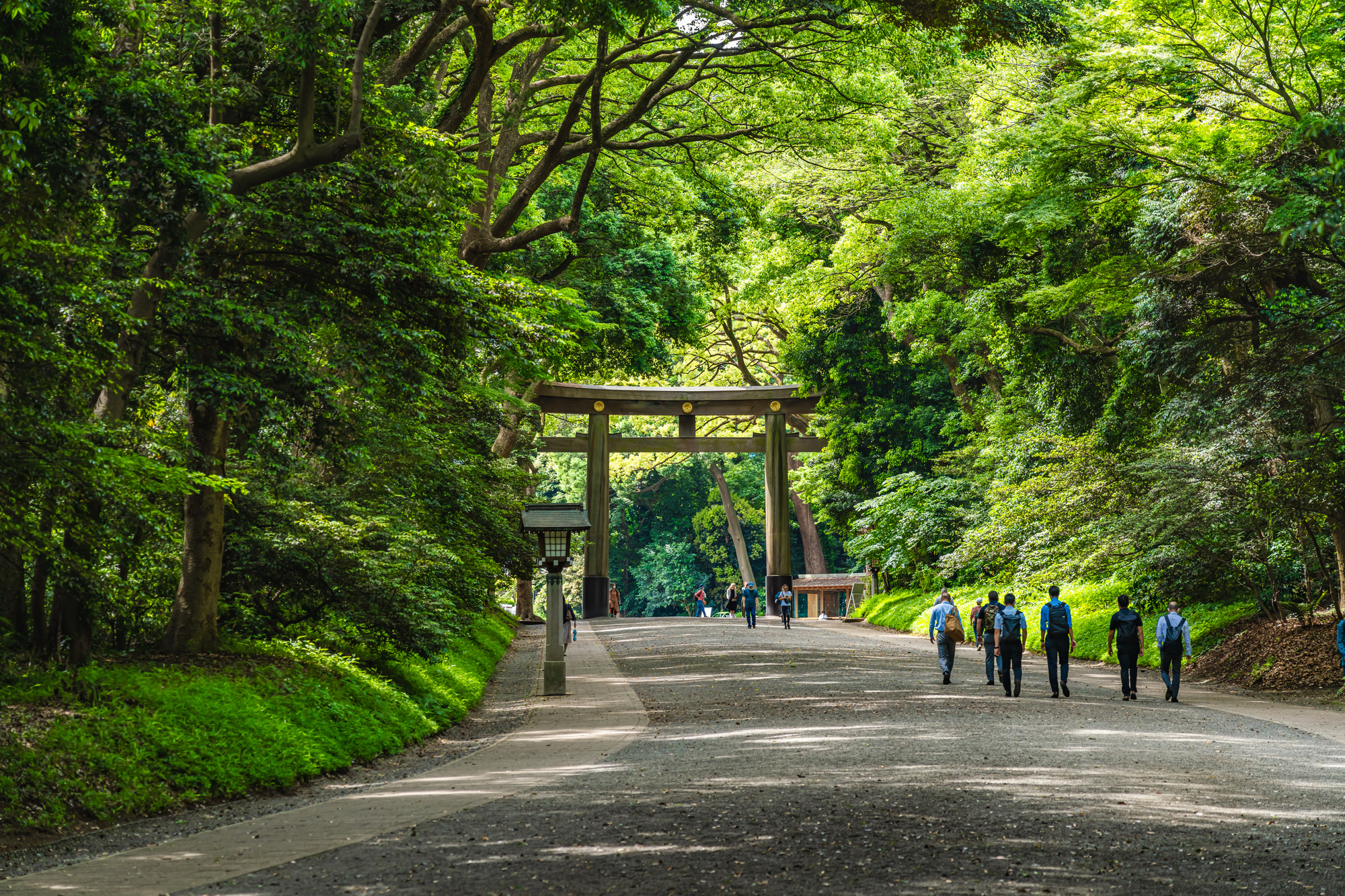
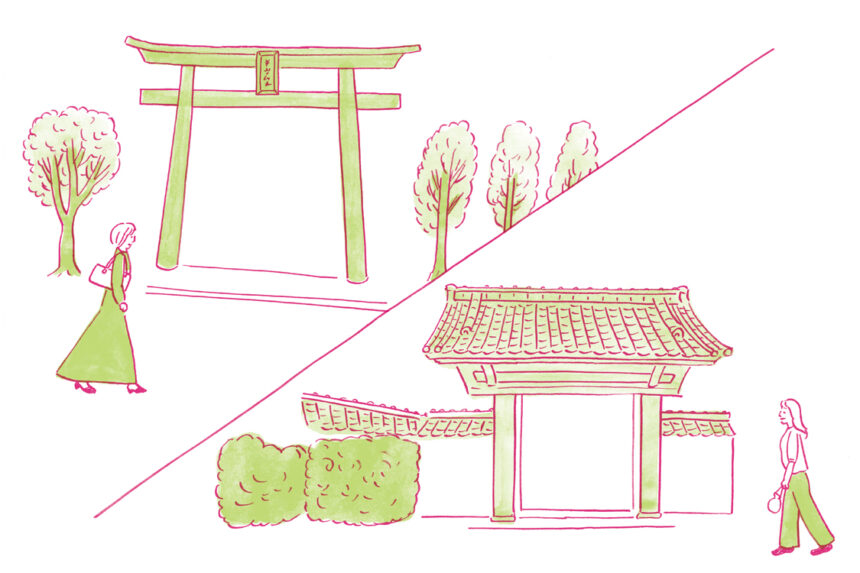
Torii gates are located at the entrances to Shinto shrines and are considered the boundary between the Shinto realm and the secular world of human habitation.
Inside the torii is the sacred area of the shrine, so stand on either side of the torii and bow. The center of the gate is the path of the gods, so do not walk through it. The way you dress depends on how you feel. The shrine does not ask you not to come dressed like this. As long as you feel gratitude to God, you are free to wear whatever you like.【2/ Perform hand-watering】.
Before visiting a shrine or temple, one should perform the ritual of “purification of mind and body” at a te-mizuya (手水屋, te-mizusha, chozuya, or chozusha). The principle of the ritual is the same whether you are at a shrine or a temple.
3 / Worship
Although the manner of worship may differ from shrine to shrine, the general procedure is as follows.
Bow, take a step forward, and ring a bell or a drum.
The bell at the head of the shrine is believed to make worshippers feel pious with its refreshing tone, purify them, and invoke the divine spirit.
It is also said that the bell is a signal to the gods,” says Nishide.
Throwing in money
It is said that the bell is also a signal to the gods.
Two cheers for worship and one bow of the head
Advance to the front of the shrine and straighten your posture.
Bend your back flat at a 90-degree angle at the waist and bow deeply twice.
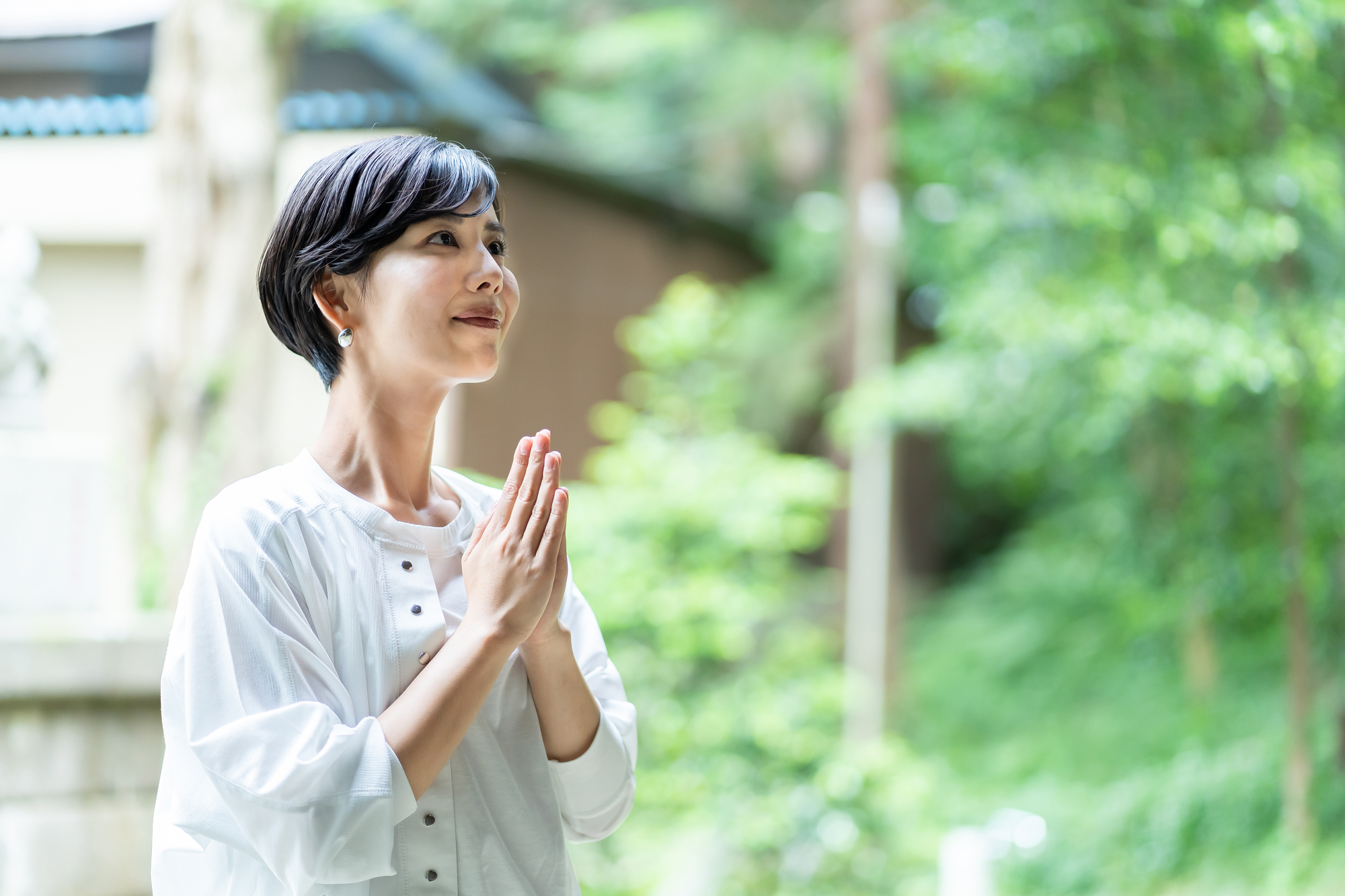
Place both hands together at chest level, with the right fingertips slightly downwards.
Open your hands to shoulder-width apart and strike twice.
5. Align fingertips and express gratitude
Lower your hands and bow one last time.
Kashiwakute in front of the shrine is to offer sincerity to the deity and to express one’s sincere gratitude for the blessings one has received.
With the first Kashiwa-clap, you announce to God that you have come, and with the second Kashiwa-clap, you signify that God and your feelings have become one.”

What is the process of visiting a temple?

Even within a single word “temple,” there are various ways to visit temples depending on the religious denomination.
It is a good idea to know in advance which denomination the temple you are visiting is. It is also important to ask the temple staff directly when you visit the temple.
The gate at the entrance of a temple is the gate that marks the boundary between the mundane world and the mundane world. In front of the gate, bow with your palms together. Gassho is the act of clasping one’s hands together in front of one’s chest, which represents becoming one with the Buddha. Although the form differs from sect to sect, gassho is the basic way to worship at temples.
When clasping hands, try not to make a sound. Although it depends on the denomination, basically temples do not clap their hands. Also, when passing through the temple gate, do not step on the threshold.
Once inside the temple grounds, purify yourself in the hand-watering fountain. The procedure is the same as at shrines.3/Worship
The manner of worship differs according to religious denominations, but the following is the general flow of the service.
When you arrive at the main hall, quietly make a monetary offering.
Sound the crocodile entrance (if available).
The “crocodile mouth” is a metal Buddhist altar hanging from the eaves of the main hall. Sounding the crocodile mouth is meant to tell the Buddha, “I have come. However, it is rude to make the sound louder than necessary, so be conscious of making a comfortable sound.
Worship
<When worshipping from outside the main hall
Straighten your back, straighten your fingers, bow your upper body, and bow with your palms together.
<When entering the main hall
Face the principal image from the front, straighten your posture, and join your palms together.
In either case, be conscious of showing your face to the Buddha.
If there is an incense burner, burn incense. The number of times to do so differs according to religious sects, so if you are unsure, it is fine to do it only once.
If there is an offering stand, insert money and light a candle. Also, light incense sticks, blow them out with your hands, and place them in the censer or lay them down (depending on the religious sect).
This concludes the service. When leaving the temple, bow in front of the temple gate.

Manners for receiving red seals

A red seal is a seal impression stamped as “proof of visit” to a shrine or temple. The red seal differs depending on the shrine or temple. At temples, red seals are called “nokyo,” or “sutra book,” because they are given as proof of having offered sutras or copied sutras. In general, in addition to the seal, the date of visit, the name of the shrine or temple, and the name of the deity or principal object of worship are written in ink.
Recently, some people collect red seals as a hobby, but it is important to remember to be thankful for the opportunity to visit a shrine, rather than just collecting them. Also, if you are going to take a person’s red seal book and receive several red seals, you need to be considerate by bailing out the person behind you, as there tends to be a queue.
Another thing that is a little worrisome is the use of different red seal impression books. Is it better to have one for shrines and another for temples and shrines?
There is no rule that says you have to do this, so it is up to you. Please take good care of your red seal book with a sense of gratitude.
Manners at shrines and temples are often obscure to people who know them. If you know the meaning of these manners, you will be able to visit shrines and temples more wholeheartedly, without being bound by mere formality.
Supervision/
Daihonzan Enpukuji Temple, Nishiyama Fukakusa School of Jodo Sect
Masamichi Kojima, 85th abbot
Mr. Kojima is fascinated by the Buddha and is popular for his easy-to-understand teachings and personality as a missionary who corrects misinformation about Buddhism and graves that is circulating in the world. In recent years, he has received many requests for pet memorial services, and he also heals the hearts of those who have suffered pet loss because of his compassion for living animals.
Oi Zao Gongen Shrine
Takamiya Yoshii, chief priest of the shrine
Interview and text by Yoshiko Tezuka
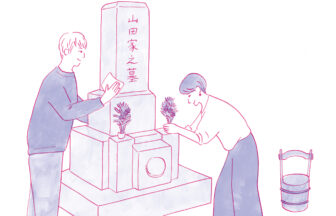
Illustrations by Tomoko Shinozuka

Hiroko Nishide

We spoke with…

Manner consultant. With the motto of “Sincerity in Manners®”, he has taught manners to actors, athletes, and celebrities for NHK historical dramas, movies, and commercials, and has also covered the manners of the Imperial Family. She has also supervised and written more than 100 books, which have sold more than 1 million copies. The know-how that Ms. Nishide imparts can be easily incorporated into daily life and work, and is popular for its highly convincing content.
For more information about Ms. Hiroko Nishide, please visitOfficial Siteand,InstagramThe information is updated as needed on the following website.

新着・おすすめ情報

  1. Edo-Tokyo Open-Air Architectural Museum (Koganei, Tokyo)

  2. Developing original materials with attention to detail, starting from the fabric. Shukusen, a long-established manufacturer of yukata loved by kabuki actors in the Edo period [Part 1

  3. long sword

  4. Edo-style Confectioner Nihonbashi Nagato

  5. Morihan Nori Store (Buy / Omori/Kamata area) page is now open.

  6. Manners for Late-Summer Greeting Cards in 2023: Common Sense to Know and Sample Cards for Different Recipients

  7. buckwheat mash (buckwheat flour in hot water served with shoyu)

  8. Imado Shrine (Asakusa, Tokyo)

  9. Toranomon Choujiya

  10. Tokyo’s “Furyu Odori” is the talk of the town since it was selected as a UNESCO Intangible Cultural Heritage site! Tokyo’s “Furyu Odori” gathers in large numbers! Report on Tokyo Folk Performing Arts Festival

  11. 【老舗ご当主・識者と歩く】日本推しラトビア人アルトゥルさんと虎ノ門−新橋の老舗をめぐる

  12. Suzuki Ruins Museum

  13. fried dough cake

  14. 【吉德】製作実演のお知らせ

  15. end of the year