

Adult Manners CourseSeasonal way of life
Manners for Late-Summer Greeting Cards in 2023: Common Sense to Know and Sample Cards for Different Recipients
Year 2023late-summer greeting card (sent from about Aug. 8 onward)late-summer greeting card (sent from about Aug. 8 onward)Example of Late Summer Greeting Cardlate-summer greeting card (sent from about Aug. 8 onward)late-summer greeting card (sent from late-Summer to early-Summer)late-summer greeting card (sent from about Aug. 8 onward)
When it comes time to send a lingering-summer-summer greeting card, one of the most difficult questions to answer is when to send it. We asked Ms. Hiroko Nishide, a manner consultant, to tell us not only when to send a late-summer greeting card, but also the difference between a lingering-summer greeting card and a hot-summer greeting card, what to keep in mind when sending them, and examples of sentences for different recipients.
Know the meaning of a late-summer greeting card.
A “lingo-summer greeting card” is a summer greeting to let people know how you are doing and to be concerned about the health of those you are unable to see or care for during the lingo-summer season. Lingering summer heat” refers to the heat that remains even after the calendar turns to autumn. There are two types of summer greeting cards: “Zanzakamishimai” and “Shochu-mishimai,” but do you know the difference between the two?
Both “Shochu-misai” and “Zanzakamisai” are the same in that they are sent to express sympathy for the health of the recipient during the hot season, when people tend to get sick easily. The major difference is the time of year when they are sent. A summer heat sympathy card sent during the hottest season of the year should be sent by the day before Risshu, the beginning of autumn, while a late summer heat sympathy card is sent after Risshu (around August 7). After Risshaku (around August 7), it should be sent as a lingering summer greeting card.
When is the best time to send out the late summer greeting cards for 2023?
How to Write a Late-Summer Greeting Card
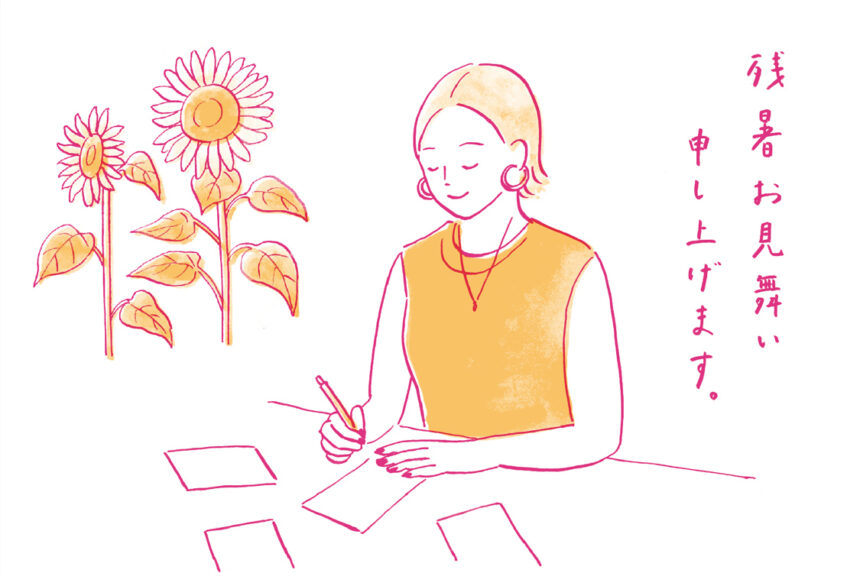
In terms of format, the most polite style is to handwrite vertically on a postcard using a brush. However, if you are not good at writing with a brush, you can use a brush pen or a pen that looks like a brush. A fountain pen is also acceptable. However, it is said that ballpoint pens and magic markers should not be used for greeting cards because they may give the impression that they are for office work.
The content of the letter will vary depending on the relationship with the recipient, but here is a general guide to writing a greeting card.
Manners for sending a late-summer greeting card other than a postcard
Late-summer greeting cards can be sent by e-mail or social networking sites. The same is true for summer greeting cards.
If the recipient is someone with whom you normally communicate by e-mail or SNS, there is no problem. As long as both parties are familiar with the communication method, there is no burden on the other party or yourself. It is good manners to be considerate of the other person by not getting too caught up in the formalities, but rather by valuing the ease with which you can communicate with each other.
NG patterns to avoid in late-summer greeting card correspondence
What if I want to stop sending late-summer greeting cards?
If I want to stop sending late-summer greeting cards to people I have become estranged from, is it better to send a few words of greeting as if I am saying goodbye to a New Year’s greeting card?
If you want to stop exchanging summer greeting cards with someone with whom you are estranged, is it necessary to say a few words as if you were saying goodbye to a New Year’s greeting card? For example, if you receive a summer or summer greeting card from someone and you want to reply, you should reply. If you feel otherwise, you may choose not to reply depending on your relationship with the recipient. Of course, it is better to reply. But if you do so, the same thing will repeat itself the next year, and it may not end up stopping the late-summer greeting cards. While it is important to be considerate of others, it is also good manners to be mindful of your own feelings, environment, and resources. Today, we live in an age where we are honest about our own feelings and do what we can within reason. Please make decisions based on your own feelings and circumstances.
A late-summer greeting card to express your feelings for the person you are sending it to
Season’s greetings should be communicated with a sincere heart. Because it is not a ceremonial occasion, it is important to be considerate of the person to whom you are sending it, and to enjoy sending a late-summer greeting card with your honest thoughts of “I wonder how that person is doing. A single postcard or SNS message sent in this way is sure to bring a smile to the recipient’s face.
Interview and text by Yoshiko Tezuka
Illustrations by Tomoko Shinozuka
Hiroko Nishidethree
We spoke with…
Manner consultant. He has taught manners to actors, athletes, and celebrities in NHK historical dramas, movies, and commercials, and has also covered the manners of the Imperial Family. She has also supervised and written more than 100 books, which have sold more than 1 million copies. The know-how that Ms. Nishide imparts can be easily incorporated into daily life and work, and is popular for its highly convincing content.
For more information about Ms. Hiroko Nishide, please visitOfficial Siteand,InstagramThe information is updated as needed on the following website.