

Festival ReportShinjuku, Nakano
Tokyo’s “Furyu Odori” is the talk of the town since it was selected as a UNESCO Intangible Cultural Heritage site! Tokyo’s “Furyu Odori” gathers in large numbers! Report on Tokyo Folk Performing Arts Festival
traditional artTokyo Folk Performing Arts Festivalelegant appreciation of nature through artistic pursuits such as poetry, painting and calligraphy
Article courtesy of Omatsuri Japan
Omatsuri Japan is one of the largest festival media in Japan. It provides information on over 300,000 festivals in Japan, how to enjoy and participate in festivals. In addition to information on festivals held throughout Japan, this website provides information on festival history and knowledge, how to enjoy festivals, and how to actually participate in festivals.https://omatsurijapan.com/
Bon dance, Sagimai (heron dance), lion dance, eisa…. There is a wide variety of Japanese folk performing arts, “furyu odori,” which was included in UNESCO’s list of Intangible Cultural Heritage last year. Why is it attracting so much attention now? We would like to deepen our understanding along with the actual performance.
On February 4 and 5, 2023, the 54th Tokyo Folk Performing Arts Festival was held in Shinjuku Ward, Tokyo. The theme was “Commemoration of UNESCO Intangible Cultural Heritage Listing: The World of Furyu Odori”. Of the 41 Furyu Odori dances from all over Japan that have been inscribed on UNESCO’s list, three are from Tokyo, and “Shimohirai no Houou no Mai” appeared on the 4th and “Ogouchi no Kashima Odori” on the 5th.
I was able to cover only the 5th event this time, and would like to share with you the charm of Furyu Odori, including my impressions of the performances of the four groups that took part.
What is Fuyudori?
So what is furyu dance? I would like to briefly touch on it.
First of all, it is read as “furyu. Be careful, because it is easy to mistake it for “fu-ryu. Furyu” means gorgeous and lively, while “furyu” means elegant.
As this meaning implies, the Fu-ryu dance is characterized by large numbers of people gathering and dancing together. The dance is filled with various wishes, including prayers for disaster prevention, memorial services for the dead, a good harvest, and rain-making.
On November 30, 2022, it was officially decided that Furyu Odori will be included in the list of UNESCO’s Intangible Cultural Heritage. Included here are 41 furyu odori from all over Japan. The dances range from Bon Odori, Odori Nembutsu, Kake Odori, Rokusai Nembutsu, Sagimai, and many others. The inclusion seems to have been prompted by the fact that they promote a sense of community togetherness, such as “encouraging people to unite and develop a sense of belonging to a community.”
A large gathering of traditional dances passed down in Tokyo
Now, let us look back at the actual Furyu Odori performance that we saw on February 5. The venue was the Shinjuku Bunka Center, a three-minute walk from Higashi Shinjuku Station.
Four groups danced in the main hall of this facility, and I will review each of them in detail.
Notice the graceful movement of the egret! Egret Dance
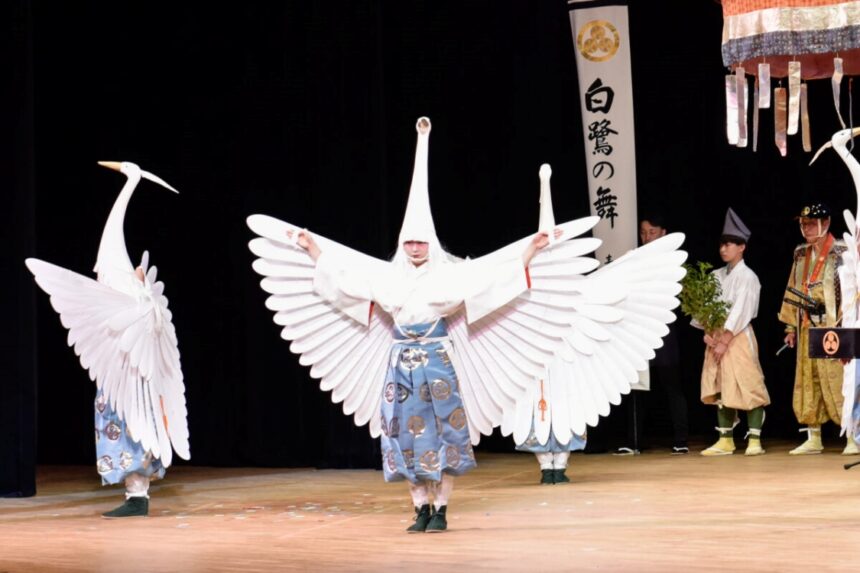
First up was the Sagimai (heron dance) performed by the Sensoji Dance Preservation Society’s Shirasagimai Executive Committee (Sensoji, Taito-ku, Tokyo).
The history of the Sagimai originates from the Gion Festival at Yasaka Shrine in Kyoto, where it has been handed down for 1,100 years as a means to ward off evil spirits. The Sagimai of Sensoji Temple is a restoration of the Sagimai of the Gion Festival in Kyoto, based on the Sagimai of the Gion Festival in Kyoto, as a commemorative event of the Tokyo Centennial by the Asakusa Tourist Federation in 1968.
It is composed of a large umbrella, warriors, stick wielders, bait makers, egrets, musicians, guardian children, and others. The atmosphere was like stepping back in time, and I felt as if I was watching an epic drama that recreated the Heian period.
The heron dance has a male and a female.
In the male, the beak is black and the mouth is open, and the male seems to be screaming. There is a blue string attached to the wings. In contrast, the female has a golden beak and a closed mouth. Their wings have red cords.
This dance seems to express the affection between the male and female.
Also, the scene of the herons eating food was very realistic. They were eating food scattered in a flurry. As the name suggests, this dance seemed to reproduce the appearance of a real heron.
Waving a gohei (sacred staff)! Hanabatake Owashi Shrine Lion Dance
The next performance was a lion dance by the Hanahata Otori Shrine Lion Dance Preservation Society (Adachi-ku). It is said that this lion dance was originally started in the mid-Edo period (Genroku era) to exorcise plague and disease, and is believed to be a prayer for the eradication of bad luck, a good harvest, and rain-making.
The lion dance is characterized by the fact that it is a three-shishimai (head lion) dance, in which three lions dance together. There are three roles: the large lion with horns at the base (the eldest), the middle lion with twisted horns (played by Jiro), and the kaka lion without horns but only with beads (played by the mother).
The lion’s head weighs two to three kilograms and has expensive wings attached to it. It also has a drum, which is beaten while dancing, making it quite a hard dance.
The name of the performance is “higakari,” which is said to be a variation of the word “gohegakari. The lion was seen approaching the bow with the gohei attached, as if it were sucking on the bow.
It was also impressive to see the lions taking a bow and waving it like a mint wielded by a Shinto priest to purge evil spirits. Although they looked like beasts in both movement and form, these somewhat human gestures were also seen, and I found such gestures fascinating.
Originally, the dance was passed down only to the eldest son, but now, due to a shortage of bearers, men and women from the second son onward are becoming involved as bearers of this art.
Kogochi-Kashima Dance, which connects the village even if the village sinks
Next was the Kashima Odori dance performed by the Ogouchi Kashima Odori Preservation Society (Okutama Town), one of the 41 dances included in the UNESCO Intangible Cultural Heritage list this year. The origin of this dance is not known, but it retains elements of old style dances such as Kabuki Odori and Nenbutsu Odori from the early Edo period.
Originally, it was a folk performing art passed down through the three villages of Hisashi, Kukizawa, and Minami in the former Ogawachi Village, but when the Ogawachi Dam was constructed in 1951, the village held a ceremony to dissolve the village, and most of the area was submerged in the dam. In an attempt to create an opportunity for people who had relocated to the new location to somehow get together, a Kashima Odori preservation society was established.
The village disappeared when the dam was built, but the dance continues to be carried on and is listed as a UNESCO Intangible Cultural Heritage. It seems that even though the land is gone, the sense of hometown still remains.
The four songs performed this time were Kokiriko, Tsuki wa Hachiman, Sankororin, and Sakuragawa. The lyrics of the songs seem to be mixed with lines from songs in Kyoto, and one can sense the connection with Kyoto.
All the dancers are male, but their faces are painted white and they wear furisode (long-sleeved kimono). The sound of the flutes and drums is very light, and the headdresses are very elaborate and gorgeous.
In the final performance, the artist held a “cherry blossom scooping net” in his hand. The shape of the net looked somewhat like a Tanabata decoration, giving the audience a sense of the festive atmosphere of the festival.
While their activities have been expanding since their inclusion in UNESCO’s Intangible Cultural Heritage list, the number of dancers has been decreasing, and they sometimes have to decline performances. In such a situation, children came to practice last summer and are now practicing, which seems to give momentum to the future succession of the dance.
A sense of unity at the venue! Cherry Blossom Wind Eisa Ryukyu Windmill
The final performance is an eisa of Okinawan origin. The name of the group is “Oukaja Eisa Ryukyu Kazegama” (Ginowan City and Machida City, Okinawa Prefecture), and they are based at J. F. Oberlin University. Since photography was not allowed this time, I would like to look back without images of the dance.
Eisa is the mainland equivalent of Bon Odori, and is said to have originated in the early 17th century as a Buddhist prayer song. I was impressed by the words of one of the performers before the performance: “The charm of eisa is that it gives a sense of unity. In fact, there were times when the performers encouraged the audience to clap and wave their hands, and the barrier between the stage and the audience disappeared, giving the audience a sense of oneness like at a live performance.
The performance structure was not complicated, and there was a sense of exhilaration and youthfulness that directly conveyed the emotion and the dancers’ way of life. There were many young dancers, and I felt that the dance was easily accessible to modern sensibilities. The calls and shouts were also very lively.
Tokyo is a place where you can see the nation’s furyu odori and folk performing arts.
Speaking of Tokyo, its central area is lined with tall buildings, and there are many areas where local communities are not active. Even so, I was again surprised to find that so many unique folk performing arts are being handed down in various places.
The space of the Shinjuku Bunka Center was splendidly built and the number of spectators was very large. There are many spaces where folk performing arts can be gathered in Tokyo, and each of them has its own attractive points.
Tracing the origins of these performing arts led me to Kyoto, Okinawa, and other places in Japan, and I felt as if I were on a simple trip in a short time. Wind Dance exists throughout Japan, and many people may feel compelled to visit it in the wake of its inclusion on UNESCO’s Intangible Cultural Heritage List. For Tokyoites, I realized once again that there are places where they can casually enjoy folk performing arts without having to venture out of their way.