

Column: Don’t call me the landlady!sodJapanese clothingclothingsilk goods
Hello.
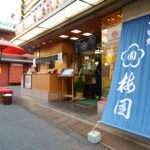
We are back to the days before Corona when we had 3 to 5 groups of overseas guests at Dingoya every day.
Thankfully, there are many luxury hotels nearby, such as the Okura Hotel and the Andaz Tokyo, which may be the reason why there are so many tourists from South America and Europe at Dingko Ya.
The other day, I was asked the same question by a father and son from Chile and a family from France, and received the same response, which made me think again about kimono = silk = natural material in Japan.
Respect for Japanese silk taught by foreign customers
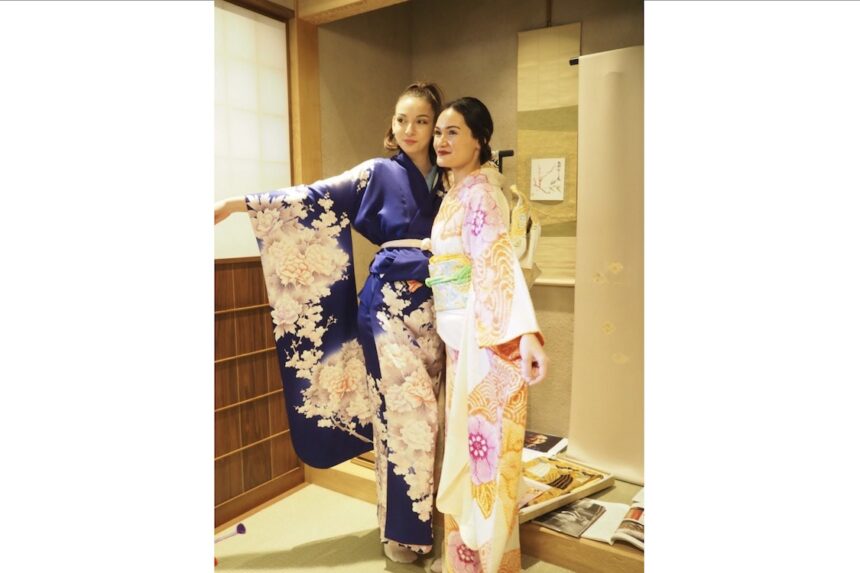
Not only them, but also other foreigners who come into the store always point to the mannequins (one man and one woman) wearing kimonos in the store, and the first thing they say is “What is this kimono made of?
What is this kimono made of?
(What is this kimono made of ?).
The majority of kimonos are made of silk, but today, kimonos are made of wool, linen, cotton, polyester, and many other materials.
Among them, polyester kimonos can be washed at home, so they are very popular among young people because they can be worn casually without worrying about rain, sweat, or dust, not to mention during tea ceremonies and kimono dressing practices.
Unlike in the past, the technology of recent polyester kimonos has advanced, and the comfort of wearing them seems to have improved considerably. We, as professionals, have always had the feeling that polyester kimono, which is more convenient than silk, has gained a position as one of the modern kimono.
Even so, when I recommend a tailored yukata (I thought it would be difficult to put on) or something made of polyester to people from …… other countries, they all say “No Thank you” (sweat), not only the people from Chile and France this time. When I asked them why, they replied, “Because we don’t have any japanese clothes.
When we asked them why, they said, “Japanese silk please! and …….
Even though I explained to them that silk kimonos are not washable, they still said “Of course”. There are some who say “Cotton is OK,” but anyway, the amount of dislike for kimonos and yukata made of synthetic fibers is tremendous among foreign people.
They have a spirit of respect for Japanese natural materials, not only for formal wear such as dresses, but also for everyday wear such as silk! Amazing!
Dingbo-ya is a specialty store that handles a lot of daily wear.
Of course, silk exists overseas as well.
However, I realized that their respect for the quality of “Japanese silk,” which became the center of Japanese exports in the past due to the Meiji government’s policy of wealth and military might, has not changed over time.
As an aside,
The size of the silkworms themselves, which grow on mulberry trees in Japan, is also different from that of their foreign counterparts.
Like the Japanese, they are small in size and produce delicate threads. Because of their small size, they are unable to produce a large amount of raw silk, which is why they are so precious.
On the other hand, how do we Japanese view Japanese silk?
In the old days, Japanese people counted one or two silkworms, which produced silk, in the same way as domestic animals such as cows and pigs, even though they were insects. The silkworms were carefully nurtured in the attic of each house by feeding them with mulberry leaves, just as if they were growing rice.
However, nowadays, with the easy availability of recycled kimonos and other items on the Internet, I feel that we ourselves have devalued the value of silk.
The spirit of the SDGs nurtured in the Japanese people, whose costume is the silk kimono
Unlike clothes, which are made by cutting out a pattern, a kimono is made by sewing almost all of the fabric from a 12-meter-long “hanmono,” without discarding any of the fabric, into one piece. Therefore, even if the sleeves, collar, body, and other parts of a kimono are cut out and made into a kimono, if, for example, the kimono becomes stained or fat and needs to be resized, it can be returned to the original piece of cloth and washed or “washed” or re-tailored. When a kimono is re-tailored, it has a different feel and texture, as if the silkworms have breathed life back into it.
In the past, Japanese people used “silk” kimonos, even after they were no longer worn as kimonos, to fulfill their missions without wasting them, from haori to obi, futon covers, nose coils, and finally to hataki (a traditional Japanese hataki).
The spirit of the SDGs was inherent in the Japanese people, who had the silk kimono as a costume.
Thankfully, our guests from abroad have taught us a respect for “silkworms” that we Japanese had forgotten.
Thank you for reading this article.
Eri Kobayashi
6th generation head of the Dingoya family
This article was written by…
She is the sixth generation of “Choukoya,” a long-established kimono store founded in Kansei 10, which suddenly appears on the first floor of the Toranomon Hills Business Tower. 2016, she decided to take over her husband’s business, a kimono shop, from a completely different industry such as ORIX Group. Kimono dresser and kimono personal color analyst. She conveys “kimonos that will last for the next generation” that are not bound by common sense or stereotypes, and is a permanent board member of the Hyakunenkai, an association of long-established kimono shops in Shiba from 2020.
Her hobbies are “dressing and coordinating others” and solo camping.Dingoya Home PageDingoya Instagram