

Nihonbashi (bridge)brushpaint brush
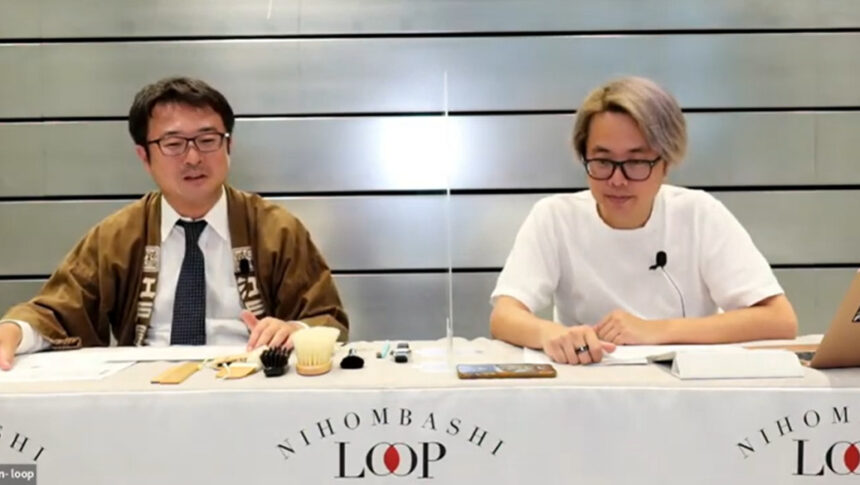
Brushes and brushes are the behind-the-scenes helpers that support our daily lives in a variety of applications, from household goods and lacquerware to cleaning and cosmetics. Edoya, founded in 1718, has been making such brushes for many years. We interview Yasuo Hamada, the 13th generation head of the company, about his passion and craftsmanship for brushes and paintbrushes.
〜first partContinued from …
Various uses for brushes, from hair treatments and cosmetics to industrial applications
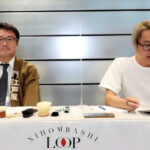
Hayashi: Now, this is a brush that looks familiar.
Hamada:This is a pig-bristle hairbrush for combing hair.
Forest:Why is pig hair used?
It is stiff and reaches down to the skin, repeatedly combing excess oil from the scalp and carrying it to the ends of the hair, making the whole area shiny. Since dozens of hairs are planted in a single hole, the hair passes through this space and strokes the cuticle, which makes it shiny.
How should these brushes be cared for?
There are a lot of bristles, so a lot of dust gets entangled in the tips of the bristles. That’s where the brush brush, “Brush Cleaner,” comes in. The best way to prolong the life of your brushes is to brush off the dust here while it is still on the top.
Hayashi: It seems like it would be a good idea to remove them frequently after use.
Yes. I think it will last longer if you remove it as often as possible and do not wash it with water.
They say it’s not good to wash human hair too much, too. And what is the thin handle here?
This is a top quality cosmetic brush made of squirrel hair.
Squirrel hair is sometimes used in calligraphy brushes.
It is very soft and delicate, and is sometimes used to remove gold powder that decorates the surface of maki-e lacquerware. When used in cosmetics, people say, “The luster is different” and “It gives brightness.
This is a must-see for everyone who will be making up. Was it also used by the people of Edo Castle?
I think the shape was the one I mentioned earlier, for white powder (laughs).
The green brush there is also very different from what we have seen so far.
This is an industrial brush. These brushes are used, for example, in machines that wash potatoes and other vegetables.
So it is used not only in BtoC (for consumers) but also in BtoB (for business use). I didn’t realize that the old technology is used in such places as well.
Because brushes are a part of our daily lives, they are used in various parts of our lives. Even for industrial brushes, we have devised ways to meet customer orders, such as placing bristles sparsely on one half of the brush and densely on the other half.
What is the secret of how the Edoya brand has continued for over 300 years?
There are so many different types of Edoya’s brands. What is the secret behind their longevity?
Hamada: I believe that our company’s brand has been established through our repeated efforts to meet customer needs and to build trust.
Do you have customers whose parents and children have loved the Edoya brand for generations?
Yes, that’s right. I have also heard that your son inherited a clothes brush that his father used.
It lasts that long, doesn’t it? It’s wonderful that you can pass on the same favorite item from generation to generation in that way.
Paying fair compensation to craftspeople to carry on the tradition
Could you give a message to our readers, Mr. Hamada?
We would like to convey that our company values not only customer satisfaction, but also the training of craftsmen who are responsible for their skills and paying them just compensation.
After all, if you don’t have something to go on, there will be no successors.
Hamada: Even if we ask people to continue their traditions with gusto, if they cannot make a living, the tradition will cease to exist. It is a difficult task.
One person said, “I want to make the world a place where craftsmen are popular. Without such clear advantages, I think it would be difficult to find people who would say, “I want to do it! I feel that without such clear advantages, it would be difficult to find people who want to do it.
In particular, since we deal with “tools” rather than “artwork,” it was more difficult for our work to see the light of day. We are working on reforms to change this situation and to make it possible for people to continue working with us as much as possible.
I think business succession is a common issue for traditional crafts. Are there any difficulties in terms of raw materials?
Our company is also able to acquire the quantity of materials itself through imports, but there are issues in terms of quality, and what used to be 80% or half usable in the past is now only 30% usable in some cases.
Hayashi: The existence of such issues has not yet been fully communicated to the public. We would be happy if we could spread the word in this way. I have heard some long-established stores say, “We have to be pretty skinny. I have the impression that long-established shops are very cautious in this regard.
It is true that it is difficult to raise prices even when the price of raw materials increases. We want to provide good products that are as affordable as possible.
If there are options in the future, such as “art,” “industrial products,” and “traditional crafts” in between, which direction do you aim for at Edoya?
Rather than being a work of art, our company wants to be a merchant that offers good tools to be used at a fair price.
There are not many tool shops in Japan that are particular about their brushes and brushes. Edoya’s discernment is uniquely valuable.
We would like to continue to make good products at appropriate prices and pay our craftsmen appropriately. We look forward to your continued patronage.
From glue brushes, bristles, and clothes brushes to industrial brushes, Edoya’s products are made with a craftsman’s dedication that sometimes seems to be beyond profitability. This is why Yasuo Hamada, the 13th generation owner of Edoya, is committed to improving the treatment of his craftspeople, and to making the store a place where they are valued.
*If you would like to see this dialogue on video.here (place close to the speaker or where the speaker is)