

Manju, Monaka, Daifuku, etc.: Manners for Eating Wagashi without Worrying about Public Appearances Anymore
rice cookiesteamed yeast bun with fillingsweet bean jellyskewered dumplings on a skewerManners of WagashiHow to eat Wagashiswallowing a great amount of tea or medicinedried confectionarymidstrice cakes wrapped in oak leavesrice cake with bean paste wrapped in a preserved cherry leaffresh Western sweets (usu. containing cream or fruit, e.g. sponge cake, pie)kneaded doughgeese alighting
When you are served Japanese confectionery at a place you are visiting, can you eat it elegantly and beautifully without embarrassment? There are a wide variety of wagashi, from freshly cut sweets to dumplings, monaka, rice crackers, and more. In this issue, etiquette consultant Hiroko Nishide teaches us how to eat such wagashi.
Let’s learn how to properly use kuromoji and kaishi, essential for wagashi.
First, the most important items when receiving wagashi are kuromoji and kaishi. The kuromoji is a toothpick-like object that accompanies the wagashi. It was originally called “Kuromoji” or “Kuromoji toothpick” in the tea ceremony because it was made by shaving “Kuromoji,” a tree of the camphoraceae family. It was called “Kuromonji” or “Kuromonji toothpick” in the tea ceremony. It is held with the thumb, index, and middle fingers of the right hand, with the ring and little fingers just supporting it. When cutting, hold the plate lightly with the left hand and cut into bite-sized pieces.
If there is no black letter on the plate, it means “please eat with your hands.
Kaigami, on the other hand, is used in tea ceremonies (tea ceremony).
Kaishi is a piece of Japanese paper folded in two and kept in the pocket, hence the name “kaishi. Kaishi is a convenient item that can be used as a receptacle for sweets, as it is used at tea ceremonies, to wipe the mouth or black letters after receiving sweets, or as a handkerchief, memo paper, or wrapping paper. When using kaigami as a saucer, it is good manners to fold it in half and take it home when you are finished with it. We recommend that you keep some in your bag as an adult etiquette item.
How to eat fresh sweets such as kneaded dough, yokan, manju, etc.
We were taught how to eat fresh sweets such as beautiful seasonal nerikiri, yokans, manjus, etc., which are served with kuromoji.
You may hold the kuromoji in your dominant hand and lightly place your non-dominant hand on the plate, or if it is a small plate, you may hold it so that it does not spill. You are asked to cut a bite-size piece of the blackletter from the left side in front of you and stick the blackletter in the blackletter so that the cross section will not be visible to the other person. If the tables are not far apart, you do not need to hold the plate, but be careful not to use your hand as a saucer. It is best to remember that it is not your hands that can be used as a saucer, but a piece of kaishi paper.
The best is served with a piece of Kaigami (Japanese tea paper). Break it on a plate and eat it.
With its crispy skin, monaka is a food that is difficult to eat with elegance.
If you are worried about the skin falling off, you can bring it to your mouth with a piece of Kaigami (Japanese paper used for tea ceremony). You can break it into bite-sized pieces on a plate, but it may be difficult to do so if there are chestnuts or other ingredients inside. Keep in mind that the skin will naturally spill out when you break it. Be careful not to use your free hand to catch the peel as you are eating. Please do not do this. In Japanese cuisine, small plates can be lifted, so if you do not have kaishi paper and are worried about spills such as peels, you may lift the plate and eat.
For skewered dumplings, don’t worry about dumplings stuck to the skewer.
Although the skewered dumplings are made to be easily eaten with one hand, they are also a food that is difficult to eat the last piece of normally eaten dumpling.
If the skewered dumplings are accompanied by a black letter, the beautiful way to eat them is to use the black letter to pull the dumpling off the skewer, then stick the pulled dumpling into the black letter and eat it. Of course, it is not against manners to eat the dumplings directly from the skewer. It is best to follow your surroundings as to how you eat the dumplings. If the dumplings get stuck on the skewer, it is easy to get concerned and try to eat them neatly, but it is okay not to be overly concerned because that is the way the food was originally made. If you are concerned about the appearance of the skewer after you have finished eating it, you can cover it with a piece of kaishi paper.
Daifuku is beautifully eaten with Kaigami
Daifuku is another Japanese confectionery that is difficult to eat elegantly, as the powder around it tends to fall off.
It is not against manners to bite into daifuku, but if you do, you are more likely to get powder around your mouth. However, if you do so, there is a high possibility that you will get some of the powder around your mouth. If you are concerned about this, it is safer to tear the Daifuku into bite-sized pieces and eat them. If you are concerned about powder sticking to your hands, wrap the Daifuku in a piece of kaishi paper and hold it to prevent powder from sticking to your hands.
For Kashiwa Mochi and Sakura Mochi, eating the leaves or not is up to the individual’s preference.
Kashiwa Mochi and Sakura Mochi are wrapped in leaves. I am wondering if the leaves are eaten together when eating them. Generally speaking, many people eat the leaves of sakura-mochi and not the leaves of kashiwa-mochi, but is there a correct answer?
The original purpose of both is to enjoy the fragrance of the leaves, so it is up to the individual to decide whether or not to eat the leaves. However, the leaves of Kashiwa Mochi are hard, stringy, and bitter, so eating them is generally not recommended. In addition to adding aroma, the leaves also have antibacterial properties and prevent the rice cake from drying out. Since each baker has different feelings about sakura mochi, it is recommended to ask the shopkeeper to show you how to eat it when you buy it. To eat it, since it is wrapped in leaves, you can hold it in your hand and eat it as it is. If it is served with black letters at a restaurant, use black letters. If you leave the leaves, fold them into about two folds instead of leaving them spread out, so they look more beautiful”.
Dried confections such as rakugan and rice crackers are served in bite-size portions
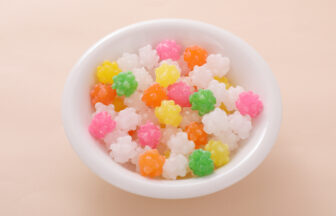
Higashi is a general term for dry Japanese confections with little water content, also written as “dried confectionery. Higashi includes such sweets as rakugan, kompeito, senbei, yatsuhashi, and amanatto (sweet bean curd). Basically, dried confections are to be eaten with the hands. Smaller ones can be put straight into the mouth. For larger ones, break them into bite-sized pieces and eat them with your hands.
The important thing is what to do when your hands get dirty. If you have a hand towel or something to wipe your hands with, that’s fine, but if you don’t have a hand towel or wet wipes, it’s important to prepare them in advance and carry them with you.
Take your time to enjoy the beauty of Japanese confectionery and the thoughts of the craftsmen.
In fact, wagashi is made through many processes. However, there is no “absolute rule” on how to eat them. Many wagashi express the beauty of the four seasons, and there is also the pleasure of savoring them while appreciating them carefully. It would make me happy if I could spend a rich time with the person with whom I share a Japanese confectionary while appreciating its profound charms.
When in doubt about how to eat not only wagashi but also other types of confectionery, it is important to adapt to the person you are eating it with.
When you ask a wagashi artisan, he or she will tell you, ‘As long as it tastes good, it doesn’t matter what way you eat it. What is important is to match the eating style of the people around you. If you eat with a piece of paper while others eat with their hands, you will embarrass them. When in doubt, eat the same way as the person you are eating with, and you will shorten the distance between you and the person you are eating with,” he says.
Interview and text by Yoshiko Tezuka
Illustrations by Tomoko Shinozuka
Hiroko Nishidethree
We spoke with…
Manner consultant. He has taught manners to actors, athletes, and celebrities for NHK historical dramas, movies, and commercials, and has also covered the manners of the Imperial Family. She has also supervised and written more than 100 books, which have sold more than 1 million copies. The know-how that Ms. Nishide imparts can be easily incorporated into daily life and work, and is popular for its highly convincing content.
For more information about Ms. Hiroko Nishide, please visitOfficial Siteand,InstagramThe information is updated as needed on the following website.