

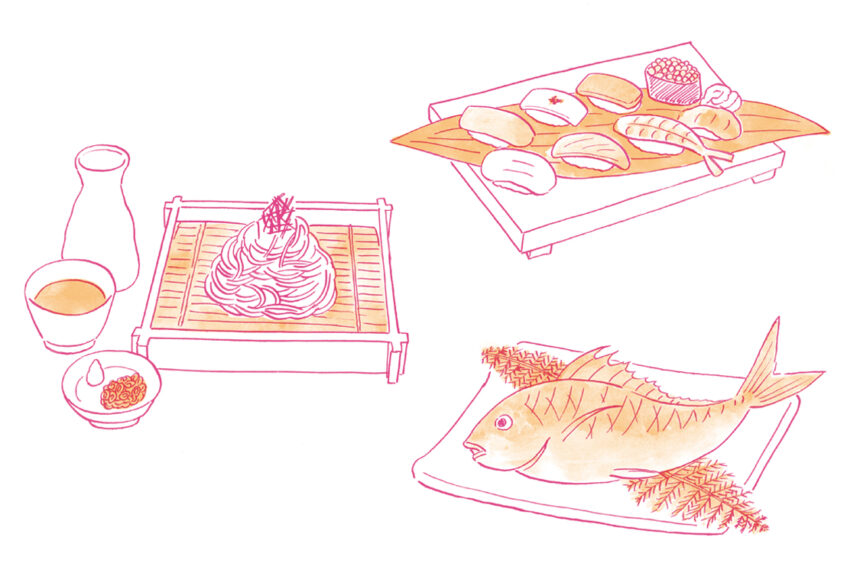
Japanese Food Manners You Should Know. Sashimi, Sushi, Tempura, Yakimono…… explained by cuisine.
sashimicloseJapanese-style mealtempurasushiJapanese cookingsoup ingredients (esp. seafood, tofu, egg)potteryway of eatingfish
Omotenashi, or the spirit of hospitality, is a concept that Japanese chefs cherish. Japanese people want to enjoy the dishes, presentation, and serving utensils that reflect this spirit in a stylish manner. In this issue, we will introduce how to eat six typical Japanese dishes, from sashimi to soba (buckwheat noodles), as well as the order and manner of eating them.
Sashimi: Start with white fish with a light flavor, and gradually move on to fatty, richly flavored fish.
First of all, let’s talk about the order of eating sashimi. I am not sure where to start. Is there a correct order?
In general, the left side of the sashimi plate is the light white meat, and from there, in a clockwise direction, the more flavorful sashimi are gradually arranged. In the case of sashimi, start with the white meat and eat the fatty ones gradually in a clockwise direction,” says Nishide.
There is also a delicious way to enjoy wasabi and other condiments.
To take advantage of their flavor, wasabi is not dissolved in soy sauce, but is placed on top of the fillet in small amounts and dipped in soy sauce. On the other hand, the yakumi (condiments) such as hujiso are added to the soy sauce. However, it is smart to add a small amount of soy sauce to the fillet in order to bring out the flavor of the ingredients.
There is also a trick to the beautiful way of eating sashimi. The basic rule of sashimi is to eat it in one bite,” he says.
If you are worried about dripping soy sauce, you can hold a small plate containing soy sauce while you eat. Basically, sashimi is eaten in one bite. For sashimi that is long, such as white meat and toro (fatty tuna), it is easier to eat in one bite if you fold it in two.
Mr. Nishide also says that one of the manners is to be considerate of the chefs.
Each chef has his or her own idea of how to serve the sashimi. Some cooks serve white meat, red meat, white meat, and red meat alternately, from left to right. The most important thing is to be grateful for the ingredients and the chef, and to be thankful for the ingredients and the chef.
Sushi: Sashimi, nigiri, maki, egg, and soup, in that order.
We would like to encourage you to eat sushi in a way that is consistent with the creator’s wishes. When you sit down at the counter of a sushi restaurant, pay attention to the order of your order.
First, you should have sashimi (tsumami) in order to taste the ingredients. Next, enjoy the taste of the sushi and the sashimi with the nigiri, followed by the maki, and then the tamago (egg) made with the restaurant’s special soup stock. Finally, finish off with a bowl of soup to complete the meal.
As with the sashimi, start with the lighter cuts of fish, such as white meat and shellfish, and move on to the more flavorful cuts, such as tuna and other red meat, toro (fatty tuna), and unagi (eel). Another question is whether to eat sushi with your hands or with chopsticks.
Sushi was originally eaten with hands. Eating with your hands is more stable than eating with chopsticks and has the advantage that it is less likely to spill. When eating with your hands, you hold both sides of the sushi rice with your thumb and middle finger, place your index finger lightly on the top of the sushi piece, and dip the tip of the sushi piece in a little soy sauce.
When eating with chopsticks, hold the fish at a slight angle with the chopsticks and dip the tip of the fish in soy sauce. To prevent the soy sauce from dripping, hold a small plate of otesho (salt) or kaigami (paper) in your other hand and eat the fish in one bite. If it is difficult to eat the sushi in one bite, finish it without putting it back on the plate. For gunkanmaki, dip a little bit of soy sauce on the bottom part of the nori and eat it in one bite. There is another way to dip the gari in soy sauce with chopsticks and apply soy sauce to the gunkan material, which is also not wrong. As for manners, it is important to match the eating style of the people present.”
If you are careful about the order in which you eat them and the decorative leaves, you can enjoy them beautifully!
We tend to worry about the bones in grilled food and find it difficult to eat. We asked him about beautiful manners until the end of the meal.
If a grilled fish has hajikami (ginger) or leaves attached to it, place them at the back of the plate and cut the fish into bite-sized pieces from the left side. For fish with a tail head, first remove all fins except the tail fin with chopsticks and eat the upper part of the fish from left to right. Then, remove the meat from the middle bone, lift up the head, middle bone, and tail fin and place them at the back of the plate, and eat the lower part of the fish from left to right. The fish is not turned inside out.
This may seem a little difficult, but what should you do if things go wrong?
If there are any bones left in the meat, remove them and place them at the back of the plate. If the bones remain in the meat, remove them and place them in the back of the plate. Also, if you put the bones in your mouth, don’t panic. It is dangerous if it sticks in your mouth, so be careful not to damage the inside of your mouth and take the bones out. Cover your mouth with a piece of kaigami or your hand and pick up the bone with chopsticks. If it is difficult to do so, put the bone out on a piece of kaishi paper with your face downwards at an angle so that others cannot see it. If you do not have a piece of kaishi, you must cover your mouth with your hand and use your free hand to serve it. In an occasion like this, please prioritize safety over appearance so as not to damage the oral cavity.”
And finally, it is time to finish eating. Please pay attention to what is on your plate.
Place the fins, bones, and skin together on the far right or left side of the plate. You may break the bones into small pieces if you can. Place a piece of kaishi paper or a decorative leaf on top of them to hide them. Hajikami, by the way, is eaten last to refresh the palate after the fish is finished.
Bowl】Take your time to appreciate the dish, and then enjoy it from the broth.
Bowls are called “the main dish of kaiseki cuisine” or “the flower of kaiseki cuisine. It is said that the chef’s skill can be seen in this one dish, and the seasonal ingredients and dishes are chosen with confidence. Therefore, it seems to be good manners to enjoy the dish in addition to its flavor.
Let’s savor each bowl of food to the fullest with our senses of sight, smell, and taste. Appreciate the ingredients before eating, and drink from the broth in order to enjoy the aroma of the soup. Then, take turns eating the soup and the ingredients in a well-balanced manner.”
Next, we will explain how to handle the lid of the bowl, which is often a confusing part of the procedure.
Hold the lid of the bowl from the side with the hand opposite to your dominant hand, and with your dominant hand hold the bottom of the lid from the side (the protruding part at the top of the lid). Then, with the back of the lid facing you, drop a drop into the bowl. Next, pass over the bowl toward yourself and hold it with both hands, with the hand opposite to your dominant hand. Continue to place it on the right outer side of the oshiki (rimmed tray) with the bottom of the thread down. Note that the bowl is not supposed to be placed inside the oshiki, as this would damage it. However, if there is no space outside the oshiki, it should be placed inside the oshiki. Some people believe that the bottom of the threads should be placed on the top because of the possibility of scratching the bottom of the threads, but today the most common practice is to place the bottom of the threads on the bottom. When finished eating, hold the lid with both hands and place the lid back on as in its original form. Be careful not to place the back of the lid up at this point.”
I now understand how to handle the lid of the bowl, which I always wondered about.
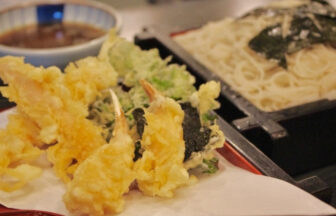
Tempura] Take a bite with chopsticks before eating.
When you see tempura arranged on a plate, you may be at a loss as to where to start eating. In such a case, it is all right to eat them in order according to how they are arranged, such as from the top of the plate or from the front to the back. Also, the basic rule of eating tempura is to cut it into bite-sized pieces with chopsticks and dip them in tempura sauce or salt to taste.
If the tempura is too hard to cut with chopsticks, chew it off. However, it is more beautiful to refrain from putting it back on the plate once you have put it in your mouth, as this will show your teeth marks to others. In that case, you should either eat the food without putting it back on the plate, or if you want to put it back on the plate, there is a technique called “shinobi-nori,” which means to remove the tooth marks. This is done by biting off a small piece on either side of the tooth marks, like a squirrel, to straighten them out.
It is also important to know the etiquette when eating with tempura sauce and salt.
When eating with ten-tsuyu, hold the bowl of ten-tsuyu and adjust the amount to your liking. When eating with tentsuyu, hold the bowl of tentsuyu and adjust the amount of tentsuyu to your liking. It is part of good eating etiquette to taste the flavor of the food itself. If too much tsuyu is dipped, the batter will absorb the water and lose its freshly fried flavor. If you do not lift the bowl of ten-tsuyu, use a small plate or a piece of kaishi paper as a saucer. Be careful not to use a hand dish to perform this gesture, as your hands will get dirty if food is spilled on your hands.
On the other hand, if you use salt, you may pick up as much as you need with your fingers, place it on the left side of the plate, and eat it while applying an appropriate amount to the tempura, or you may sprinkle it directly on the tempura. The latter is recommended as it allows you to eat the food evenly and crisply without getting too much on one spot.”
It is clear that being aware of good manners will also lead to a more enjoyable meal.
Soba: The first bite is to taste only the soba.
Finally, there is soba, which we have many opportunities to eat on a daily basis. Soba also has its own way of eating, which was created in consideration of its creator.
The official way to eat soba is to taste the soba itself without dipping it in anything, out of consideration for its creator. The second bite is to pour about a quarter of the sauce into a buckwheat choko and dip about a third of the buckwheat into the sauce. After that, add one condiment at a time, starting with the least flavorful, to the soba choko, checking each flavor as you enjoy each one. Wasabi should not be dissolved in the dipping sauce, but rather a small amount should be dipped in the chopsticks and eaten with the soba to avoid contaminating the dipping sauce. Be careful not to put too much wasabi on the soba so that you can fully enjoy the taste and aroma of the soba.
Another important point to keep in mind is how to slurp up soba.
Basically, soba should be eaten in one gulp, not chewed up halfway through. Basically, you should eat the soba in one gulp, not chew it all up. If the sauce gets too thin, pour some more to make it thicker to your liking.
It is said that “eating soba with noise is part of its taste,” but do not slurp too much so as not to make too much noise, which may cause discomfort to those around you. Eating quietly and without making noise is common etiquette for all dishes. Foreigners in particular do not like to slurp their food, so be careful. Finally, add soba-yu (buckwheat water) to the dipping sauce to make it as thick as you like. Sobayu contains vitamins B1 and B2, as well as dietary fiber, making it rich in nutrients.
Gentle consideration for the person you are attending, yourself, and the vessel.
Eating is a matter of life and health, so it is important to chew properly and avoid straining the stomach and internal organs before focusing on manners and etiquette. I often say, ‘Manners are about putting yourself in the other person’s shoes,’ and this other person includes yourself. If you are not in good condition, you cannot be kind to others and you cannot be considerate. Manners are there to make both the other person and yourself happy, so please take care of yourself as you take care of the other person.
When we think of manners, we usually think of the way we behave, but Mr. Nishide says that the true manner is to be considerate of others, yourself, and even things. This also applies to the manner in which you eat, which leads to the comfort of those around you. First of all, we should aim to enjoy a delicious meal while being kind to ourselves.
Interview and text by Yoshiko Tezuka
Illustration by Tomoko Shinozuka
Hiroko Nishidethree
We spoke with…
Manner consultant. He has taught manners to actors, athletes, and celebrities for NHK historical dramas, movies, and commercials, and has also covered the manners of the Imperial Family. She has also supervised and written more than 100 books, which have sold more than 1 million copies. The know-how that Ms. Nishide imparts can be easily incorporated into daily life and work, and is popular for its highly convincing content.
For more information about Ms. Hiroko Nishide, please visitOfficial Siteand,InstagramThe information is updated as needed on the following website.