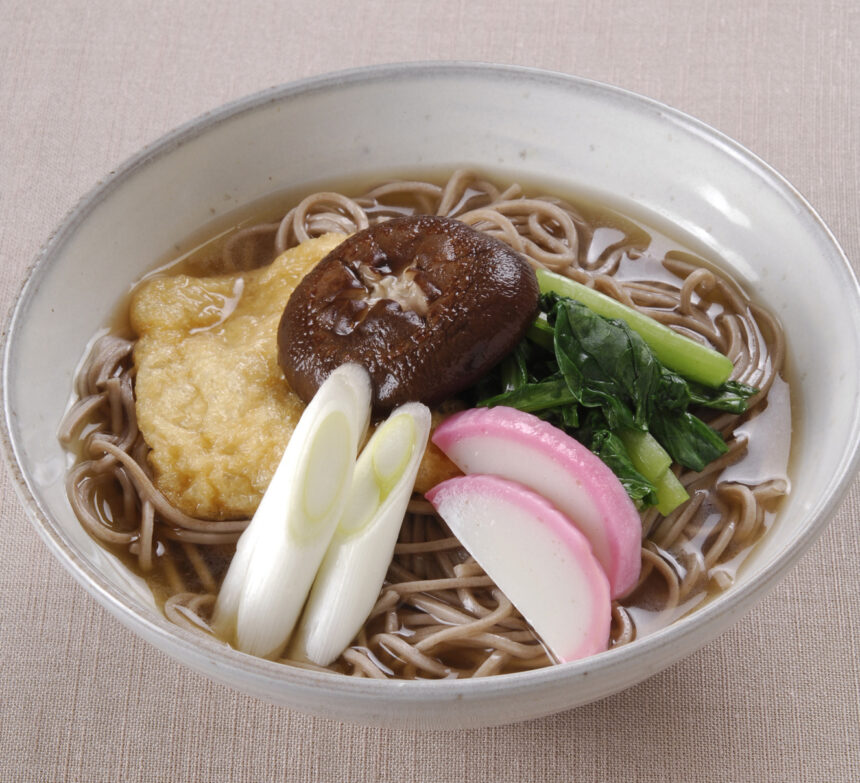
Where did okame soba originate? Ingredients used are also explained.

Soba/Udon

Where did okame soba originate? Ingredients used are also explained.(Okamesoba)

buckwheat noodles in hot brothold name of Tokyo

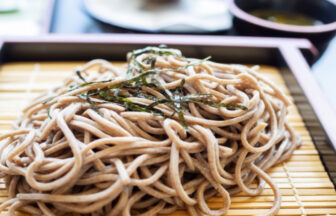
Kakesoba is a type of buckwheat noodle with an assortment of ingredients such as fish paste, shiitake mushrooms, and greens. It is said to have originated in the late Edo period (1603-1867) at a soba shop called “Ota-an” in Negishi, Taito-ku, Tokyo, and was so named because the ingredients were arranged to resemble the face of an otafuku (a type of fish). Yuba leaves tied in a butterfly shape are placed above the bowl to resemble hair or eyes, a salted matsutake mushroom is placed in the center like a nose, and two pieces of fish paste are placed on either side of the matsutake mushroom to resemble a face with a bulge at the bottom. Two pieces of fish paste are placed on either side of the matsutake mushrooms to form a swollen face. Mitsuba leaves and egg rolls are sometimes used to make the mouth and collar. Until before World War II, some restaurants placed nori (seaweed) under the yuba to emphasize the black hair. This dish shows Edo’s chic style of making a face that invites good fortune.
新着・おすすめ情報

  1. Japanese sweets in the form of long blocks (e.g. yokan, uiro)

  2. man’s stiff sash

  3. Manners for Late-Summer Greeting Cards in 2023: Common Sense to Know and Sample Cards for Different Recipients

  4. Tokyo Literature Walk] No.3: Waseda Area. Soseki Natsume and Waseda University, a journey tracing the scent of modern literature and culture

  5. Philosophical Hall Park (Araiyakushi, Tokyo)

  6. Eitaro Fuhonshop located at the foot of Nihonbashi Bridge. Traditional techniques and a desire to “create new wagashi

  7. The first “in-house work of a samurai”. Yoshinoya Shoten” has been lighting up the nights of Japan with Edo lanterns for 168 years.

  8. The ninth generation of a long-established soba restaurant teaches how to boil and taste truly delicious soba noodles

  9. The family motto is “Be a connoisseur. Gyokuho-Do” has continued to support the tea culture by handling tea utensils of the Unshu-Matsudaira and Omotesenke families.

  10. one-piece sash

  11. Shiobune Kannonji Temple (Ome, Tokyo)

  12. Kimono can be re-tailored and reused as a haori or obi. Kimono is the ultimate SDGs costume.

  13. Bodhi yeast mash starter

  14. A Walk in Edo with Old Maps] No.3: Once the Best Shopping Zone in Edo. Tracing the Traces of a Fish Market in Nihonbashi

  15. Ruins of Kira Residence (Honjo Matsuzaka-cho Park)