

You can do it yourself! How to Tie a Yukata Obi – Bunko Knot
How to tie an obipaper knotyukata (light cotton kimono worn in the summer or used as a bathrobe)
The bunko knot is one of the basic half-width obi knots with a cute yet dignified elegance.It can be arranged in a variety of ways, so let’s start by mastering the single letter bunko knot.
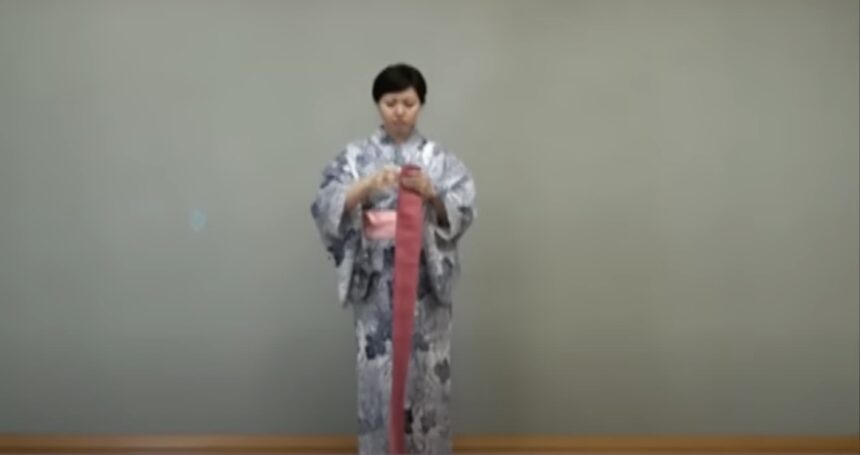
1: Fold one side of the strip in two from the middle to make it half as wide as it is.
2: From the half of the obi, take a length that does not fall over the shoulder (this is called “te”). If the obi fabric is thick, take a little longer.
3: Wrap the obi around the body. At this point, the obi on the side to be wrapped should be wrapped around the body in its original width, not in half the width of the “te” over the shoulders.
4: After wrapping two wraps around the body, hold the lower side of the obi by the sides and pull firmly downward at an angle to tighten the obi.
5: Fold the longer sash (this is called tare) inward from the side of the waist so that it forms a triangle.
6: When the “te” part is tied tightly vertically so that the “te” part is at the top, lower the “te” part down.
*At this point, place the knot on top of the obi so that the obi stands firm.
Finally, shape it so that it is not messy.
7: Fold the “tare” so that it is the same width as your waist when viewed from the front, creating a “hae”.
8: Make the center of the “spring” concave and make a mountain at the top and bottom.
9: Place the “hand” over the “spring”, wrap around the center of the “spring”, and wedge it under the “spring”.
*At this time, let the “spring” stand up and tie a knot as if lifting it up.
10: Fold the excess “te” and tuck the top into the obi.
11: Let’s shape the whole thing here.
12: Hold the top of the “spring” with the right hand and the lower side of the obi at the position next to the waist with the left hand.
13: While pulling in the belly, turn the obi back while shifting it to the right side, being careful not to expose the yukata. Finally, remove any wrinkles from the obi and you are finished.
Tokyo Tarothree
store that has been gone out of business