

Azabu, Akasaka, Roppongitemple elementary school (during the Edo period)Yuri Shikakusmall sweet bean jellytea-of-heaven (Mt. Fujiwara)hikingdried confectionaryfresh Western sweets (usu. containing cream or fruit, e.g. sponge cake, pie)sweet bean jelly
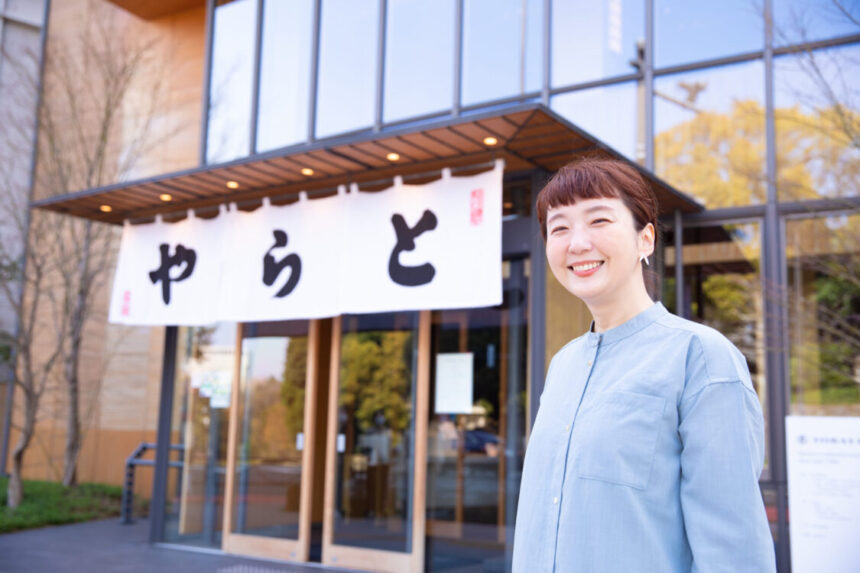
In this series of interviews, we ask celebrities from various fields to talk about their favorite long-established gems. In the third installment, Yuri Shikaku, who has popularized “mountain skirts” in Japan and introduced new ways to enjoy mountain climbing, especially among young women, visited the Akasaka branch of Toraya, which has been in business for about 500 years. She says that mountain climbing, which has an active image, and Japanese confectionery, which has a delicate impression, have a surprisingly “high affinity. We asked him about the appeal of mountain climbing, which is easy even for beginners, wagashi eaten in the mountains, and new ways to enjoy wagashi, all while enjoying wagashi at Toraya Caryo on the 3rd floor of Toraya’s Akasaka store.
Yuri Shikaku
Outdoor Style Creator
We spoke with…
She is the founder of the women’s mountaineering boom that popularized the term “mountain skirt. In addition to conveying the appeal of mountain hiking while enjoying nature in each of the four seasons, she gives lectures nationwide, writes, and plans and develops outdoor clothing and gear. She has written many books on mountain climbing that are friendly to beginners, including “12 Months of Mountain Climbing” (Yama-kei Publishers) and “One Step at a Time: An Introduction to Mountain Hiking” (Ei Publishing Co., Ltd.).
Shikaku-san’s Instagram ishere (place close to the speaker or where the speaker is)
Yuri Shikaku’s way of hiking in the mountains to get in touch with nature
In 2003, Shikaku visited Kamikochi in the Northern Alps in Nagano Prefecture, and since then, he has been fascinated by nature, which became the starting point for his mountain hiking.
My first visit to Kamikochi was for sightseeing, but I couldn’t forget the view I saw there. Until I actually went there, mountains were a distant part of the landscape, but when I walked there and saw the majestic mountain range, I felt as if I was surrounded by the great nature. I felt as if I were surrounded by nature. I felt a kind of longing to get a little closer to the mountains,” he said.
She started with an hour-long walk along a walking trail on a sunny day, and then increased the number of times she hiked one or two mountains each season, until she was hiking once or twice a week at the most.
She started hiking mountains not to climb summits or for the exhilaration of sport, but to get in touch with nature, and she also values the “snack time” between hikes.
Photo by Yuri Shikaku (Photo by Shotaro Kado)
“I cherish my snack time very much, eating my favorite Japanese sweets amidst the wonderful scenery and taking my portable coffee dripper with me to brew a cup of coffee. Among them, yokan and dried sweets (photo below: “Suiko” made of wasanbon sugar, 12 pieces, 1,296 yen) are my staples.”
These Japanese sweets are perfect for mountain climbing because they can be eaten while walking and are quickly absorbed as a source of energy. Many climbers have been taking yokan as a snack for a long time, and there are even yokan for sports for running and mountain climbing. I often bring Toraya’s ‘kogata yokan’ (small yokan, 292 yen) because I want to eat my favorite yokan if I am going to go to the trouble.
Mr. Shikaku brings several bottles of Toraya’s small yokan with him on a single mountain climbing trip.
Even though they are small, they contain a lot of energy, so I bring more to replenish my energy to make it to the end of the hike and as an emergency ration in case of an emergency. When I eat it in the mountains, I open the package and just grab it with one hand…. My hands don’t get dirty! This ease of eating is another attraction.
When hiking in the mountains, it is an ironclad rule to bring a larger amount of food (snacks and rice) for emergencies. In this sense, yokan is a perfect companion for hiking in the mountains.
Japanese Sweets” Spreading Across the Sea and in the Mountains
Among Toraya’s small yokan “Omokage”, Mr. Shikaku often picks up the seasonal packages that change from season to season. He also brings Toraya’s small yokan from Japan when he climbs mountains overseas.
When I am in the mountains overseas, I feel relieved to have a taste of Japan,” he says. When I stayed at a mountain lodge, I became friends with foreign hikers and we exchanged snacks, and I gave them a small yokan. I gave them a small yokan. I have a wonderful memory of being pleased to receive such a treat. The small size makes it easy to carry around, and it is resistant to temperature changes such as heat and cold, so it is convenient to keep for a long time.
Yokan has crossed oceans and become one of the communication tools in the mountains. Mr. Shikaku also says that he often chooses yokan that is larger than small yokan (Toraya calls it medium yokan or takebika yokan) as a souvenir for his hut owner.
When I gave yokan to the owner of the lodge, he could cut and eat it whenever he wanted, and if it was from the long-established Toraya, he could use it as a small treat when he welcomed a guest. When I visited a mountain lodge at the end of the year a few years ago, I remember bringing “Takane-gan,” yokan made in the shape of Mt. Fuji, which is available only in December every year and is perfect for New Year’s celebrations. Incidentally, I often stop by Toraya Gotemba store on my way home from mountain climbing or camping. I buy the Gotemba limited edition yokan “Shiki no Fuji” and have anmitsu (sweet bean jam) at Toraya Saryo. As a mountain lover, I was delighted to hear that Toraya’s main factory is located in Gotemba and that they make yokan using delicious Mt.
Fuji of the Four Seasons, Spring (1,944 yen) *Sold until late May
Wagashi I have come to love even more since I started climbing mountains.
Fuji in the Four Seasons” is a seasonal yokan featuring Mt. Fuji, which changes its appearance from season to season, such as in winter when it is covered with snow and tinged with sunset, and in spring when its green skirts spread out against a cherry blossom-colored background. In his book “12 Months of Mountain Climbing” (Yama-kei Publishers, Inc.), Shikaku introduces the seasonal charms of mountain climbing, and says that what he enjoys most is the “expression of the seasons.
Japanese mountains are not only beautiful at the height of their blooming and autumn foliage, but also fascinating in the delicate and dramatic changes they undergo from season to season. They are beautiful not only at the moment when the flowers are in bloom, but also after the autumn leaves have fallen. There is a story of nature that is spelled out as the fallen leaves become humus and nurture the next life to enrich the forest. I want to savor that as much as possible, so I keep coming back. The expression of the mountains is completely different in each of the 12 months, and it is actually quite busy to follow the changes, but I feel that it is very similar to the world of Japanese confectionery, which captures the detailed expressions of the seasons.
Fresh confections are made to express the changes of the four seasons in Japan. Shikaku-san says that he originally had a sweet tooth, but he fell in love with wagashi even more after he started going to the mountains and feeling closer to nature.
When I go to a nearby place, I pack fresh sweets in a basket lunch box and take it with me as a snack,” he says. In fact, when I bought fresh confections in the same color as the autumn leaves and ate them on the mountain, I was delighted to find that the confectionery matched the surrounding scenery perfectly.
For example, this kinton-made “TOOZAKURA” (1,540 yen) with green tea reminds me of the mosaic of shades of pink cherry blossoms in the mountains. Before I started hiking in the mountains, I didn’t have a view that corresponded with the sight of Japanese sweets. Now that I can envision the scenery in my mind, perhaps I am more moved by the scenes that wagashi express.”
*The lineup of seasonal fresh confections changes every half month. Tohzakura is no longer available as of April 21, 2023.
On the other hand, wagashi that remind him of mountain scenery are also nourishment for Shikaku when he is busy at work or when his mind is feeling a little crusty.
Sakura Mochi” with green tea (1,474 yen) *”Sakura Mochi” is a limited time offer and is no longer available as of April 21, 2023.
When I don’t have time to go to the mountains, wagashi is an easy way to take in nature from the comfort of my own home. I often buy wagashi and enjoy them at home when I feel that I miss nature. When I think of the distant mountain scenery while enjoying seasonal wagashi, my heart is filled with contentment, and the fresh wagashi, carefully made with time and effort, makes me feel luxurious. The “Tohzakura” here also allows you to enjoy the different textures of the kinton (sweet bean paste) around the filling and the Ogura-an (sweet bean paste) inside, and the “Sakura-mochi” with gozen-an (sweet bean paste) is also very tasty and the salty cherry leaves complement the richness of the flavor.
*Seasonal fresh confections change according to the season.
I want you to enjoy the beauty of the changing seasons with Japanese sweets, kimonos, and hiking in the mountains.
In addition to outdoor activities and mountain climbing, Shikaku also has a background as a kimono dresser. He says kimono culture and Japanese sweets have much in common.
When I started learning how to dress, I was taught that a kimono with seasonal flowers on it should not be worn when the flowers are in bloom, and that it should be worn ahead of the season. I honestly thought it was difficult because there were so many rules, but when I started studying kimono and when I fell in love with hiking in the mountains, it was right around the same time, so I thought, ‘That flower on the kimono I just wore is really blooming in the mountains right now! It was a chance for me to pay attention to nature and the seasons. The unique Japanese culture of appreciating beauty in anticipation of the changing seasons is common to both wagashi and kimono, and if you actually go to the mountains, you will see this beauty spread out before your eyes. The sense of enjoying not only the moment, but also the afterglow before and afterwards, is a richness unique to the Japanese.
Mr. Shikaku hopes that people who climb mountains will learn more about wagashi and enjoy both the appearance and taste. We asked him to show us a deeper way to enjoy wagashi, which are born from the beauty of Japan’s four seasons.
Interview and text by Zonki Fujii
Photo by Midori Shimamura
Toraya’s “Small Yokan” is available by mail order.from (e.g. time, place, numerical quantity)
Shikaku Yuri visitedVisit
| address (e.g. of house) | 4-9-22 Akasaka, Minato-ku, Tokyo |
|---|---|
| Access | 7 minutes from Akasaka-mitsuke Station on Tokyo Metro Ginza Line and Marunouchi Line |
| phone | 03-3408-2331 |
| External Links |