

Asakusa (department store)wrestler of Hokkaidan ancestrybeef sinew stewed in miso and mirinJapanese-style meal
Komagata Dozeu was established in 1801, the first year of the Kyowa Era. The “dozeyu nabe” served at the restaurant has been popular among the general public since the Edo period (1603-1867), and its flavor can be felt for more than 200 years. We interviewed Mr. Sukeshichi Echigoya VI about how such dozeyu nabe is made.
Thoroughly prepared to ensure the delicious taste of loach.
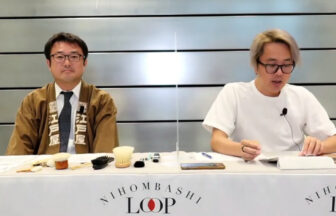
First of all, please begin by introducing yourself, Sukenichi.
My parents had a very difficult time running the store, partly due to the war. Before I took over the store, I was not allowed to go to school as a child. In reaction to that, they insisted that I go to school, so I did, and I took over the store. My father was very attached to Edo culture and traditions, so he said, “A loach shop must be an old-fashioned loach shop,” and that was the mainstay of the business. We have been doing this business for a long time, focusing only on dojo-yaki.
Next, may I introduce “Komagata Dozeu”?
Our company was founded in 1801, the first year of the Kyowa Era. I am the sixth generation in the company, and my son is a candidate for the seventh generation. My son is now a candidate for the seventh generation, and he is doing his best. It has been a tough time, but we have not changed the store’s appearance.
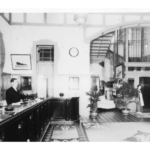
The inside looks like this.
This is called “Iretomi” and has two tables in the front, but it did not exist in the past. There is a type of tatami called “door tatami,” which is made of woven doors instead of tatami mats. There is a Shinto altar in front, and the area below is called “miyashita,” and many customers say, “I only sit under the altar.
Miyashita! I have not sat down yet and would like to. This place is very tasteful. There are all kinds of pots and condiments on the board. What is that board called?
It is called “Kanaita” (gold plate). A red copper helicopter was made around the board to prevent the “doze soup” or “doze-nabe” from being spilled. The height of the heri was about 1 cm to 5 mm. It was wrapped around the board to keep the juice from spilling out. After the Meiji period (1868-1912), the metal hardware was removed and the boards were left alone, because it was said to blow greenish blue and cause food poisoning. We traditionally call it “Kinban” (metal plate).
You call it a gold plate as a remnant.
That’s right. If you could eat dojo on the gold plate, it would really be an atmosphere of the Edo period, when you were already watching the play.
Yes, I know. I actually had my grandfather take me there when I was little, and I already remember this view intensely. I remember how impressed I was as a child, thinking that the atmosphere of the store was just like in a TV drama or a period drama, and that there really was a place like that. Miyashita” is also a place that can be enjoyed in a “twu” way, so I hope that everyone will visit there.
That is why we asked you to introduce us to your restaurant. Now, please also introduce how to make “dozenabe”.
Let the loach drink sake and then simmer for 40 minutes until tender.
The loach is kept alive in a barrel. These barrels are drained well and replaced with smaller vats. Nowadays, loach is not natural. They are farmed. That is why they used to be called “muddy” or something like that. But now, the loach we use has never been in contact with mud, so it should not really have a smell, but we use the same method as in the past. Nowadays, we farm our loach in hot spring water.
What we are doing here is sake. It is sake. When we say, “Give them sake,” we mean that they will drink any kind of water, because they are intestinal breathers. So they drink sake and water without knowing whether they are drinking sake or water, but this is the euthanasia sake before they are cooked. When the rampaging fish has quieted down, the next step in the process is to put the limp, drunken dojo into a pot of boiling miso paste.
If you put them in a hot pot out of the blue, they will go wild.
Yes, it is. Because they are violent. We feel sorry for them and euthanize them. Our loaches are happy. They come to our house after taking a bath in the hot spring, are allowed to drink alcohol, and are now being cooked. They are not unhappy.
Yes, it is.
The fish is then simmered until the bones are tender. In the old days, the number of minutes of boiling varied depending on where the loach came from, but nowadays, since the loach is farm-raised, it is boiled for about 40 minutes. When they are done, they are placed in hot water and steamed. This process produces tender loach.
If you cook it in miso all the way through, it can get a little tough, so you have to move it back to the hot water again and steam it to make it softer.
I see. So you steam them. Then the rest is seasoned, placed in a pot, and everyone cooks it and enjoys it while adding green onions. About half of the process is done when you transfer them to hot water.
There is a picture of the finished product for your viewing.
This is “dozenabe”. After steaming in hot water, the fish is boiled one more time in soup stock. We then arrange them in a pot and bring them to our customers. Customers can add as many condiments as they like on top, but traditionally, we do not charge for more green onions, no matter how expensive they are. It’s like a sore loser for an Edo-kko.
So you are saying that you are sore losers from the spirit of the Edo people (laughs).
Yes, it is. And the setware on the left side of the photo is called warishita. It is made of slightly diluted broth from boiling dojo, and is boiled in a brazier. The edge of our “doze-nabe” is very thin so that the broth does not go in too much. The reason for this is so that it can be boiled quickly over the fire of this stove.
I see.
Instead, the dish is served while you insert the Warishita yourself. As one who makes the dish, it is difficult to enjoy it if you are a beginner. So please come with an experienced chef. Take a little bit of sansho and chili pepper on a small plate. If you like chili pepper, you can add what we call “seven colors” of chili pepper, and if you like sansho, you can add sansho. And if you eat it with green onion and dojo, it is the best.
In today’s sense, you can change the flavor, adding sansho (Japanese pepper) or shichimi (seven spice flavors). Some people add leeks to the soup and eat it as a snack. It is good to have people try it once in a delicious way.
That’s right. Sometimes my sisters teach those who don’t know what they are doing, but they usually act like they know what they are doing even though it is their first time. I think to myself, “If you eat it that way, it won’t taste good. But after a few times, they understand that this is the way to eat it. For those who eat rice, we serve the rice in a bowl with green onions and dojo. This is very energizing, even if you are not only a drinker.
Doze-nabe” has been handed down since the Edo period (1603-1867), and in order to maximize the deliciousness of dojo, the cooking method was thoroughly particular about its preparation. That means never changing the “flavor. That is why “Komagata Doze-nabe” has been supported for over 200 years.
latter part(temporal or logical sense) follow …
*If you would like to see this dialogue on video.here (place close to the speaker or where the speaker is)