

Column: Don’t call me the landlady!turffamily crestKimono Mannerssemi-formal kimono for women
The season has arrived when it is hard to even breathe!
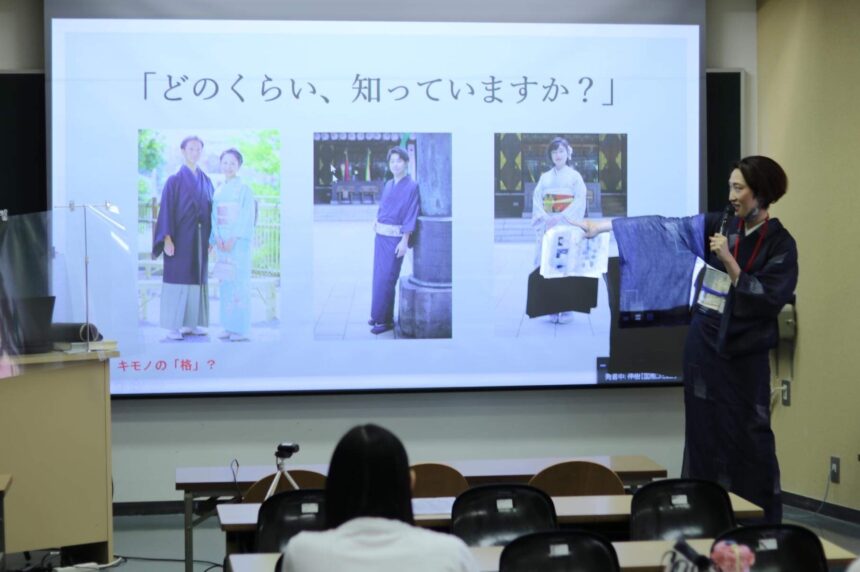
For one week every year, I teach a class in yukata at a girls’ high school in Minato Ward for an on-site yukata dressing class. This year, too, the class was held from last week to this week, and by the time the class was over, I was drenched in sweat every time due to the enthusiasm of the young people that filled the classroom. ……
Important to match limited seasons and situations.
In this situation, what I feel every year when I teach young people how to wear yukata is that, as is often said, everyone looks definitely prettier than when wearing western clothes! (lol). Sorry for my middle-aged perspective: …… (laughs). (Laughs) When I see teenagers wearing yukata at firework festivals and other events, I really feel that way.
I think it is not only because they are young and energetic, but also because it is an outfit that fits the “limited season and situation (TPO)” of “summer and fireworks festivals” in Japan. This “limited season” and “situation” are related to the “class,” which is considered a difficult problem for kimono beginners. In this column, I would like to briefly explain what “rank” means in the context of “seasons and rank of kimono” from my point of view as a complete amateur who took over a kimono shop in my mid-30s!
The most basic concept of kimono TPO = “rank” is to be able to make a person shine the most in a given occasion, and to please the people you invite. This is the most basic concept of kimono TPO = “class”.
The important point is that it incorporates a “viewpoint that considers the other person, not oneself,” such as “the person who invited the guests. If you think with this in mind, I think you will naturally understand the rank of kimono.
Formality means expressing consideration for others and the occasion
From here, we will tell you specifically how to choose a kimono that suits your TPO.
If you think about it too hard, you will lose the desire to wear a kimono. So, let’s consider “casual” and “formal” kimonos, just as we do with western clothes.
First, let’s talk about “casual kimono.
Basically, I believe that a person should wear what he/she wants to wear. In my previous column, “Seasons,” I talked about summer attire, but in order to make the wearer feel “cool,” the wearer actually puts on a “skinny” face even if he or she feels a little hot.
It is just like a young lady wearing a fur coat and shorts in winter, who does not feel the cold and remains fashionable (laugh).
It does not matter if the timing of wearing “ro” or “gauze” transparent material is a little early. In short, it is just considered “more fashionable if it fits the season. I think this concept is the same for clothes, but it is completely up to the individual’s own sensibilities.
Also, if you are the only one attending a dinner party with friends in a kimono, it is important to at least not be too “kime”. For this purpose, I would wear a silk or a komon with a full pattern. I think such a degree of “TPO” for casual kimono is sufficient.*Komon with a full pattern…A kimono with a fine pattern throughout and few plain areas. It is not often worn as formal or ceremonial attire.
Now, on the other hand, about “formal” kimonos.
I think it can be paraphrased as a “thoughtful attire” that is considerate of “the person who invited you” and “the occasion. The kimono is divided into formal wear, semi-formal wear, and formal wear, and even formal wear is divided into more detailed categories, which is the troublesome part of the kimono and a headache.
The point is to incorporate “white” in accessories such as the han collar and obijime as you approach formal wear such as weddings and name-attribution parties. Also, in the case of gorgeous party kimonos such as the visiting kimono and tsukebake, there is a regularity in the way the patterns are attached and the number of “crests” that are attached increases. There are so many “rules” that it is unimaginable when compared to wearing a formal dress.
Now, I would like to explain the roots of “crests” among these “rules. Nowadays, you can only see the crest of each family on the gravestone of your own family.
In ancient times, it was worn by warriors to show their work to their allied generals during battles. It was a “marker” to make “one’s house” remembered more loudly and clearly on the battlefield where many people were mingling. Because of these “roots,” the male crest is said to be larger than the female crest.
Nowadays, “battles” are no longer fought, and they are replaced by “occasions of competition” (weddings, succession of names, etc.), and in situations where more seriousness is required, people wear more crests (one, three, or five) to show themselves off. It is easy to understand if you see it in this way.
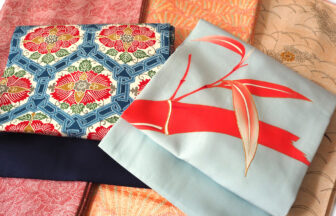
As a side note, as a kimono shop, we often add a crest to visiting kimonos that are ordered (see photo above), but we are sometimes caught between the customer who does not want the crest itself to stand out too much and the crest-applying craftsman who knows the “roots” of the crest. According to the craftsman, “A crest that doesn’t stand out is not a crest at all! LOL”. and …….
I hope you have a good understanding of the “rules” and “roots” of kimono.
Thank you for reading.
July 12, 2023 Eri Kobayashi
Eri Kobayashi
6th generation head of the Dingoya family
This article was written by…
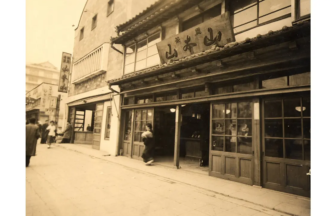
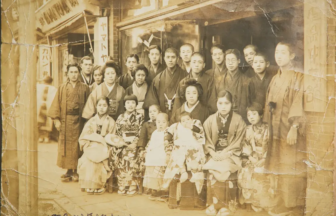
She is the sixth generation of “Choukoya,” a long-established kimono store founded in Kansei 10, which suddenly appears on the first floor of the Toranomon Hills Business Tower. 2016, she decided to take over her husband’s business, a kimono shop, from a completely different industry such as the ORIX Group. Kimono dresser and kimono personal color analyst. She conveys “kimonos that will last to the next generation” that are not bound by common sense or stereotypes, and is a permanent board member of the “Hyakunenkai,” an association of long-established kimono shops in Shiba from 2020.
Her hobbies are “dressing and coordinating others” and solo camping.Dingoya Home PageDingoya Instagram