general (household) goods Nihonbashi (bridge)
Established 1830
Attention as a tool for SDGs. Edo broom, where the art of genius has been passed down from generation to generation
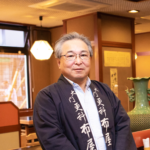
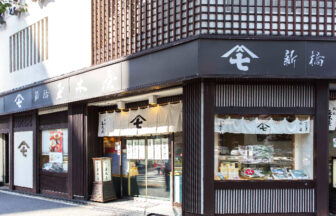
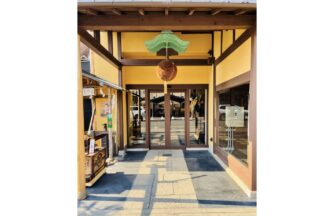
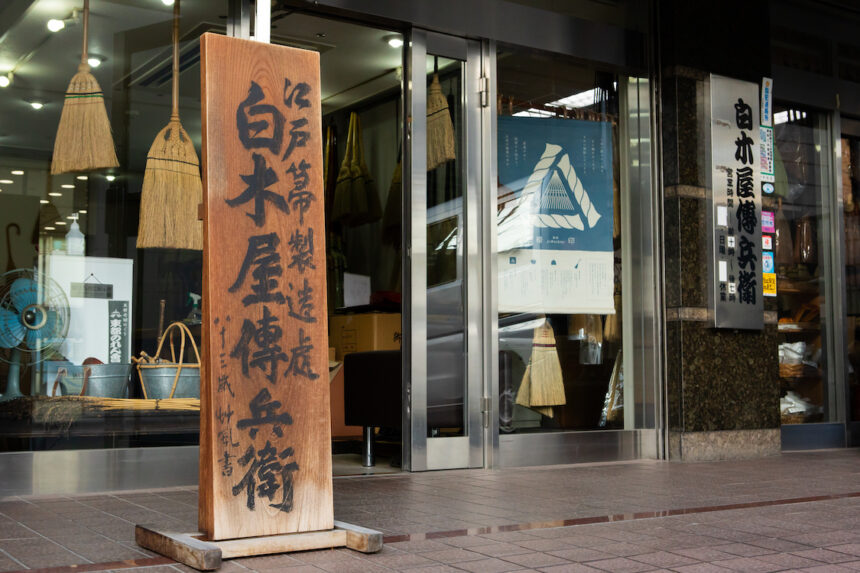
As you enter the store, you will see Edo brooms hanging all over the walls. The sight of brooms of various sizes and shapes lined up in a row is artistic. Nakamura Satoru, the seventh-generation owner of Denbei Shirakiya, says, “These brooms are tools for daily life, but when they are made by a skilled craftsman, they are beautifully finished. While many broom stores have shifted to simplified methods, the brooms are still made almost entirely by hand by craftsmen, preserving the techniques of the founder, who was said to be a genius at making brooms in Edo (present-day Tokyo).
Shirokiya Denbei’s unique process is called “Kusa-Selection. When matching the ears of broomcorn, a member of the grass family, the ears are “ranked” by rubbing them with the tips of the fingers. The better the ear, the more elastic it is, and the more grass it has, the easier it is to collect dust and the more durable it is. The only thing we rely on is our fingertip senses. After making 1,000 brooms, one will be able to tell the difference between one type of ear and another. From there, they gain experience with 2,000 or 3,000 brooms and learn the differences between the different types of brooms. By selecting the right kind of brooms, it is possible to maintain a constant quality without hitting the wrong broom of the same rank. Even if someone wants to buy another broom ten years from now, we can offer them almost the same one, just by looking at the color of the binding thread,” he says. The owner says this with confidence because of his craftsmanship, which can never be mechanized.
After “ranking” the brooms, they are woven in balance with the bamboo handle, and it can take as little as one and a half hours to weave a single broom. The resulting Edo broom is surprisingly light and supple. Even within the same rank, there are subtle differences in firmness and strength, so Shirokiya Nakamura Denbei Shoten always recommends that customers try out a broom before buying one. It is a wonder that after trying many brooms, you will find one that fits your body comfortably. It is no wonder that you feel a sense of familiarity with the broom, as if it were your partner in life.
After the rapid economic growth period, vacuum cleaners replaced brooms. However, the owner of the company says, “Brooms are the right tool for modern life. They can be used early in the morning or late at night because they don’t make a sound, they don’t take up space so they don’t disturb even the most compact rooms, and they are environmentally friendly because they don’t use electricity. As the owner says, “It’s actually an SDG,” and a tool that should be handed down for the next 100 years.

History
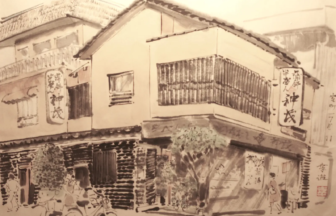
The Kyobashi River, where the Metropolitan Expressway now runs, once flourished as a “bamboo river bank” lined with bamboo shops. Bamboo shops lined the streets, and because bamboo stems and broomcorn, the raw materials for Edo brooms, were readily available, there were several stores that sold brooms made from broom grass. One of them was Denbei Shirokiya. It was originally founded in 1830 in Ginza as a store selling tatami mat covers, but later moved to Kyobashi and began manufacturing and selling Edo brooms. Due in part to the Great Kanto Earthquake and the war damage, by 1955 there was only one Edo-style broom store in Kyobashi, Shirokiya Denbei. Nevertheless, the business has remained unchanged and has many customers who have been with the company for decades. Currently, the seventh generation, Satoru Nakamura, is the head of the family, and there are three craftsmen, including Seiichi Takagi, the head artisan.

Satoru Nakamura
Denbei Shirokiya, 7th generation head of the family
We offer a bottle that fits your lifestyle.
Each broom is made with great care, making full use of craftsmanship such as the “grass picking” technique bequeathed by the company’s founder. If you are a first-time broom user, please visit our store. We will suggest the best one for your lifestyle.

Featured Products/Pickups

Edo-style broom
Special 11,000 yen, Top 8,800 yen
This is one of Shirokiya Denbei’s representative Edo hand brooms. The springiness of this broom is one of the best among all Edo brooms, and it removes dust very well. It can be used in any place, including tatami rooms, wooden floors, and carpets, but it is especially recommended for carpets. It is especially recommended for carpets, where it can scoop out dust, hair, and pet hairs that have been lurking.

Otegaru Broom, Stubble Broom, Long-handled
Otegaru Broomstick 4,950 yen, Slack broom, long-handled 3,850 yen
A reasonably priced broom made of imported Indonesian grass is also available. Indonesian and Japanese broom craftsmen have close ties, and have been providing local guidance on how to cultivate raw materials and broom production since around 1965 (Showa 40). The brooms are sturdily woven and can be used all over the house.

Edo-style broom
6,600 yen
This Edo hand broom has a slimmer width than usual with less volume in the ears. The fewer ears make it lighter and easier to handle. It can reach deep into places that are difficult to reach with a vacuum cleaner, such as the crevices of a wardrobe or under a TV stand, to scoop out dust. It also looks stylish casually displayed on a wall as an interior decoration.

Outline of long-established businessOutline
| address (e.g. of house) | 1F Hakuden Building, 3-9-8 Kyobashi, Chuo-ku, Tokyo |
|---|---|
| Access | 1 minute from Takaracho Station on the Toei Subway Asakusa Line, 3 minutes from Kyobashi Station on the Tokyo Metro Ginza Line |
| phone | 03-3563-1771 |
| Business Hours | 10:00~19:00 |
| regular closing day | Sunday |
| Payment Method | Cash, credit cards (AMERICAN EXPRESS, VISA, JCB, Diner’s Club, Mastercard), electronic money |
| External Links |
|
03-3563-1771 Official Web Site
The information is current at the time of publication. The information is subject to change.