

Adult Manners CourseSeasonal way of life
When should I send out my summer greeting cards in 2023? Is it OK to send it by e-mail? Common sense and examples of sentences you should know
Year 2023inquiry after someone’s health in the hot seasonSample sentences of a hot summer greeting cardreply to a person’s letter of condolence in the hot seasonmanners for visiting customers in the hot seasonsummer greeting card
Do you know what the meaning of a summer greeting card is? We asked Ms. Hiroko Nishide, a manner consultant, about the surprisingly unknown origin, when to send them, and NG manners. We also introduce some example sentences that can be used immediately. Why don’t you send a hot-summer greeting card this summer to people you don’t see often or to those who have been indebted to you?
What is a heat-related letter? What is its origin?
Many people may be unaware of the actual meaning of the summer greeting cards that are exchanged during the summer season.
Shochu-komishii” is a greeting card sent during the heat of summer to let the recipient know how they are doing and to show concern for their health,” says Mr. Nishide.
Originally, it originated from the custom of offering offerings to one’s ancestors when returning home for the Bon Festival. By the Edo period (1603-1867), this custom had changed to greeting people in general with summer souvenirs, and gifts and letters were delivered to distant homes that could not be visited using a courier service. With the development of the postal system in the Meiji era (1868-1912), the custom of sending simplified greeting cards was established, and the current “Shochu-kosai-sho” (summer greeting cards) took root in the Taisho era (1912-1926).
When to send out hot weather cards in 2023?
It is not acceptable to send a summer greeting card at any time during the summer, but there is a guideline for the timing.
Shochu” refers to the hottest season of the year, and according to the calendar, it lasts for about 18 days during the summer Doyo (the period before the first fall). According to the calendar, it is about 18 days before the first day of summer (Doyoshu). However, recently, according to the actual climate, it is considered to be the standard time to send a heat-related letter from July 7, the day of the 24th solar term, to August 7, the day before Risshu (the first day of autumn). If it is after Risshu, it is called “Zanzakamai” instead of “Shochu-misai. It is safe to send a lingering summer greeting card by the end of August. At the latest, they should be sent by September 7, the day before the end of the “summer heat wave” called “Shiroro (white dew).
Once July arrives, you should start preparing to send out your summer greeting cards.
How to write a hot-summer greeting card. General examples of sentences and examples of sentences for different recipients.
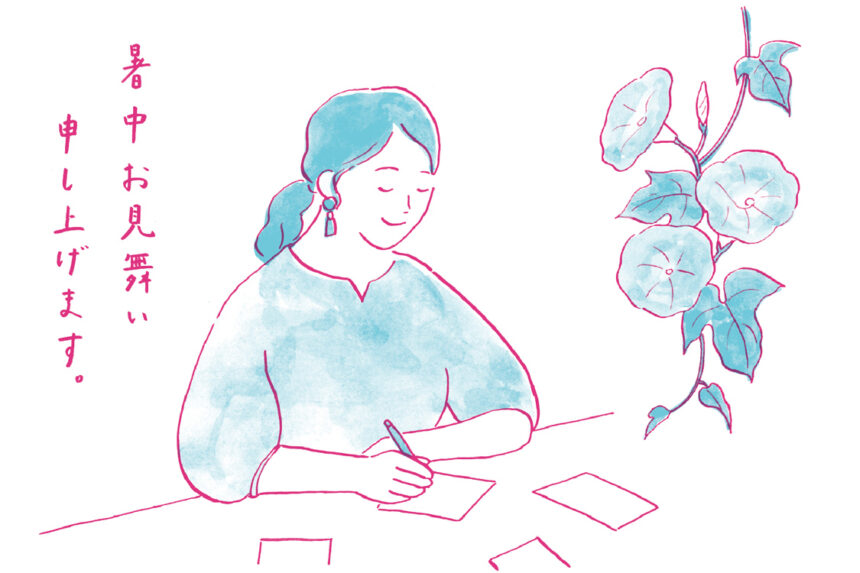
It is common to send out a postcard for a summer greeting card.
In Japan, the writing style is vertical, so it is basic to write vertically and by hand. In this case, writing with a brush is the most polite and respectful style. Recently, there are writing pens that can write in the style of a brush, so why not check them out? You can also use a fountain pen. You may also send a printed postcard. In that case, it would be easier to convey your feelings by adding a handwritten message. We recommend that you use a brush or fountain pen. Ballpoint pens and magic markers are not recommended when writing a letter because they give the impression of being used for clerical work. It is especially safe to avoid using them when writing to elderly or superior persons.
The way to write a hot-summer greeting card differs slightly depending on the recipient, but we were first taught the general way to write a letter.
What about social networking sites and e-mail? Manners for sending a summer greeting card other than a postcard
Is it acceptable to send a hot-summer greeting card to a close friend via e-mail or social networking service?
In this day and age, it is of course fine if the recipient and the recipient’s relationship is such that they usually communicate with each other via e-mail or social networking services. It is easier for the recipient to reply.
If both parties greet each other in a way they are familiar with, there is no burden on either of them. It is good manners to be considerate of others by valuing ease of communication without being overly formal.
What is the reply or not to the hot-summer greeting card received and what is an example of a response?
NG patterns to avoid in the exchange of hot-summer greeting cards
What if I want to stop a hot weather letter?
What is the best way to stop exchanging summer greeting cards with those who have become estranged from you? Should you send a few words of greeting and then stop, as in the case of “closing a New Year’s greeting card”?
The meaning of “nengajou” is different from that of “nengajou,” and if the person is estranged from you, there is no need to be proactive about it. For example, if you receive a summer greeting card from someone and you feel like replying, you may do so; if not, you may choose not to reply depending on your relationship with the recipient. Of course, you should reply. But if you do so, the same thing will be repeated the next year, and it may not stop you from sending a hot-weather greeting card after all. While it is important to be considerate of others, it is also good manners to be mindful of your own feelings, environment, and resources. Today, we live in an age where we are honest about our own feelings and do what we can within reason. Please make decisions based on your own feelings and circumstances.
A hot-summer greeting card is a heartfelt exchange that is important to the recipient and to your own feelings.
Seasonal exchanges are becoming less common today. A hot-summer greeting card that is considerate of the other person’s wellbeing is actually a very good communication tool for strengthening bonds. A little effort on your part, for example, using a postcard to share happy memories from your trip, will convey your feelings to the person you are sending it to. Why not enjoy good communication by writing a hot-summer greeting card with your own feelings of “I wonder how that person is doing” in mind?
Interview and text by Yoshiko Tezuka
Illustrations by Tomoko Shinozuka