inscription

armour

inscription(MEI)

Japanese sword

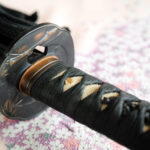
In general, as the character meaning “inscribe” or “engrave” implies, it refers to characters or writings engraved on a metal stone. In the case of Japanese swords, it means that the sword maker has inscribed his name and the year of sword making as his signature on the sword. The inscription is placed on the sword’s stem, which is the part of the blade that is attached to the handle. Inscription on the stem is called “mei wo kiru” (to inscribe the name on the stem). Inscription was mandated by the “Taiho Ritsuryo (law)” enacted in 701, and became common from the end of the Heian period. It is also an important element in the appraisal and appreciation of Japanese swords. Normally, a sword with an inscription is considered more valuable than an “unmarked” sword without an inscription. However, there are exceptions such as “Masamune” and “Sadamune,” which are unmarked swords.

新着・おすすめ情報

  1. grilled eel

  2. kneaded dough

  3. What are the characteristics of Edomae Sushi?

  4. 【第12回】「手打ち」というだけで蕎麦は美味しいわけではない

  5. Chinzan Villa

  6. Zoshigaya Old Mission Building (Zoshigaya, Tokyo)

  7. Sticking to domestically produced raw materials, each tooth is spun by hand. The commitment of the long-established “Juso Yakushi-ten” (Juso Yakushi Shop)

  8. duck meat stew (dish from Ishikawa prefecture)

  9. Nogi Shrine (Akasaka, Tokyo)

  10. Tsutanoya” was established in 1937 and supports Japan’s fish-eating culture with its delicious taste. What is “Kyoka-zuke”, an evolution of Saikyo-zuke?

  11. combined off-license and pub (licence)

  12. Tsukiji Honganji Temple

  13. 【第23回】蕎麦屋店主が考える真の蕎麦「通」の定義

  14. Tokyo Literature Walk] No.5: Literary figures of the Showa period settled in Shimokitazawa one after another. Why Shimokitazawa became a town of culture

  15. sand pit