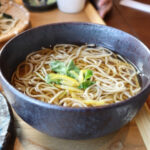
gelidium jelly strips (made from agar-agar)

Japanese confectionery

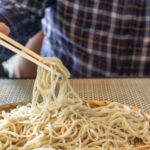
gelidium jelly strips (made from agar-agar)(Tokoroten (tokoroten)

summer

The agar is extracted by boiling the seaweed, poured into a mold, cooled and hardened, then placed in a “tokoro-ten-pusher” and pushed out to form a string. It is eaten with vinegar and soy sauce or nihaizu (vinegar and soy sauce), and garnished with hot spices. It is a common summer delicacy. There are various theories about the origin of amakusa, but one theory is that the process of boiling and melting amakusa was introduced by Japanese envoys to China during the Tang Dynasty. Amakusa was originally called “korumoha” or “kokorofuto,” and the food itself was initially called “kokorofuto. By the Edo period (1603-1867), it was called “Tokoroten” as we know it today. Incidentally, the same type of natural grass, when frozen and dried, is called “agar-agar.
新着・おすすめ情報

  1. clothes for a newborn baby

  2. sweet burdock and miso-bean paste covered with a thin layer of mochi

  3. Hotel New Otani, Tokyo, Japan

  4. Tsukiji Honganji Temple

  5. man’s stiff sash

  6. triumvirate

  7. cucumber sushi wrapped in nori (seaweed)

  8. underskirt (half-slip), worn under kimono

  9. What is the meaning of “hi-ire” in sake making? Words related to Sake

  10. Tozenji Temple (Shinagawa, Tokyo)

  11. The important thing is to build a steady network. Nakazawa Nyugyo Co., Ltd. is expanding its business with the spirit of “Be with each other and do business with each other.

  12. Anyone can do it by themselves! Basic yukata dressing – women’s version

  13. Shinjuku Gyoen

  14. 8220;Sake Samurai”s Tour of Tokyo’s Long-established Sake Breweries with Yuki Aoi

  15. Tokyo Grand Shrine