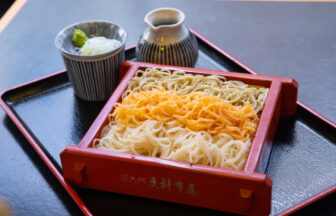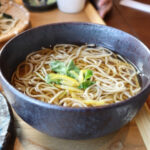
gelidium jelly strips (made from agar-agar)

Japanese confectionery

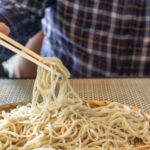
gelidium jelly strips (made from agar-agar)(Tokoroten (tokoroten)

summer

The agar is extracted by boiling the seaweed, poured into a mold, cooled and hardened, then placed in a “tokoro-ten-pusher” and pushed out to form a string. It is eaten with vinegar and soy sauce or nihaizu (vinegar and soy sauce), and garnished with hot spices. It is a common summer delicacy. There are various theories about the origin of amakusa, but one theory is that the process of boiling and melting amakusa was introduced by Japanese envoys to China during the Tang Dynasty. Amakusa was originally called “korumoha” or “kokorofuto,” and the food itself was initially called “kokorofuto. By the Edo period (1603-1867), it was called “Tokoroten” as we know it today. Incidentally, the same type of natural grass, when frozen and dried, is called “agar-agar.

新着・おすすめ情報

  1. Hatomori Hachiman Shrine (Sendagaya, Tokyo)

  2. Gansenen Park (Waseda, Tokyo)

  3. Tokyo’s “Furyu Odori” is the talk of the town since it was selected as a UNESCO Intangible Cultural Heritage site! Tokyo’s “Furyu Odori” gathers in large numbers! Report on Tokyo Folk Performing Arts Festival

  4. Chinzan Villa

  5. What are the characteristics of “Tailings”? Words related to sake

  6. He started helping out in the family business as a child and went on to become a part of it. Kimuraya Honten, Asakusa’s oldest doll-shaped yaki store

  7. Musashi Fuchu Kumano Shrine Tomb (Fuchu, Tokyo)

  8. Itsukushima Shrine (Shinjuku, Tokyo)

  9. Types of “Hina Dolls.” What are the characteristics of their costumes?

  10. The first “in-house work of a samurai”. Yoshinoya Shoten” has been lighting up the nights of Japan with Edo lanterns for 168 years.

  11. Long-established Tabi Shoes supported by all generations. Ohnoya Fuso-Honten” continues to make Tabi Shoes with all our hearts.

  12. Why do we need Bonbori? Decorating Hina Dolls

  13. Shukusen, a dyed kimono store for yukata and Edo komon. What is the pride and confidence in the words “Shukusen Kansei”?

  14. Kimono is an SDG costume. Unused clothes and tenugui (hand towels) can be used as obi sashes.

  15. What does “Oyako” mean? Hina Dolls