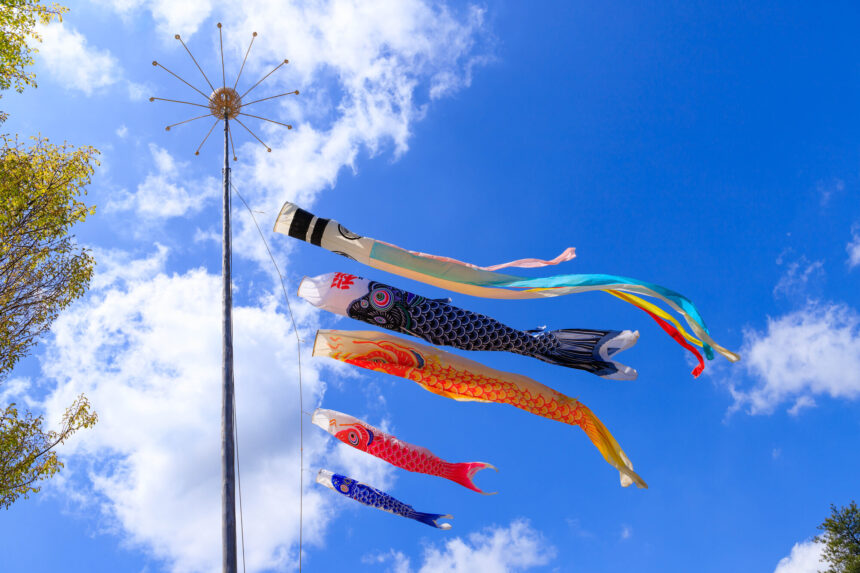
Why is “Koinobori” carp? The reason is said to be based on Chinese folklore.

puppet

Why is “Koinobori” carp? The reason is said to be based on Chinese folklore.(koinobori).

Children’s Day (national holiday; May 5th)Boy’s Day celebration (May 5th)

This is a typical outdoor decoration for Dragon Boat Festival. It is said that the custom originated in the mid-Edo period, when samurai families erected banners in their yards to wish for the growth of their boys. These banners were then transformed into five-colored streamers. At the same time, commoners invented a carp-shaped banner based on a Chinese legend about a carp climbing a waterfall (a carp that climbed a fast-flowing waterfall and became a dragon and danced across the sky), and began to hang it outside. Today, most carp streamers are made up of a set of a streamer, black (true carp), red (scarlet carp), and blue (baby carp), and are decorated with many baby carp to symbolize the family. In recent years, due to housing conditions, carp streamers for balconies and indoor use have also become popular.
新着・おすすめ情報

  1. Suzuki Ruins Museum

  2. Itsukushima Shrine (Shinjuku, Tokyo)

  3. Types of “Hina Dolls.” What are the characteristics of their costumes?

  4. Katsusenji Temple Enma Opening in Kitasenju! A New Year’s tradition with stalls on the first Enma day

  5. end of the year

  6. 【第6回】9月に当店で「生姜切りそば」を出す理由

  7. Where did okame soba originate? Ingredients used are also explained.

  8. To make Japanese “tea culture” widely known. Flexibility of “Gyokuho-Do” to change with the times.

  9. A Walk in Edo with Old Maps] No.4: Was the Yoshiwara brothel located in Ningyocho? A play by day, a brothel by night. A Journey to the Ruins of a Former Pleasure Spot

  10. Zenkokuji Temple (Kagurazaka, Tokyo)

  11. marks indicating the Japanese meaning of the texts of Chinese classics

  12. triumvirate

  13. Where does the name “Sakura Denbu” come from? How is it made?

  14. What is the meaning behind the three colors of “Hishimochi”? Hina Doll Decorations

  15. What is the origin of the name “Kintsuba”? How is it written in kanji?