

Asakusa (department store)Japanese confectionerycafe featuring Japanese-style sweets
Umezono is a sweet shop in Asakusa that is popular among people of all ages, from seniors to young people. Over the course of its long history, Umezono has survived the Great Kanto Earthquake and the Tokyo Air Raid, and while maintaining its main store in Asakusa, it also operates Japanese confectionery stores throughout Japan. We interviewed Mr. Takashi Shimizu, the seventh generation head of the family, who has created a succession of new products that have captivated people of all ages, including the famous awa-zenzai.
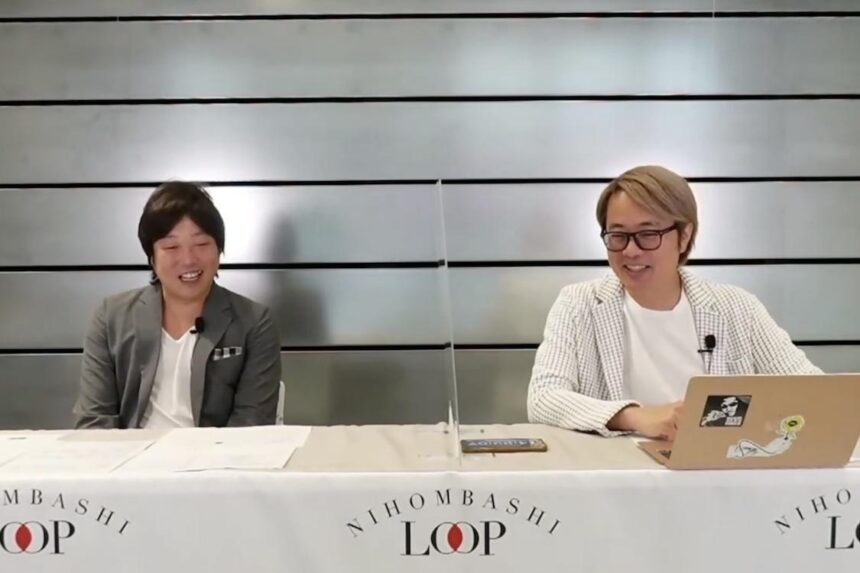
Today we will talk to Mr. Takashi Shimizu, the 7th generation head of Umegakuen. Mr. Shimizu, it is a pleasure to meet you. Please begin by introducing yourself.
My name is Shimizu of Umeen Co. I am the seventh generation in the company. After graduating from university, I joined Umezono Co., Ltd. in 2006 and became the representative director in 2013.
Thank you very much. Could you also introduce Mr. Umezono?
It was founded in 1854, the first year of the Ansei Era. It started when we rented the garden of Bai-en-in, a branch temple of Sensoji Temple, and opened a teahouse there. We received the trade name “Umezono” from Bai-en-in Temple. The first generation gained a good reputation for the original awa-zenzai (sweet bean soup), and for the past 169 years, we have continued the tradition as a sweet specialty store. Currently, we also sell Japanese sweets at commercial facilities such as department stores in the Kanto area.
It is not surprising that the name “Umezono” comes from “Umezonoin”.
Yes, it means that we read Umeen as a kun reading.
The “Bai-on” part was changed to “Ume-zono” (plum garden). It is a very chic twist. You are going to introduce awa-zenzai later today, but it also appears in the works of writer Kafu Nagai, doesn’t it?
Burned down in the Tokyo Air Raid. The only remaining water gauge told us where the store was located.
It is said that Mr. Kafu Nagai brought about 10 geiko to the restaurant, and they ate a lot of ozoni and oshiruko (sweet red-bean soup).
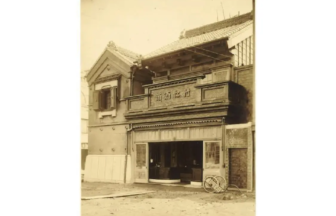
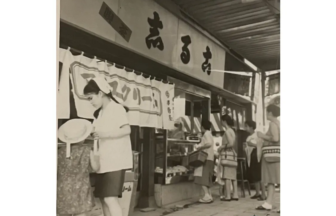
That is wonderful. So that is how you maintain your traditional culture. Now, I would like to ask you to show us what your store looks like. Is this picture from the Taisho era the current location of the store?
The location is a little different. Tokyo was burned down twice, once in the Great Kanto Earthquake and once in the Tokyo Air Raid. This photo was taken when the store was renovated and opened in the Taisho Era (1912-1926). After that, it was burned down during the Tokyo Air Raid, and we lost the location of the store. When the previous generation returned to Asakusa, the water jar was the only thing that remained. The only jar of water that remained was the one that told people that Umezono was here. We still keep that water jar as a treasured possession.
So this water reservoir has protected the land from being lost in a land parcel.
Thanks to this, other nearby stores realized that our store had also been burned down.
The fact that it was not burnt in an air raid indicates that it was built quite sturdily.
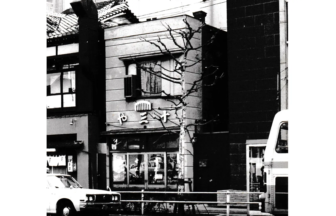
This is a very heavy one. I don’t think it can be made anymore. Now customers can see it, and many of them take pictures and are interested in it. And this picture is the current appearance of the Asakusa main store.
So it was moved to another location than Taisho.
Yes, we do. And as I mentioned earlier, we have a total of 18 stores that sell Japanese confectionery.
I think many people become fans after visiting a store in Asakusa, but I think there are also people who enter through stores in department stores and shopping centers like this one.
Yes, there are both patterns, but many of the connections are made after first coming to the Asakusa store. Some customers often say to us, “I visited your store in Asakusa the other day. I am so grateful that there is another store nearby.
Were you affected by the Great Kanto Earthquake? All of the long-established shops were greatly affected by the Great Kanto Earthquake. We often hear that some of their materials were burned and are no longer there.
There are some stores that have them, but basically, everyone doesn’t have them.
I sometimes hear stories of miraculous finds at temples and such. …… I feel that the common point among long-established shops in Tokyo is that they have overcome various hardships and continue to do so.
What is the secret behind the deliciousness of Umeen’s popular “awa-zenzai” menu?
Now, I would like to introduce you to some of Umezono’s wonderful products. Their specialty, awa-zenzai, is delicious!
Our specialty, awa-zenzai, is not made with awa but mochi kibi. The millet is half pounded and kneaded in a rice cake pounding machine, then steamed and mixed with slowly cooked sweet bean paste in a bowl. The reason why it is called “awa-zenzai” is because after World War II, it was no longer possible to obtain millet, so the name was changed to “kibi” (millet) because it had a better texture. The name “Awa-zenzai” has been popular for a long time, so the name has remained unchanged until now.
Another point is, as I mentioned earlier, that the rice cake is half-polished. There are two reasons for half-pounding the kibi: one is to preserve the texture of the kibi. The other reason is that the kibi has a slightly sour taste, which balances the flavor better, so it is half-polished. This is the ratio that best matches with the sweet bean paste, or rather, the ratio of deliciousness.
Wasn’t there any talk of changing the name to Kibizenzai?
It didn’t happen. …… It didn’t happen for generations.
After all, customers remember the name “awa-zenzai” and come to eat it.
That’s right. That is one of the reasons why we will keep the name “Awazenzai” and protect it.
Is the main store the only place where I can eat awa-zenzai?
It is served at the main store and “Sweet Cafe Umeen” at the Nihombashi Takashimaya Department Store.
I hope everyone will come and try our food. The best thing is to have it freshly made and served hot.
That’s right. One of the bad characteristics of millet is that it becomes a little hard after a long time. It is recommended to eat it freshly made.
I can’t really describe that deliciousness, but it’s very chewy and has a very nice moisture content. You have to try it to know for sure, so please visit our stores in Asakusa or Nihonbashi. And next is the delicious cream shiratama.
The homemade molasses is addictive. Cream Shiratama Anmitsu” popular among men and women of all ages.
Our cream shiratama anmitsu is made of high-quality, domestically produced amakusa (Japanese angelica sandalwood), which gives it a very plump texture. It is topped with smooth red bean paste, mikan (mandarin orange), pineapple, and shiratama (white bean curd). This is also a popular menu item. It is also popular among young customers. This menu is enjoyed by customers of all ages, from the elderly to the young. The shiratama seems to be especially popular among younger customers.
You can eat the cream shiratama anmitsu at the store and buy the shiratama anmitsu as a souvenir at the store. …… The agar-agar texture is very addictive once you try it, so please give it a try. I also like it very much.
Up to this point, we have asked about the history of Plum Garden and its standard popular menu. In the second part, we will talk about the new menu items that have recently become popular on social networking sites.
latter part(temporal or logical sense) follow …
*If you would like to see this dialogue on video.here (place close to the speaker or where the speaker is)