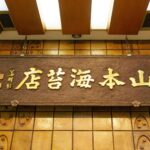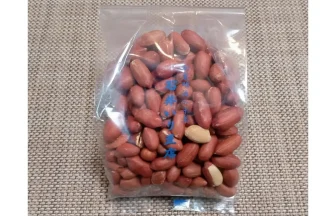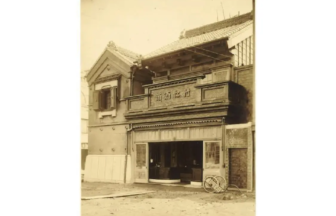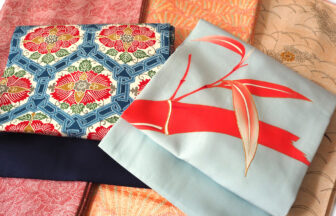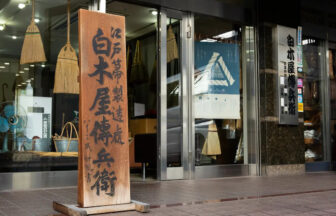


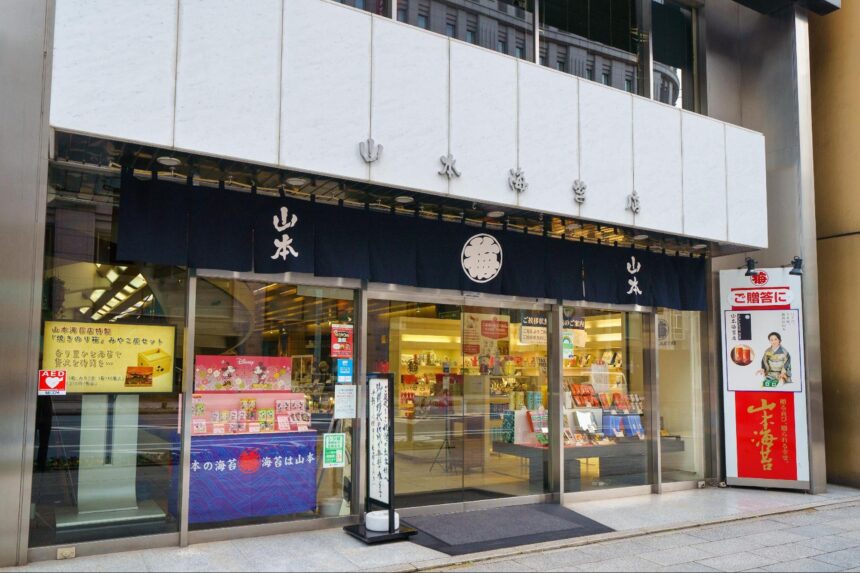
Yamamoto Nori Store has a history of more than 170 years dedicated to laver. When it comes to mouth-watering, delicious seaweed, no one is better than Yamamoto. We interviewed Takahiro Yamamoto, president of the company, about the history of this long-established business and its commitment to flavor.
How did “seasoned laver” come about?
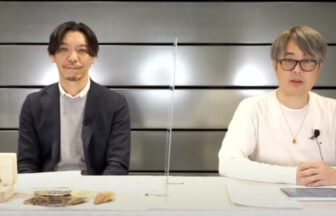
First of all, please introduce yourself.
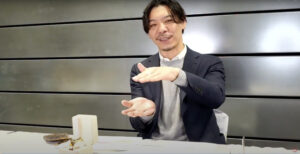
My name is Takahiro Yamamoto from Yamamoto Nori Store, and I graduated from university in 2005. After that, I joined Yamamoto Nori Store in 2008. Since then, I have gone through many hardships, and last year I became the president of the company.
Then, please introduce your restaurant.
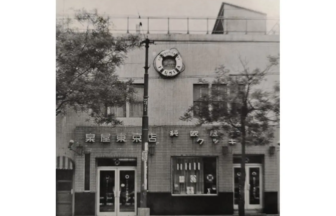
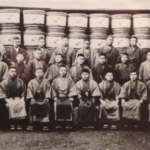
Yamamoto Nori was founded by Tokujiro Yamamoto in Nihonbashi in 1849, approximately 174 years ago. Perry arrived in 1853, so it was the end of the Edo period. It was located on the north side of the Nihonbashi River, across from the Mitsukoshi Department Store.
I believe there is now a fish market in Toyosu, but before that, it was in Tsukiji, and even before that, in Nihonbashi. Shellfish, fish, and seaweed caught in Tokyo Bay were unloaded and supplied to Edo Castle and the Edo Castle Town from there. Therefore, the area is characterized by many marine product wholesalers that deal in marine products both now and in the past. We have been in business here for 174 years.
We have been using the Marubai mark since the establishment of the company. There are two reasons for using this mark. The first is to indicate that laver harvested during the season of plum blossoms is very tasty. The second is to indicate that the seaweed has a great aroma, which is important for seaweed. With these meanings in mind, we have been using this mark since our establishment.
The product names “Ume-no-Hana”, “Beni-Ume”, and “Asahi-no-Umi” are actually the names of types of plums. However, they do not taste like plums, so we hope you will not misunderstand that.
Some people call Yamamoto Nori Store “Marubai-san.
That is what connoisseurs call it. If you go to a department store and ask, “Where is Marubai?” you will be guided to our store. They will think, “This person is a connoisseur.
During my second generation, I did two major things. The first was the invention of seasoned laver. When the Meiji Emperor asked a historical figure named Yamaoka Hikaru, “I am going to Kyoto next time and I want you to make me some interesting Edo souvenirs,” Yamaoka Hikaru asked Tokujiro Yamamoto, the second generation, and as a result, the seasoned laver was born. This led to the creation of seasoned laver, which has since become Yamamoto Nori, the originator of seasoned laver.
Second, nori had previously been sold only as seaweed, but was now sorted into eight different uses, such as “this is nori for sushi” and “this is nori for soba noodles. This sorting has continued unbroken to this day.
Yamamoto Nori Store has been developing seasoned laver and still has a variety of seasoned laver. And because of their sorting techniques, they are all really delicious.
During the third generation, we standardized the size of laver. At that time, there were many different sizes of laver. It was Tokujiro III who unified them, which was innovative in the laver industry at that time.
So you have decided on a format.
Yes, we did. I believe that by deciding on a format, the logistics were set up and expanded.
It looks like Qin Shi Huang.
That may be an exaggeration (laughs). Then came the era of the fourth generation. These were difficult times, with the war and the Great Kanto Earthquake. At that time, the fish market in Nihonbashi was moved to Tsukiji. That is why Yamamoto Nori Store also opened its first branch in Tsukiji. There are now 100 branches in the area, but at the time there were zero, and we made it one. This was a big deal for Yamamoto Nori Store.
When I became the fifth generation, I started to work for a department store, which is now a very good friend of mine. Department stores are the place to buy luxury goods, so the laver also had value as a gift. Moreover, it is lightweight. This is how Yamamoto Nori Store grew. The drive-through store, which can be found in many places throughout Japan, was actually started by Yamamoto Nori Store.
So you were one of the first to adopt it.
A new type of laver product that is not dependent on rice consumption
Nori is something to put on soba noodles or to roll into rice balls, and it is not easily a staple food. It is also something that goes well with rice, so as rice consumption decreases, so does the amount of nori consumed. Compared to three or four decades ago, per capita rice consumption has decreased from 120 kilograms to about 60 kilograms. This would mean that the amount of laver consumed would also decrease by half.
We felt a sense of crisis that this would not increase the consumption of nori, so we thought of ways to get people to eat nori by itself. For example, we created a product called “Nori and Ume Plum Scissors” that we thought would be nice to have next to the dried and grilled ume plums at convenience stores.
New needs were further created.
That’s right. Yamamoto Nori Store is in the position of having led the nori industry by doing innovative and epoch-making things. We hope to continue to do so in the future.
Thank you very much. I believe that Tokujiro’s innovative challenges have led to the present. What kind of products are actually reflecting this?
Ume-no-Hana” is our signature product, but we are just as particular about the taste, and we make delicious laver with the utmost care. It is a good seaweed for gifts, in short, for use in mid-year and year-end gifts. But there is more than that. That is “Asahi no Umi.
Nori has many different values, but Yamamoto Nori places great importance on “mouth feel. As I mentioned earlier, nori is required to perform various functions, such as rolling rice balls and making thin rolls. That is not a bad thing, but at Yamamoto Nori, we put all of that aside for a moment and focus on “laver with a good taste” as the definition of good laver.
However, the process of making it is a little more difficult. Nori grows during the winter, and during the summer, the shells contain nori spores. In winter, it comes up, sticks to the net, and grows in puffs. The faster you cut it, the better it tastes, smells, and feels in your mouth.
In order for the fisherman to ask you to cut it at 10 dm, when he really wants to stretch it 20 cm, because that would not be tasty, you still have to tell him that you will buy it at more than twice the price per cm.
It is more efficient that way. But Yamamoto Nori asks us to cut it short anyway, because they buy it at a high price.
The fishermen are in the position of selling seaweed, so our position should be stronger, but we ask them, “Please, please say it shortly! The fishermen would say, “Oh, no. If you cut it short, it will come out in a mess. We have an interesting relationship where we are always talking about such things.
It is only with the cooperation of all producers that we can produce a good product.
Yamamoto Nori-ten has taken on innovative challenges with each successive generation. In the second part, we will look at what is important in preserving the brand “Yamamoto Nori-ten.
latter part(temporal or logical sense) follow …
*If you would like to see this dialogue on video.here (place close to the speaker or where the speaker is)