Innovation by “Shinseido”, creator of the unconventional and popular “Seppuku Monaka” product

Shinbashi, Shinagawa, Odaibastaircase leading to success in lifeharakiriIn the midst of an economic upswingmame daifuku (sweet bean jelly made from rice or glutinous millet flour with sweet bean paste)Jintaiko Dorayaki

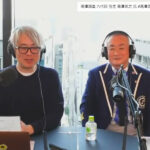
Seppuku monaka” for greetings and apologies, “Keikatsukyo monaka” and “Jintaiko dorayaki” for commemorating a public listing. Shinshodoh Shinbashi, founded in 1912, is a 100-year-old company that produces a variety of wagashi that bring humor and “deliciousness” to various business and personal occasions. How were the company’s unique products born and evolved? We asked Mr. Hitohisa Watanabe, the third generation head of the company, who has a unique background as a graduate of the prestigious Kuwasawa Design School and has a bright personality that embodies the individuality of Shinshodo.

first partcontinued

Seppuku monaka” is not only about the bean paste, but also about the skin.

Mr. Hayashi:In the second half, I would like to ask you more about “Shinseido” products.

Mr. Watanabe: The name “Seppuku Monaka” (Seppuku in Japanese) refers to its open shape, which allows people to enjoy more of our specialty red bean paste. Usually, a monaka weighs about 40 grams, but this one weighs 62 grams. The unconventional name and appearance of the product caused it to be scolded a lot, but its impact was effective, and it became a very popular product. Not only is it loved by fans of Chushingura, but we have also received comments such as, “My child, who could not eat monaka, is now able to eat it.

Ms. Hayashi: I see.

Mr. Watanabe:I was also particular about the skin. I disliked the skin of “monaka” because of its tendency to stick to the inside of the mouth. So at first, we did not intend to make monaka, but the manufacturer of the skin told us that if we were particular about the ingredients, we could make a product that would not stick to the skin. The cost of the product would have been higher, but we prioritized the taste, leading to the current patronage of “Seppuku Monaka”. If you scoop goldfish using the skin of our “seppuku monaka,” which is made to be less sticky, you will be able to scoop a lot of goldfish (laughs).

What a surprise, you even brought it today.

We hope you will enjoy the crust alone. Although the reduced water content means that fewer pieces can be made from the same ingredients, the crispy texture is superb.

So “Seppuku Monaka” was an innovation not only in its product name and shape, but also in the product development process.

Our success came from questioning the conventional wisdom of Japanese confectionery. It would have been outrageous to change the way to cook azuki beans. That is why I was so happy when my boss at the time said to me, “Isn’t that good? My son, who is now the fourth generation, told me that the method was imitated by his apprentice and led to increased sales. After all, good food sells.

Visual impact unique to Kuwasawa Design School graduates

Is it because Mr. Watanabe is a graduate of Kuwasawa Design School? The visual impact of the “Seppuku Monaka” is one of its charms, isn’t it?

Since I wanted to be a designer, I was interested in Japanese confectionery packaging, so I looked around. I found that all of them had similar shapes and designs, partly for the convenience of mass production by the manufacturers. I encountered some opposition, but since my generation, I have been freely experimenting with designs. For example, I was able to experiment with gradations from white to black, colorful gradations, and other colors to make them look more delicious, which was a good thing I did when I studied design.

The form is similar to maritozzo, an Italian sweet that is very popular right now.

Mr. Watanabe: I say that I am the original Maritozzo (laughs). It was just a coincidence, but as a result, people find it interesting.

Economic Rise in the Middle,” “Ishidan of Succession,” “Jintaiko Dorayaki,” and many other conceptual products at ……

Can you tell us about other product innovations?

It is “Keizai Kokaizanzaka. We wanted to come up with a name that would be the opposite of “Seppuku Saichu,” and initially planned to call it “Keikin Keizo-Saichu. However, we decided to call it “Keizai Kyoatsu Saichu” because the “economic recovery” part overlapped with a trademark that was already in use. While the “Seppuku Monaka” is made with a sweet bean paste, this one is made with a sweet bean paste, and brown sugar is kneaded into the bean paste to wish for a “turnaround” in the economy. In order to preserve the aroma of brown sugar, block brown sugar from Hateruma and Kikai Island is crushed and used in this product.

Like “Seppuku Monaka,” it is a product that is made with the best ingredients.

Mr. Watanabe:It’s about enhancing the quality of the ingredients. Brown sugar that is shipped pre-crushed is easier because we don’t have to crush it, but it oxidizes and loses its aroma. The brown sugar used in “Keizo-Keizo-Ichu” is crushed and kneaded within two hours, so the aroma can be tasted very well. I place great importance on aroma when making Japanese sweets, and I believe that the aroma that permeates the mouth and nostrils when eating monaka also produces a delicious taste. It is like saying, “Aroma is taste.

Mr. Hayashi: There is a similar story, I believe, at “Matsuya Coffee,” a 100-year-old company in Nagoya: …….

I have heard the same story. I was also happy to hear the owner of Sarashina Horii, a long-established soba restaurant in Azabu Juban, say, “Soba is the same way.

Coffee also oxidizes when it is ground.

Vacuum packing may be a good idea, but it still does not prevent oxidation 100%, so it is best to grind just before drinking.

This is a discovery. I see that the concept of “Boom Boom” was first formulated, then product development proceeded, and you arrived at the “answer” of adding aromatic brown sugar to the product.

We also developed a long-lasting product called “Seisei no Ishidan,” a sable that can be stored for two months, and with the approval of Atago Shrine, the surface of the sable is engraved with a pattern that resembles the famous “86 stone steps to success in life. It is often purchased during the months of March and April as a good-luck charm for success in life.

Atago Shrine is located at the top of Mt. Atago, not far from Shinseido. The long and famous stone steps of Atago Shrine are called “Seisei no Ishidan” (stone steps for success in life). It is a souvenir of the area, and is probably purchased by many visitors to the area.

The next item is “Mame Daifuku,” which has been produced since the previous generation. At one time, the number of pieces produced was less than 200 per day, but we have many strong fans and they sell out quickly. In my generation, we made improvements to the red bean paste, making it even tastier. We also use salt from Ako as an ingredient, in reference to the Ako Ronin of the Chushingura story. We do not add any preservatives to make them last longer, and we are very particular about this product.

Just the other day, I was visiting Takehara City, the home of the Asano family. The Asano family has a deep knowledge of salt, and they used to distribute information on how to make it. I think such a relationship is also connected to “Shinshodo”.

I am actually also a tourism ambassador for the city of Ako in Hyogo Prefecture.

That is amazing. I feel a conceptual connection between “Shinseido’s” business, Chushingura, and all of Mr. Watanabe’s efforts.

Ms. Watanabe:Our company’s Chushingura-related products include “Jintaiko Dorayaki”. This product is also made with our special red bean paste, and people enjoy it with “Seppuku Monaka” as part of the “Uchiriiri Set” (a set of products that includes the “Uchiiri”).

We have heard that it is also used for commemorating corporate listings, etc. Speaking of which, I would like to invite everyone to take a look at Mr. Watanabe’s jacket.

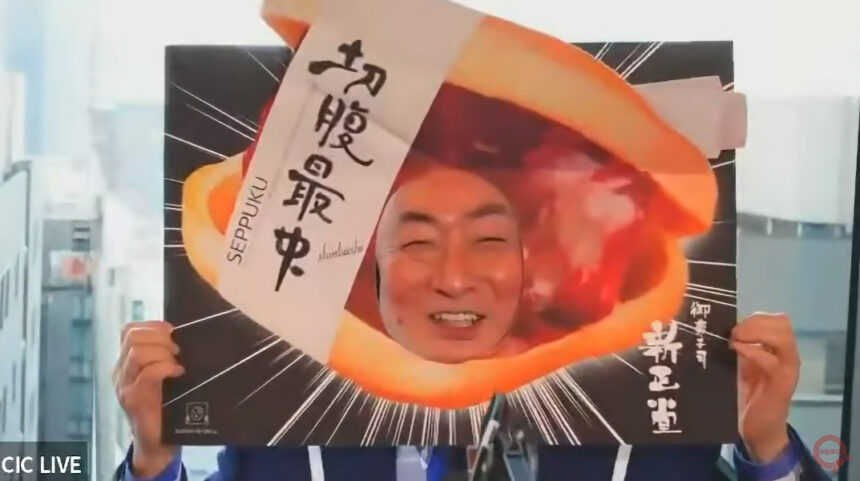
Mr. Watanabe: As expected, you have a good eye. On this arm, there are patches sewn on, such as “47” for the 47 Ronin, “G” for the Ako Gishi, “Jintaiko’s mark,” and “star mark” because Chushingura is a star. And on the inside, there is also an engraving of “Seppuku zaka Shinshodou”. In addition, a “face-framing panel of “Seppuku-zanaka” was also created between the Corona disaster. We were inundated with customers who wanted to put their own face on the panel, so we also made a three-dimensional version that can be spread out for easy carrying. There is also a plush doll of me welcoming customers.

Finally, do you have a message for our readers?

Mr. Watanabe:I urge you to question conventional wisdom and take on the challenge of change. If you fail, just try again. Don’t be afraid to jump into change.

Traditional and long-established, yet unconventional, diverse yet conceptual, Shinshodoh’s Japanese confectionery is a combination of different elements and an outstanding sense of taste. Shinshodo’s Japanese confectionery has an outstanding sense of coexistence of different elements, and the care that goes into its product development can be felt. This is why our sweets add a touch of comforting color to any occasion, whether it is a greeting, an apology, or just a daily routine.

*If you would like to see this dialogue on video.here (place close to the speaker or where the speaker is)

新着・おすすめ情報

  1. soba water

  2. Takahata Fudo Kongoji Temple

  3. Bank of Japan

  4. double-woven obi

  5. 【上野精養軒】本店パンダカフェ3月中旬再開

  6. 【第16回】江戸蕎麦の流儀〜蕎麦の洗い方編〜

  7. Kiyosubashi Bridge (Kiyosumi-Shirakawa, Tokyo)

  8. What is the “rank of kimono” that kimono beginners have trouble thinking about?

  9. Minami Aoyama Shimizu-yu

  10. combined off-license and pub (licence)

  11. Shinbashi Tamakiya] Spring tsukudani cuisine and wine pairing course available for a limited time only.

  12. 【第22回】お寺とお蕎麦の切っても切れぬ関係

  13. What are the characteristics of Edomae Sushi?

  14. sake specially produced without added alcohol or sugar

  15. 京都でも最古の歴史を持つ「松井酒造」。日本酒づくりを軸に展開する、革新的な取り組み