

Nihonbashi (bridge)katsuobushi
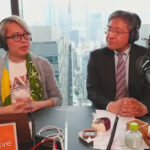
Ihee Takatsu, the 13th generation owner of Nimben, says, “Even though we are a dried bonito flakes shop, our management style is that of a financier. What is the pride of this long-established company that has sustained Niben for 321 years, a company so pervasive in the lives of ordinary people that it is now the first name that comes to mind when one thinks of dried bonito flakes? Together with cultural entrepreneur Kenichi Saito, we will hear about their beliefs in management that are still applicable today, such as their ability to acquire large customers, cash flow management, and astute reading of market needs, which can be gleaned from this experience.
~first partis here~.
What was it like after the customers changed from the samurai families to the townspeople?
Yes, they did issue gift certificates in the latter half of the Edo period.
Was the system of gift certificates common at that time?
I have heard that there were commodity stamps that could be exchanged for candy in candy shops when people brought them in. But this may be the first time that they issued a lot of them and turned them into a business.
It’s a series of innovations, really.
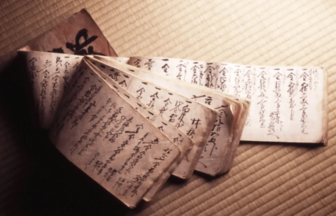
In short, they issued a large number of stamps and turned them into a business. This is the first silver stamp we issued. It is quite small, isn’t it? Since they were made of silver, they started a system of exchanging them for dried bonito flakes equivalent to the value of the silver.
That’s great. Because it’s already a monetary economy, isn’t it?
So to speak. So, since it was not allowed to issue such a coin without permission, it had the word “stipulated” written on the back, which was a sign that it was approved by the government. I guess they had that much trust in the government.
He said that it was not allowed to mix silver or anything like that, so he was told that if it was Nimben-san, they would do it properly, so it would be fine.
It must have been recognized as proper silver. The price of the coin is written here as “2 monme,” which is 1/30th of 1 ryo, since 1 ryo is a unit of 60 monme. One ryo is said to have cost about 100,000 yen at the time, so it is said that this was exchanged for dried bonito flakes worth about 3,300 yen.
3,300 yen dried bonito flakes are quite a lot.
It would be one or two bottles, now. Two if they are small, one if they are big.
I wonder what kind of needs led to the gift certificate.
I don’t know that because I didn’t ask them directly. Everyone says why did they put it out there?
It’s strange, isn’t it? Maybe there was a gift need.
That might have been the case, too. Bonito flakes are big and heavy, so this would be small and could be used as a gift in large quantities. Also, the silver itself has value, so even if it couldn’t be exchanged for dried bonito flakes, the value of the silver wouldn’t be diminished. However, when we offered this gift certificate, it would take a lot of time and effort to make a silver coin like this, and exchange it for the same value….that’s not profitable, is it?
It’s something that I was kind of wondering and bothered about but couldn’t ask (laughs).
Once they trusted us with this, we issued a large number of paper gift certificates. That brought costs down, and we rolled it out on a much larger scale.
It’s a deadly profitable pattern. It’s just like printing money. Basically, people don’t exchange it, so it’s an advance.
This would have had an enormous effect on cash flow.
You have been doing cash flow management since the first generation, haven’t you? I guess it is in your nature to do so.
As a result, in hindsight, it is a dried bonito shop, but it is financial.
Finance. I love business. I never get tired of doing business (laughs).
Moreover, dried bonito flakes themselves can be preserved. It’s a preserved food. It matches our business style very well. You can keep it in stock and serve it immediately when it is needed. That is a very big innovation. There are many innovations related to cash flow.
This is why we think that maybe when the country changed from the Edo period to the Meiji period, we were able to overcome the change in government.
There was a strong incident, though. I know I am not supposed to talk about it, but a certain Tokugawa shogun, you know.
It’s a bad debt, which is no longer recoverable, such as the Imperial money or the money that various feudal lords had paid out.
People talk about the Meiji Restoration and Sakamoto Ryoma, but if you think about it, the Shogunate is no longer a trading partner. There are people who say they are the 10th generation of the Tokugawa family. But they are companies, not individuals….
Individual compensation is.
I know, right? With that cash flow, we have finally passed through the Edo period and are now approaching the Meiji period.
A little over 100 years, I guess.
A revolutionary innovation in the “mold” on dried bonito flakes.
Were there any major innovations during the Meiji Restoration?
This led to an innovation in dried bonito flakes. The “honkare bonito flakes,” which are dried and aged many times with mold, were created.
Is Honkare from the Meiji era?
It is said. Since the Meiji era, or rather, since the end of the Edo period.
It is what is called a “raw” part.
It was originally called arabushi, which is smoked, then mold is applied. It is a member of the koji mold family.
How did you come up with the idea?
According to the passage, in the old days they used to bring dried bonito flakes from Osaka, and while they were being transported on those boats, they noticed that the flakes got moldy, and they were trying to remove it but couldn’t. But when they tried it, they realized that it tasted better. So they actively went about putting mold on it and had it made.
The Japanese are very good at this. They are very good at getting to the bottom of things. If we are going to put mold on something, let’s do it thoroughly.
Maybe it was a coincidence at first.
That’s right. It is sometimes said that the origin of nyokumam is a coincidence. There is a story that fish left on the shelf became fish sauce.
There is also the high humidity.
It is also a difficult decision to actively encourage that.
Maybe it’s like that with everything, but I wonder how the first person ate it. Natto (fermented soybeans), sea cucumbers, etc., the first people to eat them are really great. That’s how honkare bonito flakes were born. But I am sure that even in earlier times, that is how it must have been done.
Yes, molding it only once had been around for a long time. But the purpose was different from doing it over and over again.
This also reduces the water content and dries out the meat, concentrating its flavor. The hardest in the world, right?
No, I have been trying not to say that lately. Our R&D department seems to be saying that the candy is harder or something like that, so I am not saying it right now for a moment. It’s like the world’s hardest food, that’s how we describe it (laughs).
The point is that dried bonito flakes are very hard, so they are the hardest preserved food, or the hardest fermented food. I think it would be better to say that it is the hardest among fermented foods, rather than among foods.
Recently, there has been a lot of talk about fermented foods, and some scholars have suggested that it is not fermentation but ripening.
Is it possible that the dried bonito flakes are not fermented, that there is a possibility of aging?
Fermentation itself changes quite a bit. Milk becomes yogurt, for example. Although dried bonito flakes themselves are not changed that much, there is an effect of enzymes by adding mold. I have talked with the laboratory about how to describe it, such as “matured food. I think it might take some internal proofreading to see if we are still saying it correctly (laughs).
I am a little worried about whether publicity is OK, though. I guess it will be the Meiji era, then the Showa era, and finally the end of the Showa era.
At the time of the Meiji Restoration, the Edo Shogunate lost its customers, but we were able to do business with some of the most important big spenders of the Meiji government, so it seems that new customers continued to be created. The Mitsui family and the Iwasaki family, for example.
And two major products representing Niben were born.
The basic strategy has been decided. There are two major pillars of our strategy: to secure a large customer base and to focus on cash flow. I think that since then, especially after the war, there has been a great deal of innovation.
It was the Great Kanto Earthquake in Taisho, right? It seems that things were going relatively well up to that point.
The company’s business continued to do well, and it was doing well with the Meiji government for a long time, and then entered the Taisho era.
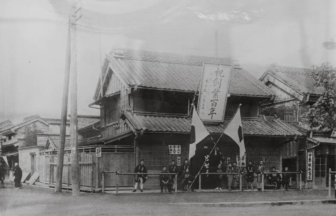
The Taisho period was also marked by the Great Kanto Earthquake. The Nihonbashi branch, which had been in business for 200 years since the Edo period without burning down, burned to the ground.
You burned once in Taisho.
As an asset, it was quite large at the time.
I am sure you are right. I immediately resumed business in a temporary store and did not stop doing business, and returned the following year from the temporary store to continue business again in Nihonbashi.
There’s a fire story about Edo, right? Not that Niben-san was involved?
I was involved in the Great Kanto Earthquake. Until then, we were back in the Edo period, but the shogunate recommended that we build storehouses that would not burn, so we made the change in the Kyoho period (early 1700s), and they did not burn for the next 200 years.
You went to the trouble of making it unburnable, but it burned in the Taisho era.
What does the Taisho year have to offer as far as innovation?
(It was about rebuilding (from the damage).
And finally, we come to the Showa period, and as a large company, we have a large amount of innovation.
You didn’t hear much about the first one, because there was a war. During the war, it was a fair economy, so we distributed what we were given, kind of like a leave of absence. After the war, we resumed business, and that’s when we changed the name of the company to Nimben.
Until then, what’s your name?
The company was first named Ihee Iseya and later became Takatsu Shoten Co.
Why ‘Nimben’?
I am usually asked this question, but Iseya Ihei has the kanji character ninbei. Our mark also has the character “Kin-ninben”. People who saw this mark called us “Nimben-san” since Iseya’s time. People who saw it called us “Nimben-san” from the time of Iseya. On various printed materials, “Nimben” was written in hiragana, together with “Iseya. After the war, we changed the name to “Ninben,” which was more recognizable. That’s why we used the nickname our customers used to call us as our company name.
And then you changed the name of the company, and I think this is where the explosion of innovations started.
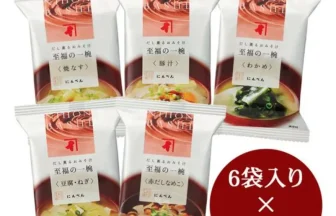
We were able to develop the “Fresh Pack” and “Soup Stock” products, which have become our mainstay business to date, and we have been selling processed foods to this day.
Fresh packs are a revolution.
Before I was born, people said that dried bonito flakes themselves were a declining industry. The custom of shaving dried bonito at home was dying out due to the popularity of seasonings that could be poured on quickly, and this product was the catalyst for a revival. The technology to establish such a product was developed at that time. The bags that support the gas filling, the film that prevents oxygen and keeps moisture out, and so on were developed and established.
This technological advancement and innovation has directly led to the innovation of Namben’s products.
It’s also a container revolution.
If you are not in a place where you can catch up on information, you will be ahead of other manufacturers, so I guess the key is being there and being able to make the investment.
They have been developing such freshly shaved dried bonito flakes for several years with the idea of making them easily available.
You have to be aware of the market to come up with such ideas. The third pillar is market needs, after cash flow and so on. And can you talk about dew?
Five years before “Fresh Pack” was released, there had been a variety of men-tsuyu products, but this was the first product that contained real dried bonito flakes and was sealed. We developed it as a versatile product that could be used not only for men-tsuyu, but also for cooking and simmered dishes, and it became very well established in the market. These two products are still our main business today.
Then, during the postwar period of Japan’s economic growth, people began to have less time, and the need for shortening the time required for production led to the introduction of fresh packs and tsuyu. Were these two products produced by your father’s generation?
At the time of its launch, the first generation, and then the previous generation grew.
After that, various innovations will occur again.
We are in the process of working on it. We are creating a dashi community called “Nihonbashi Dashiwa” at the retail level, where people can taste and enjoy dashi. As a result, we have received a great deal of support for the opportunity to introduce people to dashi, and our products are expanding into the dashi domain.
Finally, may I ask Mr. Takatsu to summarize a few words about innovation?
It means that some of the new things we have done over the years have been supported. I think that is the reason why we have been able to continue. I would like to continue to do so.
Keep doing new things. It is not an easy task. That is why Niben has been able to establish its position in the katsuobushi industry by embodying it. That challenge will continue in the future.
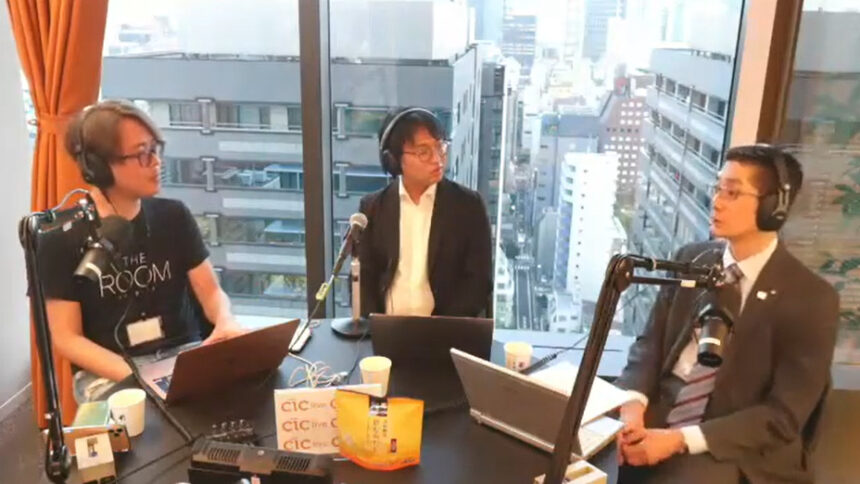
*If you would like to see this dialogue on video.here (place close to the speaker or where the speaker is)