

turftraditional craftJapanese swordarmor and helmet (armour)
Japanese swords have many enthusiasts overseas. For beginners, it may be a difficult world to enter, but if you take a closer look at each of the sword fittings, you will realize its high value as a work of art. The Japanese Sword Museum, located in Toranomon, is engaged in a variety of efforts to make such swords more attractive to a wider audience. For this interview, we sat down with Kenichi Saito, a cultural entrepreneur, to talk with Kenichi Iha, the fourth generation owner of Nihon Sword.
Today we are pleased to welcome Mr. Kenichi Iha, the fourth generation of Japanese swordsmiths. First of all, please introduce your store.
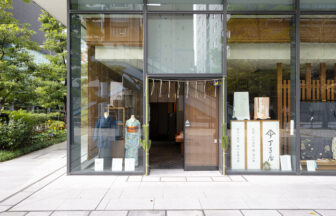
It is said that Iba originally ran a sack accessories shop in Shintomi-cho, but when his great-grandfather returned from the Russo-Japanese War with injuries, the shop was transformed into a wholesale store that traded in antiques. Around 1913, Iba’s name appears in a book titled “Taisho no Tsukijikko” written by playwright Yoshiemi Kishii. After that, two of his sons helped out at the store, and the second son moved to the current location in Toranomon. At that time, there were many samurai residences and stores dealing in antiques, and the store he opened there is connected to the present day.
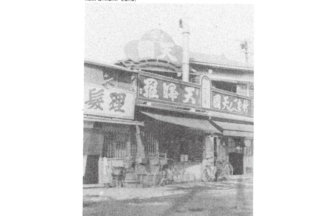
You can still see a picture of the store with a large sign that reads “Japan Sword.”
I think this photo is probably from the 1950s or so. After World War II, my grandfather was interrogated by GHQ for handling swords. However, he had knowledge of swords, so I heard that he was sent to work a lot to sort out whether the confiscated swords could be disposed of or not, and whether they had historical value. Before the war, it seems that you were working hard in the sword business, working on the preparation of military swords.
That is wonderful. Could you please introduce yourself, Mr. Iha?
After leaving school, I worked for about five years at a company called Wako in Ginza. After that, I was able to work at a museum for about two years, so I studied there as well.
First you went to commerce, and then you studied at a museum. After all, when it comes to swords, it is necessary to have a good knowledge of history, isn’t it?
The family business has been handed down from generation to generation, but at the time I did not want to take over immediately. The theme of my seminar was marketing, so I entered Wako first because I wanted to study the retail industry.
Wako-san does not deal in swords.
Yes, there are. There are art galleries, though. By the time I was a sophomore in college, I was helping a little with accounting, going to the bank and keeping the books, and I thought business was interesting. But the economy was bad at that time, and I think our father was having a very hard time. In the end, I wondered if I could work in a place like this, so I went to work for Wako. After that, the economy gradually improved, and I moved to the outside sales department, where I was making a lot of sales. While I was doing a lot of work like that, I felt that I wanted to use this power for the family business, so I decided to come back. My father’s health was also not good, so I think that also pushed me to come back.
So you had a change of heart there. Did you go to the museum after that?
It is common in any industry for college graduates to suddenly try their hand at a new field, isn’t it? So I thought I should be able to do anything, but as expected, the world of swords had a depth that a little study could not make up for. At that time, I happened to have a seat at a museum, so I studied there for a while. It may have been a turning point in my life.
Have you been exposed to swords since you were a child?
I did not touch swords because they are products. I really liked the designs of sword accessories such as tsubas and menuki, so when I was in junior high school, I did stand in the store and rearrange them.
After all, that’s the kind of place you look at when you don’t seem to be looking at it.
On the second floor of the store, they made sword exteriors during the war. There were several craftsmen who used their skills to make daggers and other souvenirs. My grandparents lived on the third floor, so I often visited them.
We will do business with the spirit of the samurai.
What is the family motto of such Iha family?
There is a naval club called “Suikosha” near the restaurant, and I heard that Mr. Isoroku Yamamoto used to drop by often. Because of this, Mr. Isoroku Yamamoto wrote “Shikon Shokusai” on the wall of our store. The idea is to do business without forgetting the spirit of a samurai.
It’s great that Isoroku Yamamoto is writing about you.
Also, as my father often says, I was taught not to fall too much in love with swords and not to have my own collection.
What does that mean?
You buy a sword with the intention of selling it, but if you fall in love with it, you don’t want to let it go. That would be bad for business. We were told that it was fine to collect other works of art, but not to collect the products we handle.
I see. Now I would like to ask you about innovation.
There is a photo of my grandfather Tomijiro explaining the sword to Director Akira Kurosawa. It looks like he stopped by quite a bit.
I like the firm and long sword blade.
I think it is probably an old type. You can tell the age of a sword to some extent by looking at its length and warp. We pay a lot of attention to this when we appraise swords.
If it was long, then you were swinging it around on horseback.
You know it well. Swords used on horseback are long so that they can be swung down at a distance.
Do swords get shorter toward the end of the Edo period?
Yes, it is. It will be about 70 cm with less warping.
I see. I am personally very excited.
There was also a connection to MacArthur’s descendants.
There is also a photo of my grandfather Tomijiro, who is shown with Mr. MacArthur’s nephew. He was working at the U.S. Embassy and was so pleased to see our swordsmithing skills that he made and delivered a saber to the embassy.
By saber, do you mean a Western-style sword?
Yes, it is. It is used for ceremonies, etc. and is not a weapon.
Then, may I ask you to introduce Japanese swords to some people who may not be familiar with them?
In the 1500s, when firearms were introduced, it became common to set up a camp with the general sitting behind and people around him, as often seen in dramas, since being on horseback in battle would result in being shot. In this way, swords gradually became shorter because they were inconvenient if they were too long. The tachi is long and has the blade on the bottom, while the katana has the blade on the top.
The pattern is gorgeous.
It is made from a type of ray called umehana bark shark. The skin is pasted over the wood and the black color is deposited by applying lacquer to the mottled areas. Then, when the surface is polished, a white speckled pattern appears. This looks like a plum flower, so it is called ume-hana-hinzame. There are many different designs of tsubas for these battoushi. Do you know what the tsubas are made of?
It would be a stopper when you receive a sword.
Yes, that’s right. Another reason is that a sword is a straight stick, so if you put a lot of force into stabbing, your hand will slide toward the blade. It also serves to hold your hand so that you do not cut yourself. There are many collectors who collect only this tsubagaki.
Dokuganryu Masamune wears the tsubasa over his eyes, right? The sword is very elaborate, even if it is just the brim.
If it were only to protect the hand from going toward the blade, a mere board would be fine, but it is Japanese culture or chic to elaborate in this way. There are so many fans of tsubas, but most people just put their collections away in a box. As I mentioned earlier about innovation, I would really like people to display and appreciate tsubas as well. So, framing the tsubas and having people enjoy them in the same way as paintings is another issue that we are working on right now.
Japanese Sword,” which carries the calligraphy “Shihon Shoken Shosai” (The Spirit of the Samurai), which was given to him by Isoroku Yamamoto, and says that he does not forget the spirit of the samurai as he conducts his business. At first glance, the world of swords may seem like a hurdle to overcome, but in fact, he says, swords should be enjoyed like paintings. Yes, swords are works of art.
latter part(temporal or logical sense) follow …
*If you would like to see this dialogue on video.here (place close to the speaker or where the speaker is)