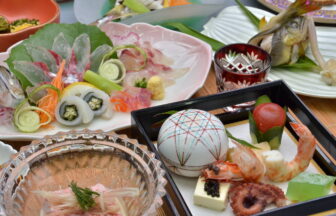
What is included in “chopstick washing” in kaiseki cuisine? In what order are they served?

Japanese-style meal

What is included in “chopstick washing” in kaiseki cuisine? In what order are they served?(Hashiarai)

tea-ceremony dishes

Kaiseki cuisine is a Japanese traditional cuisine. It is a small soup to refresh the palate served after the “three dishes” of “rice, soup and mukozuke”, “wanmori (boiled dish)” and “yakimono (grilled fish)”. It is a small soup to refresh the palate served after “Ippushi-Sansai” consisting of “Oshiki (rice, soup, mukozuke),” “Bowls (simmered dishes),” and “Yakimono (grilled fish)”. It is often served in a small bowl with a light-flavored soup that contains few berries. It is also called “ichigu-suimono,” “kosuimono,” or “yu-suimono. After this “chopstick washing,” guests exchange sake with each other.
新着・おすすめ情報

  1. Ruins of the Tokugawa family residence of the Kii Wakayama domain (Kioicho, Tokyo)

  2. Former Iwasaki Residence

  3. neckpiece (on a kimono)

  4. mound containing a monument to Shomon (i.e. a place of scenic beauty)

  5. graupel

  6. What is meant by “santai zorai” offered for the May dolls?

  7. What is “Gyoku (sushi)”?

  8. What’s in a Kaiseki meal? Explaining the Difference from Kaiseki Cuisine

  9. Itsukaichi Constitution Draft Monument (Akiruno, Tokyo)

  10. Shiba Daimon Sarashina Nunoya

  11. Where did okame soba originate? Ingredients used are also explained.

  12. A Walk in Edo with Old Maps] No. 6: Kagurazaka is full of historical attractions. From alleys where you can feel the Edo period to wooden buildings of the Showa period

  13. Old Furukawa Garden (Komagome, Tokyo)

  14. Customer information is written down in a notebook and shared with all staff. Ginza Mikawaya’s commitment to hospitality

  15. Taisyuji Temple (Shinjuku, Tokyo)