inscription

armour

inscription(MEI)

Japanese sword

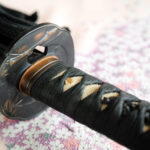
In general, as the character meaning “inscribe” or “engrave” implies, it refers to characters or writings engraved on a metal stone. In the case of Japanese swords, it means that the sword maker has inscribed his name and the year of sword making as his signature on the sword. The inscription is placed on the sword’s stem, which is the part of the blade that is attached to the handle. Inscription on the stem is called “mei wo kiru” (to inscribe the name on the stem). Inscription was mandated by the “Taiho Ritsuryo (law)” enacted in 701, and became common from the end of the Heian period. It is also an important element in the appraisal and appreciation of Japanese swords. Normally, a sword with an inscription is considered more valuable than an “unmarked” sword without an inscription. However, there are exceptions such as “Masamune” and “Sadamune,” which are unmarked swords.

新着・おすすめ情報

  1. Okadaya Fuse” has a history of 188 years.

  2. graupel

  3. black formal kimono with designs along the bottom of the skirt worn by married women on ceremonial occasions

  4. Yuri Shikaku] Toraya’s Yokan, a must-have for a mountain snack. How to enjoy Japanese sweets that reflect the changing of the seasons

  5. What is “Yanagawa Hot Pot”?

  6. Yamamoto Nori Store, a long-established business with 170 years of history. The birthplace of “seasoned laver” talks about its commitment to flavor.

  7. gelidium jelly strips (made from agar-agar)

  8. Omori Shell Mound Site Garden

  9. combined off-license and pub (licence)

  10. box lunch (containing rice and 10-15 small portions of fish, meat, and vegetables)

  11. Zoshigaya Old Mission Building (Zoshigaya, Tokyo)

  12. Bon Festival gifts

  13. very young fish (esp. a konoshiro gizzard shad)

  14. Nara Ningyo” is characterized by the powerful touch of a single sword digging. What is the meaning behind it?

  15. buckwheat mash (buckwheat flour in hot water served with shoyu)