

Ginza (shopping district in Tokyo)Japanese confectionerymanjuu
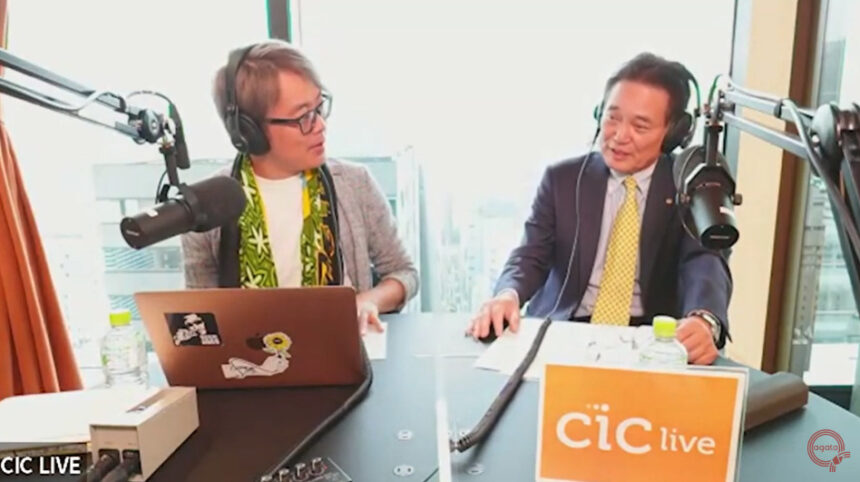
Founded in 1349, Shioze Sohonke invented Japanese-style sweet buns. The Shioze Sohonke invented Japanese-style sweet buns and has continued to innovate throughout its 670-year history, and still supports Japan’s wagashi culture today. We interview the 35th head of the family, Issei Kawashima, about the history and family traditions of the family. The history of the Shioze family, which is grander than a great river, including the invention of sweet buns by the first generation Hayashi Jochin, the development of the Shioze family with close ties to the Ashikaga and Tokugawa families, and the transition of buns, brings us many surprises beyond the image we have of “buns.
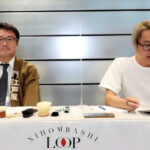
Forest:We are pleased to welcome Issei Kawashima, the 35th head of the Shioze Sohonke family. Could you first introduce yourself?
Mr. Kawashima: I was born in Tokyo in 1950. After graduating from Azabu Junior and Senior High School, I entered the Department of Law at Keio University Faculty of Law. I liked English so much that I initially thought of becoming a diplomat. Then, by a fortunate chance, I joined Japan Airlines. My first year was spent taking about 150 phone calls a day, and from there I was assigned to the Takamatsu Sales Office, and two years later, in 1977, I was assigned to JALPAK to work as an attendant.
Mr. Kawashima:During my two and a half year secondment, I visited most of the places where JALPAK is located, except for South America and the southern part of Africa. I even went inside the pyramids in Egypt.
Hayashi: Amazing.
Mr. Kawashima: From 1979, I worked at the Tokyo Branch Steel Building Counter and Shibuya Dogenzaka Counter, where my OJT period finally ended. 1980, I was in charge of reservation management for European routes. The reservation information is managed by computer, of course, but the work is mostly done by human labor.
Yes!
I was in charge, and I had a rough idea of how many seats were reserved for the year.
It is a divine work.
As a global company, I had to deal with the other side of the world and travel on business, and in 1985, I married my current wife, who was a flight attendant. In 1985, I married my current wife, who was a flight attendant, and in 1984, I started working in the Milan sales office. I worked there for about 5 years and was about to turn 40 years old and thinking about my next career move when I called my parents and somehow they told me that they had bought a food factory in Beijing, China. My father and mother could not speak English, so how could they do it? And I said, “I’m going to quit my job and help you. So I said, “I’ll quit my job and help out,” and I joined Shioze Sohonke.
Hayashi: I see.
When I joined the company in 1989, it was the Tiananmen Square incident. As a result, all contracts with the West were cancelled. So there was no more talk of going to China. I have been working for the company for 33 years this year. My hobbies include tea ceremony Urasenke, associate professor, golf, and traveling.
I had heard that you do tea.
One of my ancestors was married to Sen no Rikyu’s granddaughter, and because of that connection, I was told that I had to do tea ceremony. We used to have a tea ceremony class at our head office, so I started studying tea there for almost 30 years now.
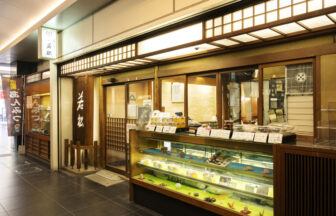
Shionose Sohonke has a wonderful teahouse in the back of their main store, so why don’t you visit it?
How was the bun born?
By the way, Mr. Hayashi, what do you think of buns?
Nowadays, buns have a rather sweet image.
The definition of “bun” is difficult. For example, the definitions of Chinese buns and Japanese buns are slightly different. The name “buns” originates from the “Romance of the Three Kingdoms”. When Zhuge Liang was on his way back from attacking Shu, he could not cross the Jinsha River because it was flooded. When he asked an old man in the village for help, he was told to “cut off 49 heads of his retainers and throw them down the river.” Kongming instead made 49 steamed buns made of mutton wrapped in wheat skin and threw them down the river. As a result, the flooding subsided without incident. That is why steamed buns were born around 200 A.D.
This episode also appears in Yokoyama Mitsuteru’s “Sanguozhi” (The History of the Three Kingdoms).
Now, how did steamed buns, which originated in China, come to Japan? There are various theories, but it is said that it was introduced by a man named Shoichi Kokushi during the Kamakura period (1185-1333). Between the time of the Three Kingdoms and when it was introduced to Japan, buns underwent a metamorphosis. Steamed buns with meat in them are called baozi (包子) in today’s China.
Oh, yes, indeed.
In Seiichi Kokushi’s time, buns were wheat breads with nothing inside, and around 1988, a NTV program called “Journey of Mystery Study” examined the records of Tofukuji Temple, which was opened by Seiichi Kokushi, and found that he mainly introduced milling techniques. And it was concluded that Rin Join (林浄因) started the buns with what we now call anko (sweet bean paste) in them.
Lin Jo-Yin, who has the same one character “Lin” as me, is from China, isn’t he?
Now, please take a look at the family tree.
Ms. Kawashima: This is a summary of a longer family tree. Lin Nasei, on the far right, was a person of about 1000 AD, and Lin Join came to Japan in 1349, so there is a gap of almost 300 years. Someone in China who said that we are also descendants of Lin Hejing once came to visit us at the hotel after seeing the images of the Manju Festival.
That’s great.
Lin Hejing was a famous poet in the Song Dynasty of China. He lived in Fox Mountain in West Lake and composed poems. He was so famous that there is a room for Lin Hejing in Edo Castle, and his ideas were very much in line with Bushido. So, our company’s catchphrase in the Edo period started with “Our first Hayashi Join was a descendant of Hayashi Kazuyasu ……”.
Hayashi Kazuyasu is such a saint that he has been likened to “loving plums and nourishing cranes.
Shioze Sohonke with a history like a great drama.
And then there is Hayashi Jochin, the first Shioze. This person studied under Ryuzan Tokken, who trained in China for 44 years, and this master-disciple relationship is described in the novel “Manju Denraku” by Ryotaro Shiba.
The arrival of Ryuzan Tokumi and Hayashi Jochin is recorded in the diary of Sonotai Reki, the Minister of Grand Council of State at the time, by Toin Kin’taka, and after a nearly year-long visit, the group arrived at Kenninji Temple in Kyoto, which was founded by Eisai Zenji, the founder of tea ceremony. There, Hayashi Jochin served a so-called “Japanese manju” made with red bean paste to accompany the tea ceremony, which became very popular.
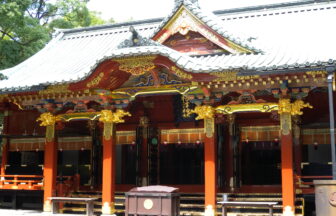
That is how Hayashi Jochin gained his reputation,Emperor Go-Murakami gave him a courtesan, who became his wife and lived in Nara.Today, he is enshrined at Hayashi Shrine, which was established in the Hankoku Shrine near Nara Station. The reason why Hayashi Jochin moved to Nara in the first place is probably because there were many Chinese immigrants who came to Nara to build the Great Buddha and temples.
Mr. Kawashima: That is how we made Nara manjuu. It was brown because there was no white flour at that time, and sweetened by boiling down the juice from a vine plant called “Amarasen” was used instead of sugar. This was loved by the nobles and feudal lords of the time, and the Shioze family figures are depicted making the buns in a document that conveys the food culture of the Muromachi period called “Shuhan-ron Eshin”.
The gifts given out by Hayashi Jochin on his wedding day were Japan’s first red and white manjuu (steamed buns).It is said to be the beginning of the custom of handing out red and white manjuu for congratulations.Praying for the prosperity of his descendants, Jochin buried a pair of red and white buns as a bun mound under a large stone. After that, the Shioze family was divided into three factions: Nara, Kyoto, and Edo, and we are in Edo.
Soji Hayashi of Nara studied while working at a bun shop and published a book titled “Manju-ya hon shokuyo shu” (Manju-ya book collection). Print publications were rare in those days, and he is called the “Gutenberg of Japan. When I was a student, I learned about “Manjusaya hon shuseyoshu” in Japanese history class.
Hayashi: Wow, that’s great.
It is such a famous book. In addition, the hon-manju, invented by Soji Hayashi, is a historic product that was presented to Ieyasu Tokugawa during the “Battle of Nagashino” in 1575. Also known as Kabuto Manju, Ieyasu enjoyed it as a sweet that only he could eat. It is still served at Shiose today. Ieyasu also had a deep connection with the Shioze family. When Yukimura Sanada cornered Yukimura in the Summer Campaign, he received a set of armor and helmet as a thank-you for hiding him, and some of his descendants have made it their main business to manage the armor and helmet.
The history of the Shioze Sohonke family is as grand as a great drama. The attitude of keeping the flame of making manju, which has been passed down from generation to generation, alive may be said to be a true treasure of Japan.
latter part(temporal or logical sense) follow …
*If you would like to see this dialogue on video.here (place close to the speaker or where the speaker is)