The Five Secret Secrets of Long-established BusinessesNihonbashi (bridge)cleaning utensilsEdo-style broombroom
Bringing the best of Japan to the world, and the best of the world to Japan, agatajapan.Japan is one of the few countries in the world where there are more than 33,000 long-established shops that have been in business for a hundred years. In this series of articles, we ask the owner of a long-established business about the “five secrets” that make it a long-established business.Founded in 1830, Shirokiya Denbei has continued to make handmade brooms since the time of the first generation, even though the company’s name has changed from Edo to Meiji, Taisho, Showa, Heisei, and 2022. Behind the careful maintenance of this tradition for more than 200 years has been the company’s desire to contribute to society and its customers.The “Five Secret Secrets” of Shirokiya Denbei’s traditions will give us a glimpse into the company’s commitment to broomstick making.
Handmade, lightweight, easy-to-use Edo broom to nurture tatami mats
It’s a series of small tasks that can only be done by hand.”
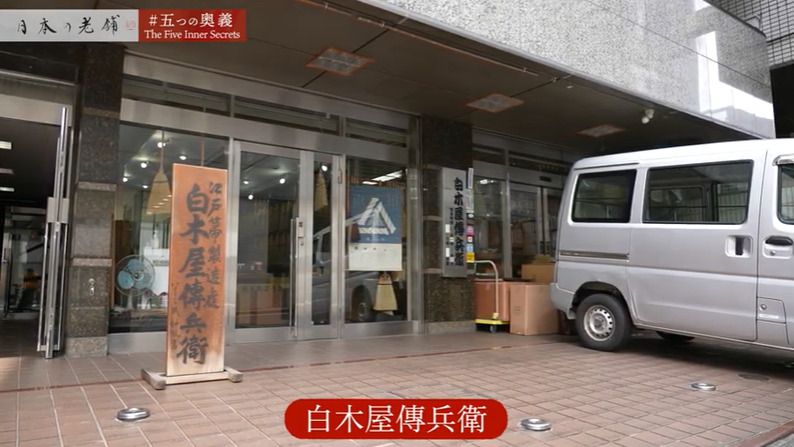
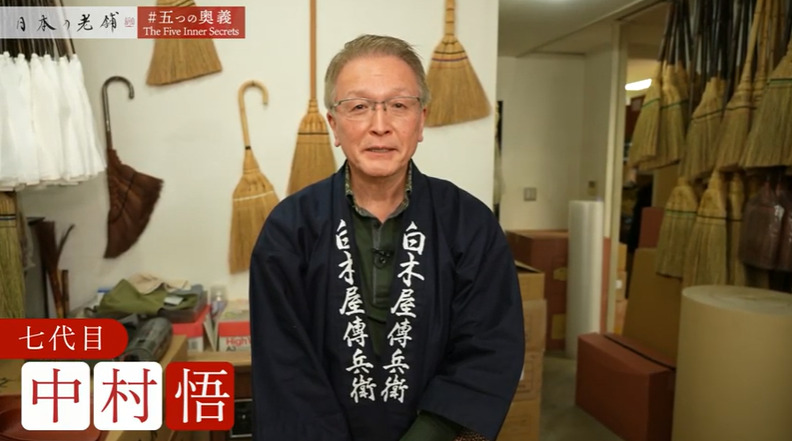
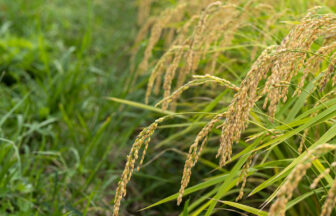
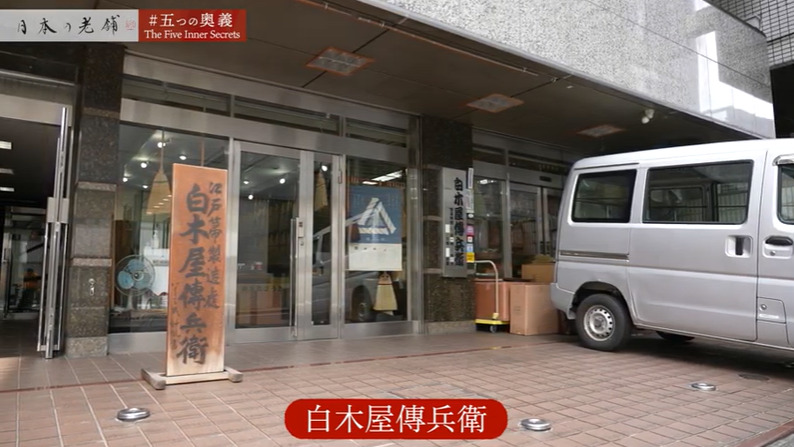
So says Satoru Nakamura, the seventh generation head of “Shirokiya Denbei. The Edo broom, which has maintained the same quality since the Edo period, is produced by reflecting the aesthetic sense of each craftsman. If you see a wooden signboard in Kyobashi, Tokyo, lined with skyscrapers, that reads “Edo Broomstick Manufacturing Place: Shirokiya Denbei” in black ink, you are at the Shirokiya Denbei store.Mr. Nakamura welcomes us with a “Welcome” in his store, which also serves as a workshop, where manufactured brooms are hung on the walls. Once inside the store, one can smell the aroma of Edo brooms made from broomcorn grass, a member of the grass family.
Shirokiya Denbei’s Edo broom has a vegetable scum that makes it difficult for dust to adhere to the surface of tatami mats and also prevents the surface of tatami mats from becoming shiny and scuffed. Another appeal of this broom is its lightness, which allows dust and dirt to be ejected without exerting force.Shirokiya Denbei was originally a wholesaler of tatami mats. As tatami mats became increasingly popular, the lack of brooms for sweeping and cleaning led Denbei Nakamura I to start making Edo brooms, entering an environment where there were no competitors.
Five secrets of a long-established business No. 1: 99% of broom making is done by hand
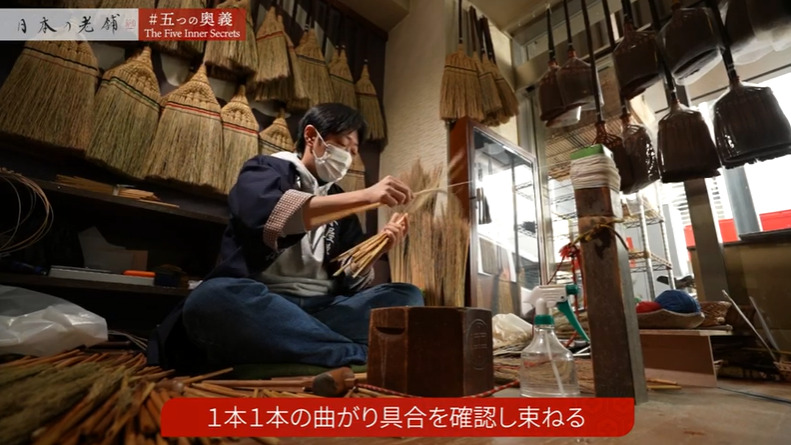
Broomweed always bends in one direction or the other,” Nakamura says.The process of knitting the curves so that they are gathered in the center can only be done by hand.
The first step is to bundle the broom grass, checking the bend of each individual strand. Weaving the broom grass so that it does not fall out is truly a craftsman’s art. The force with which the broom grass is tied together is adjusted according to the thickness and firmness of the strands. The parts made in this way are then further weaved together, and gradually the shape of the broom becomes visible.This production method has remained basically unchanged since the Edo period. Nakamura says, “Our challenge will be to what extent we can preserve and pass on this method of production.Now, you say that 99% of the work is done by hand, but what is the remaining 1% of the process?The answer is: “Drilling a hole in the handle of a bamboo broom with a screwdriver. 99% handiwork and 1% mechanized work produce a superb broom that can be used for more than 10 years.
The Five Secret Secrets of Long-established Businesses No. 2: Pursue “beauty” because it is a practical product.
A broom is, of course, a practical item for sweeping the floor. However, the “Shirokiya Denbei” bamboo broom is backed by a “craftsman’s sense of beauty” that goes beyond that. Nakamura believes that this may be the reason why the bamboo brooms are so well-loved.
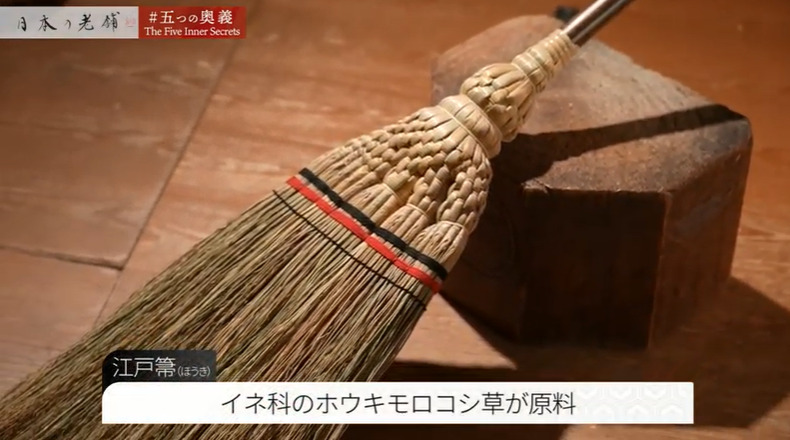
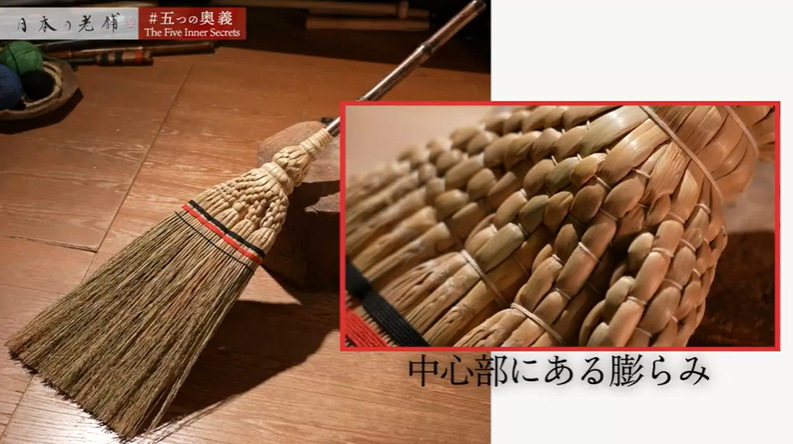
If you look closely at a bamboo stick, you will notice a rounded bulge in the center. This cannot be achieved simply by weaving. The inside of the bamboo stick is made of “kudagara,” a short piece of broom grass stem, which is used to create a rich form. The strong weave also raises the broom’s center of gravity, making it easier to sweep.
Five secrets of a long-established business No. 3: All materials used are natural.
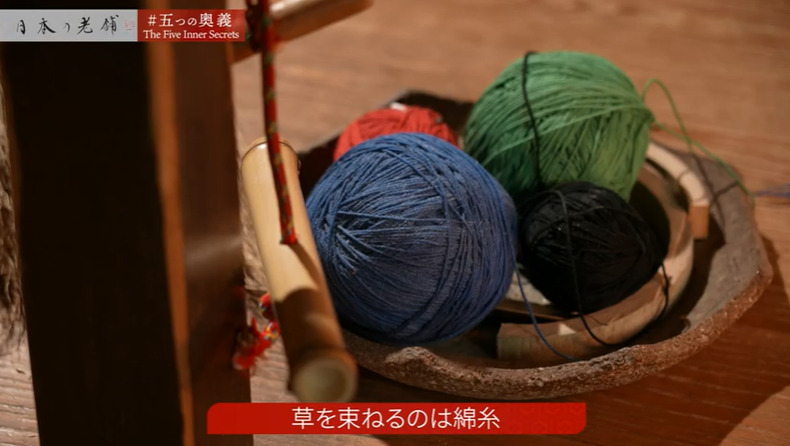
Shirokiya Denbei’s bamboo boki is made of only five materials: hemp yarn, cotton yarn, broom grass, bamboo, and tow. In other words, they are made of 100% natural materials. Cotton thread is used to bind broom grass. The parts used to secure the bundled broom grass and the bamboo stakes used to embed the broom grass are also made of natural materials.
The importance of the SDGs is being called for these days. The merits of the traditional bamboo stick, which emits almost no CO2 from production to disposal and produces no waste, are in line with social issues such as global warming, microplastics, and unburnable waste.
Old shop Five profound secrets No. 4: Constant contact with broom grass sharpens the senses.
Shirokiya Denbei produces 15,000 brooms a year. The most difficult part of the production process is “sorting brooms by rank.
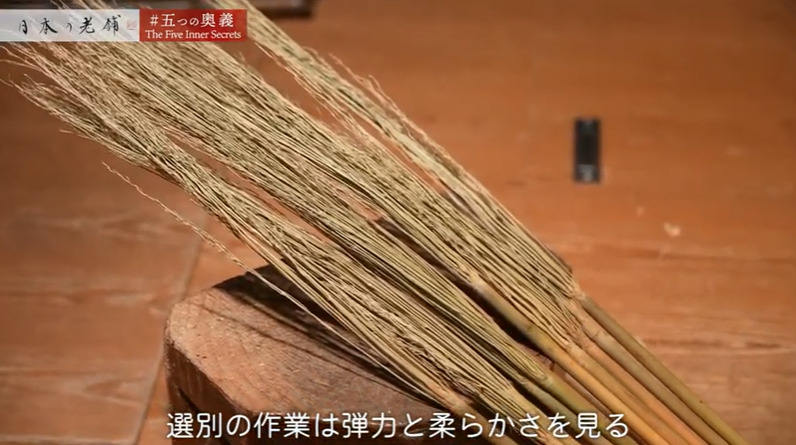
Normally, broom grass varies in quality and texture. Shirokiya Denbei sorts broom grass into about 20 types, such as “extra fine” and “fine,” to avoid any discrepancies in brooms.As you get more practice, you learn to recognize the quality of broom grass by feeling it with your fingers,” Nakamura says.It is said that the sense of craftsmanship, which cannot be conveyed in words, is fostered through the practice of continually checking the elasticity and softness of the broom grass during meals and breaks.
The Five Secret Secrets of Long-established Businesses No. 5: Preserving Traditions from the “Edo Period
The Edo broom, which is hard to break, bends well, and easily removes dust, is sometimes used by parents and children for generations to come.When asked why they have been loved throughout the ages, the answer is very simple: “Because we have continued to make good products. Mr. Nakamura expresses his confidence by saying, “I am proud that we have been able to carry on the broom culture into the next generation,” by not sacrificing quality and by continuing to hone our techniques and preserve the broom culture.
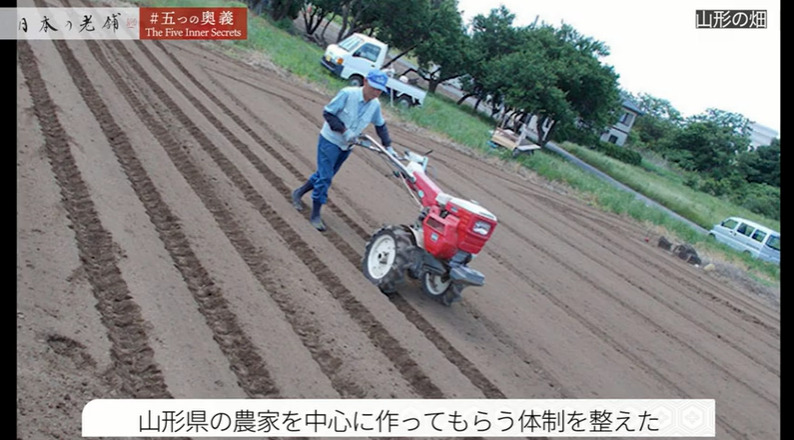
In fact, most of the broom grass used as ingredients is grown in Indonesia. Mr. Nakamura himself visited Japan to provide guidance so that high quality grass could be grown. However, it is the policy of “Shirokiya Denbei” to preserve domestically produced grass as well. A system for growing broom grass in Japan has been established, centering on farmers in Yamagata Prefecture.These efforts are made to preserve the broom tradition that has been handed down since the company’s inception.
Products that do not lie against tradition and pride.
I think brooms are a very Japanese and good quality product,” says Nakamura.Today, Shirokiya Denbei continues to fulfill its role as a long-established company that has a positive impact on society and its customers by continuing to produce products that are true to its traditions and pride.
Starmark CorporationGood things of Japan to the world Good things of the world to Japan Good things of tradition to the present day Good things of the present day to tradition.
The Five Depths:The video “Shiraki-ya Denbei” is available athere (place close to the speaker or where the speaker is)from (e.g. time, place, numerical value, etc.)