

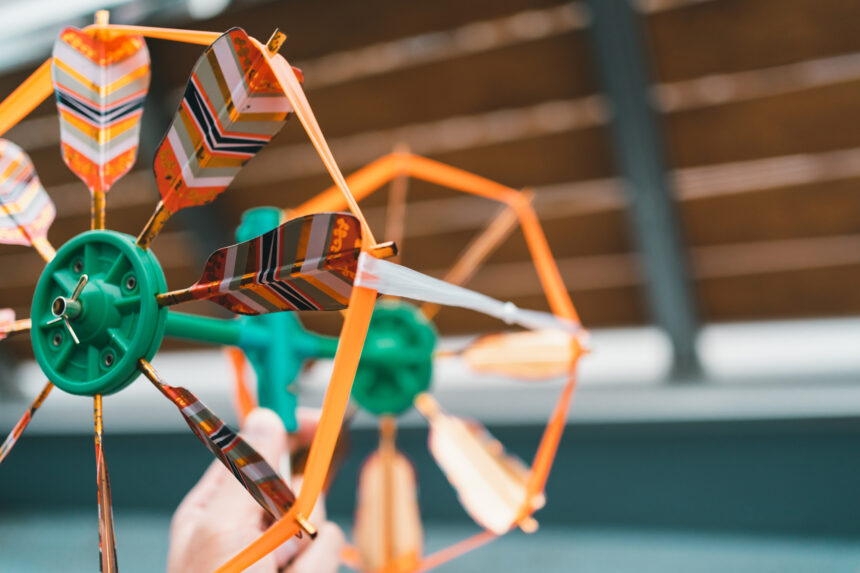
An arrow wheel is a windmill attached to the pole of a carp streamer. What is the meaning of the sound of its spinning?(yaguruma)
Children’s Day (national holiday; May 5th)Boy’s Day celebration (May 5th)
A windmill at the end of a pole on which a carp streamer is erected. The circular part in the center is covered with arrow feathers (yabane, a feather of a bird worn to keep the arrow flying in the right direction. A pair of radially pierced arrow feathers (yabane, a bird’s feather worn to keep the arrow flying in the right direction. A pair of arrow feathers (yabane, a bird feather worn to keep the arrow flying in the right direction, or its pattern or shape) pierced in a radial pattern are attached to the circular part in the center. The arrows are meant to catch good luck or to drive away evil spirits, and the sound of the windmill and the circular motion it makes as it spins in the wind have the power to drive away evil spirits. Furthermore, the sound of the arrow wheel spinning is said to be “the sound of calling the gods,” and it also serves to notify the heavens of the birth of a baby boy.